


What is a workflow graph in simple terms?

- Systems of record such as CRM, ERP, and loan origination platforms store the outcome of a decision, but rarely the reasons for it.
- AI agents work inside the workflow at the moment a decision is made. That position lets them capture inputs, policy checks, exceptions and approvals as they happen.
- Linked together over time, those decision traces form a workflow graph: a searchable record of how an organisation actually decides.
- Regulators in the EU, UK, India, and US are already asking for evidence in this graph, not in the ledger.
- The ledger stays the ledger. The workflow graph becomes the system of record for decisions, and credit is one of the first places it will matter.
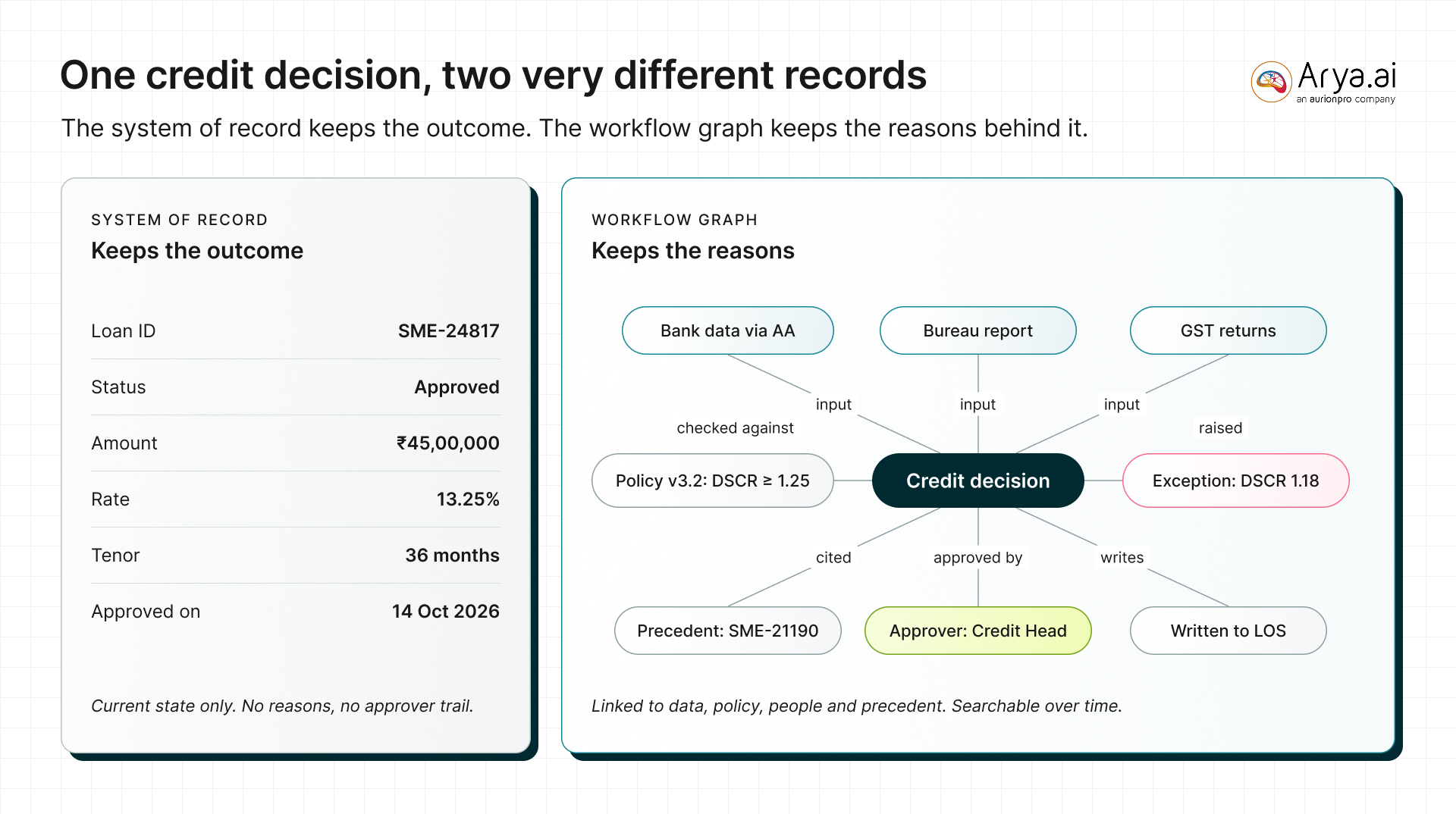
A system of record stores the outcome of a decision, but not the reasoning behind it. A loan origination system, for instance, clearly records the amount, rate, tenure, and approval date of a loan. But it does not record the conversation that made it possible. The rationale probably lives in an email thread and in two employees' heads.
Six months later, when an auditor asks why the exception was granted, someone reconstructing the evidence encounters this gap. It is not ideal, but solvable nonetheless. But now that AI agents have assumed the task of assembly, checking, and routing inside financial workflows, where the reason gets recorded becomes an architectural decision.
This article argues that the answer is the workflow graph, and that it is on track to become a system of record in its own right.
What a system of record was built to do
For three decades, enterprise software leaders won by owning a system of record: Salesforce for customers, Workday for employees, SAP for operations. In banking, core banking and loan origination platforms play the same role.
Jamin Ball of Altimeter puts the purpose plainly. In his December 2025 essay Long Live Systems of Record, he describes a system of record as the answer to a simple question: where does the truth live? When a workflow needs a fact at a specific step, one place must be treated as canonical.
Ball argues that agents raise the stakes. They work across many systems and take actions that change state. If an early step grabs a stale number, the rest of the workflow automates the wrong thing. He expects CRMs and ERPs to become "state machines with APIs" that agents read and write.
That framing is sound. It also reveals the limit. These systems are designed around state: what is true now. They were never designed to hold the path that led there.
The gap: records store outcomes, not reasons
Two weeks after Ball's essay, Jaya Gupta and Ashu Garg of Foundation Capital published a response titled AI's trillion-dollar opportunity: Context graphs. They agreed that systems of record survive, but there’s a caveat.
So, rules tell an agent what should happen in general. And decision traces record what happened in a specific case: which definition was used, under which policy version, with which exception, approved by whom, based on which precedent.
They identify four kinds of knowledge that systems of record never capture:
- Exception logic that lives in people's heads.
- Precedent from past decisions, with no link between similar cases.
- Cross-system synthesis, where a person reads three systems and makes a call that only the outcome reflects.
- Approvals that happen outside systems, such as a sign-off in a chat message or on a call.
Their worked example: a renewal agent proposes a 20% discount against a 10% policy cap. It pulls incident history, an open escalation and a prior exception, then routes the request to Finance, who approve it. The CRM ends up holding one fact: the discount. Everything that justified it is gone.
Translate that into lending, and the pattern is familiar. Credit policies are full of thresholds. Real portfolios are full of approved deviations. The deviation is what regulators, auditors, and future underwriters most want to understand, and it is the part least likely to be stored in a structured way.
What is a workflow graph?
A workflow graph is a linked record of how decisions are made inside a workflow. Each time work runs, the workflow layer records the inputs it gathered, the policy it checked, the exceptions it raised, who approved what and what it wrote back. Over time, these decision traces connect across customers, policies, people and dates, so past decisions become searchable precedent.
This accumulated structure is called a context graph. This article uses "workflow graph" to stress where it comes from. The workflow produces the graph as a by-product of doing the work, at the moment of decision.
It helps to place the idea next to familiar ones:
- A knowledge graph maps entities and their relationships. It usually describes what is generally true. A workflow graph records what was decided, when and why.
- Process mining reconstructs how work flowed from event logs. Celonis now describes its Process Intelligence Graph as a "living digital twin" of operations and has extended it to support AI agents (Celonis, November 2025). Process mining sees what happened. A workflow graph adds why it was allowed.
- Event sourcing stores every state change. A workflow graph focuses on decision changes: the reasoning and authority behind a state change.
- None of these components is new. Agents simply make it practical to capture them at the point of decision, at scale, without another form to fill in.
Why the graph is forming in the workflow layer now
Three forces are pushing the record of decisions upward, out of the ledger and into the workflow.
First, agents sit in the execution path.
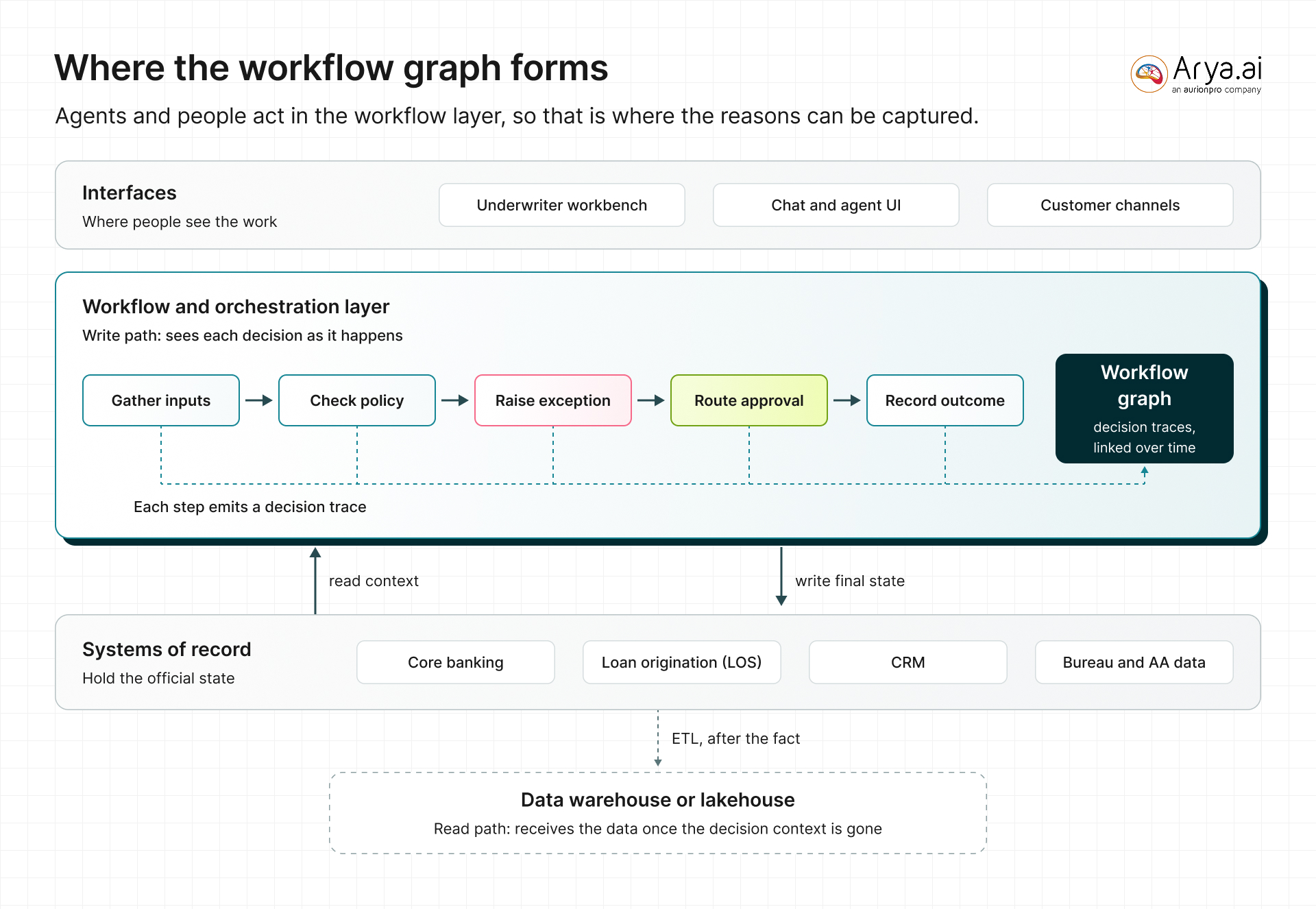
Incumbent applications store current state and see only their own slice. Data warehouses sit in the read path and receive data through overnight loads, after the decision context has gone. The orchestration layer is different. It gathers inputs from several systems, evaluates the rules, routes the exception and writes the result. It can record all of this as it happens.
Below is a reference architecture for how this may potentially look:
Second, the work is moving there.
Gartner predicts that by 2028, agentic AI will autonomously make at least 15% of day-to-day work decisions. More telling for this argument, Gartner's 2026 Hype Cycle for Agentic Automation, as reported by Kissflow, forecasts that by 2030, 60% of organisations will adopt agent orchestration platforms from vendors outside their existing system-of-record providers. The coordinating layer, and the decisions it sees, is expected to sit somewhere new.
Third, the standards for recording it are arriving.
OpenTelemetry now maintains dedicated semantic conventions for generative AI, covering agent invocations, tool calls and Model Context Protocol requests. They are still in development. Even so, a shared trace format is the plumbing a cross-vendor workflow graph needs. Database-backed workflow engines already let teams search, resume, and replay a workflow from a specific step using standard queries. Replay is what makes it possible to ask what the world looked like at decision time.
Adoption is real but uneven. McKinsey's State of AI 2025 found 62% of organisations experimenting with agents and 23% scaling them somewhere, yet no more than 10% scaling agents in any single function.
The case for the existing system of record
Systems of record are not going away. Agents need one canonical home for the balance, the contract term and the reported number. Foundation Capital agrees. Garg has since accepted the criticism that true human intent is internal and cannot be observed, so the graph should focus on observable decision processes (Latent Space summary).
Gartner has warned that over 40% of agentic AI projects will be cancelled by the end of 2027 because of cost, unclear value or weak risk controls. And some of the loudest claims come from vendors with a stake in the outcome. ServiceNow's chief executive called agentic AI an "extinction-level event" for traditional CRM in July 2025 (CX Today). That is competitor positioning and should be read as such.
The more defensible view is additive. The ledger remains the system of record for objects. The workflow graph becomes the system of record for decisions. Final state still syncs back to core banking or the loan system. The graph holds the lineage that explains it.
Why credit is where this lands first
Foundation Capital's guidance on where to start is specific: look for high-headcount, exception-heavy work where "it depends" is the honest answer. They name underwriting and compliance reviews directly. Lending fits on every count. Decisions draw on many sources. Policies carry thresholds. Exceptions are routine. Precedent matters for consistency and fairness.
The evidence on autonomy points the same way. The Bank of England and FCA's 2026 survey of AI in UK financial services found that 86% of firms now use AI and 80% have AI agents deployed. Most of those agents provide decision support: they recommend, and humans decide. Only 2% reported agents with broad autonomy. Even including plans for the next twelve months, no more than 9% expect agents to approve or decline customer outcomes.
Horizontal bar chart from the Bank of England and FCA 2026 survey showing the share of UK financial firms with AI agents in production at each autonomy level: decision support 80%, constrained execution 46%, conditional autonomy 22%, broad autonomy 2%.
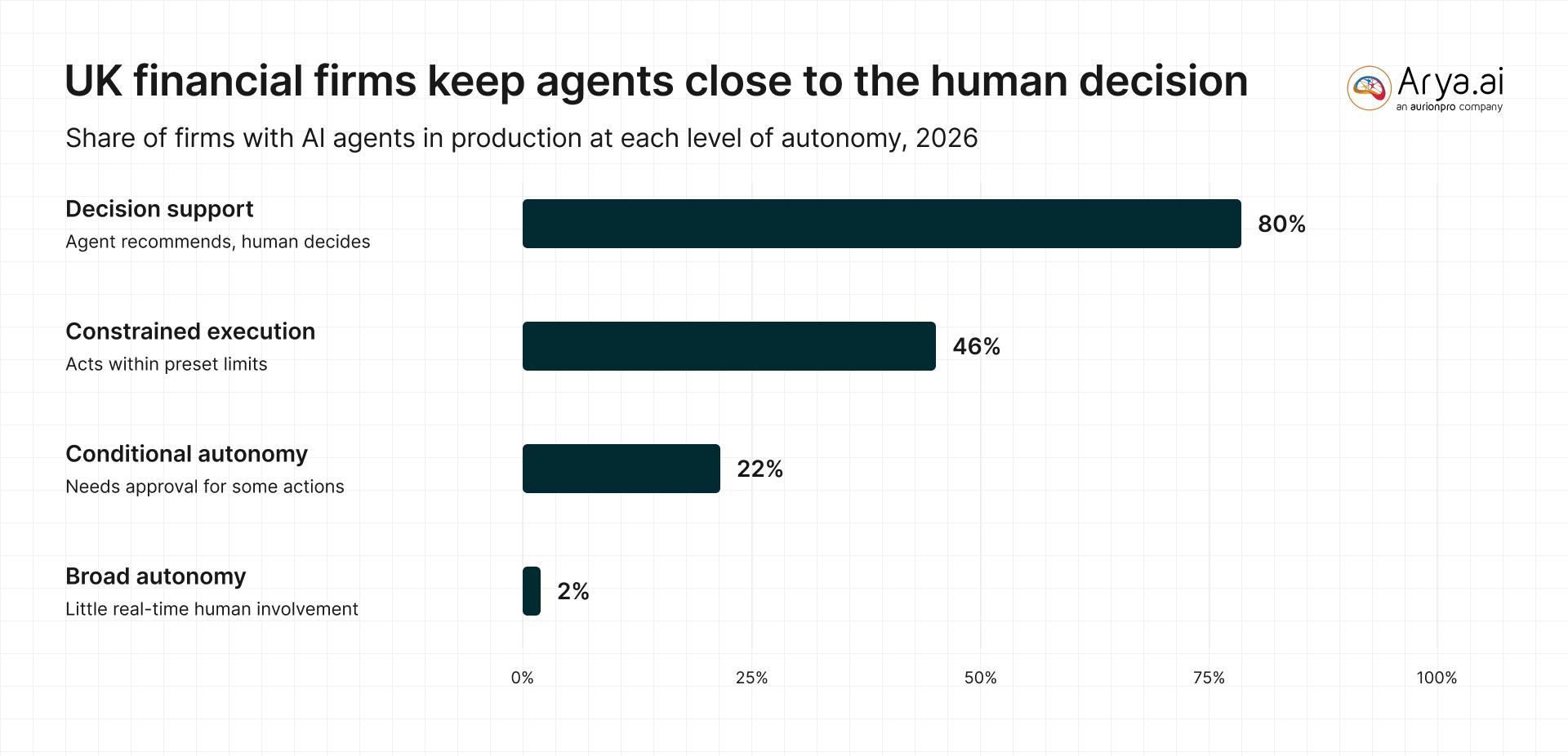
That suits the workflow graph. Foundation Capital is explicit that it starts with a human in the loop: the agent proposes, gathers context, routes the approval and records the trace. Every decision adds to the graph, even when a person makes the call.
The same survey shows the gap the graph can close. More than 90% of UK firms reported pre-deployment controls such as human approval and vendor due diligence. Only about half reported ongoing monitoring or periodic review, and only 39% monitor customer impact. Firms check AI carefully before it goes live, then lose sight of how it behaves in production. A workflow graph is a continuous record of exactly that behaviour.
Where CredAI fits. CredAI is one concrete instance of this pattern in SME credit. It handles assembling the credit file: gathering bank statements and financial documents, running the checks, surfacing ratios and flags, and presenting the evidence in one place. Each step records its source and outcome. The underwriter retains the decision. When an exception is approved, the reasons sit alongside the evidence, ready for the next reviewer, the next audit or the next similar case.
How to start building a workflow graph
A practical sequence for lenders and financial institutions:
- Pick one exception-heavy workflow. SME credit, limit reviews and KYB onboarding are strong candidates. Routine processes need execution more than lineage.
- Instrument at decision time. Record each step as it runs. Use open trace conventions where possible so the record outlives any single vendor.
- Model decisions as first-class objects. Link each decision to the entities you already track: borrower, facility, policy version, approver, data source.
- Keep the ledger authoritative. Write final state back to core banking or the loan system. The graph explains the state. It does not replace it.
- Query precedent before you automate. Ask the graph how similar cases were handled. Automate the paths where precedent is stable. Keep humans on the rest.
- Govern the graph like a record. Decide who can see sensitive traces, how long they are kept and when old precedent is retired. Align retention with EU, UK, Indian and US expectations.
The record follows the decision
Every generation of enterprise software has placed its system of record where the most valuable truth was created. For thirty years, that was the transaction. As agents move into the workflow, the most valuable truth is increasingly the decision itself: the evidence, the judgement, the exception and the authority behind it.
Organisations that capture this at decision time can explain themselves to regulators, apply precedent consistently and automate with confidence. The rest will keep reconstructing reasons from email threads. The ledger will still say what happened. The workflow graph will say why.
Frequently Asked Questions
Will a workflow graph replace core banking, CRM or ERP?
Does a workflow graph help with EU AI Act compliance?
Do we need fully autonomous agents to build one?
Share this post


Table of contents
Low-Code AI Automation Starts Here – Try Arya Apex
Access 100+ plug & play AI APIs to streamline manual tasks and improve productivity. A low code solution for enabling seamless automation of processes at scale.
Start Free Trial


