


.png)

Across organizations, models are being deployed into critical workflows and producing outputs that look polished and decisive. The problem arises when the output is scrutinized. Most AI systems operate on signals, processing one event at a time without visibility into how those events relate and influence each other.
Simply put, the lack of structure is why these systems fail. In environments where outcomes depend on chains of dependency, such as financial risk, operational flows, and customer behavior, this limitation becomes costly. AI must see the connections between events and data points to produce plausible answers.
Graph-based models address this blind spot by organizing enterprise data around relationships rather than records. Instead of treating information as isolated inputs, they encode how entities connect, interact, and evolve. This structural layer lets AI reason across systems, not just within them.
In this article, we’ll look at how knowledge graphs give AI its missing structure, and why context graphs are what turn fluent outputs into dependable decisions.
What Are Knowledge Graphs?
A knowledge graph organizes enterprise data so it mirrors the ground reality of the operations. Instead of storing information in isolated tables or systems, it connects things the way people naturally think about them.
Think of it as turning data into a network: customers, accounts, products, documents, and the relationships between them. Each connection adds meaning: on its own, a data point says very little; in a graph, it becomes part of a bigger picture.
That’s why knowledge graphs are so good at answering factual questions: Who owns what? What is connected to this account? Which transactions relate to this customer? They shine at discovery, search, and consistency, especially in complex environments where data keeps changing, and relationships aren’t one-to-one.
More recently, knowledge graphs have become important for AI. They give models a structured understanding of the business instead of forcing them to work from raw text or fragmented data. When AI can reference a graph, the answers are grounded in how entities are actually connected. That improves accuracy, consistency, and explainability.
But knowledge graphs have a natural boundary: they describe the world as it is. They capture facts and relationships well, but they don’t fully capture decisions, exceptions, policies, or evolving situations. They can tell you what happened, but not always why it happened or under what conditions.
That limitation is what leads to the next layer: context graphs, where structure meets decision history, rules, and real-world conditions.
What Are Context Graphs?
If a knowledge graph shows how a business is structured, a context graph shows how it actually operates.
A context graph builds on top of a knowledge graph and adds what’s usually missing: decisions, timing, rules, exceptions, and outcomes. It connects what happened, why it happened, and what followed. Think of it as memory for intelligent systems.
While a knowledge graph might tell you that a customer has a certain credit limit, a context graph can tell you why that limit exists. Was it raised as an exception? Who approved it? Under which policy version, and during what period? What happened afterward? Those details rarely live in a single system, but they matter deeply when AI is asked to make or explain decisions.
Knowledge graphs describe the world. Context graphs describe behavior over time.
Over time, context graphs become a searchable history of how the organization makes choices. That history is what makes AI trustworthy: instead of responding with generic answers, AI can reason with precedent, see similar situations, understand constraints, and explain outcomes the way experienced teams do.
Take cloud cost management. A basic system can show spending and ownership. A context graph can show why spend increased: who approved it, what project it supported, what constraints were in place, and whether the decision aligned with current priorities.
Knowledge Graphs vs. Context Graphs: Key Differences
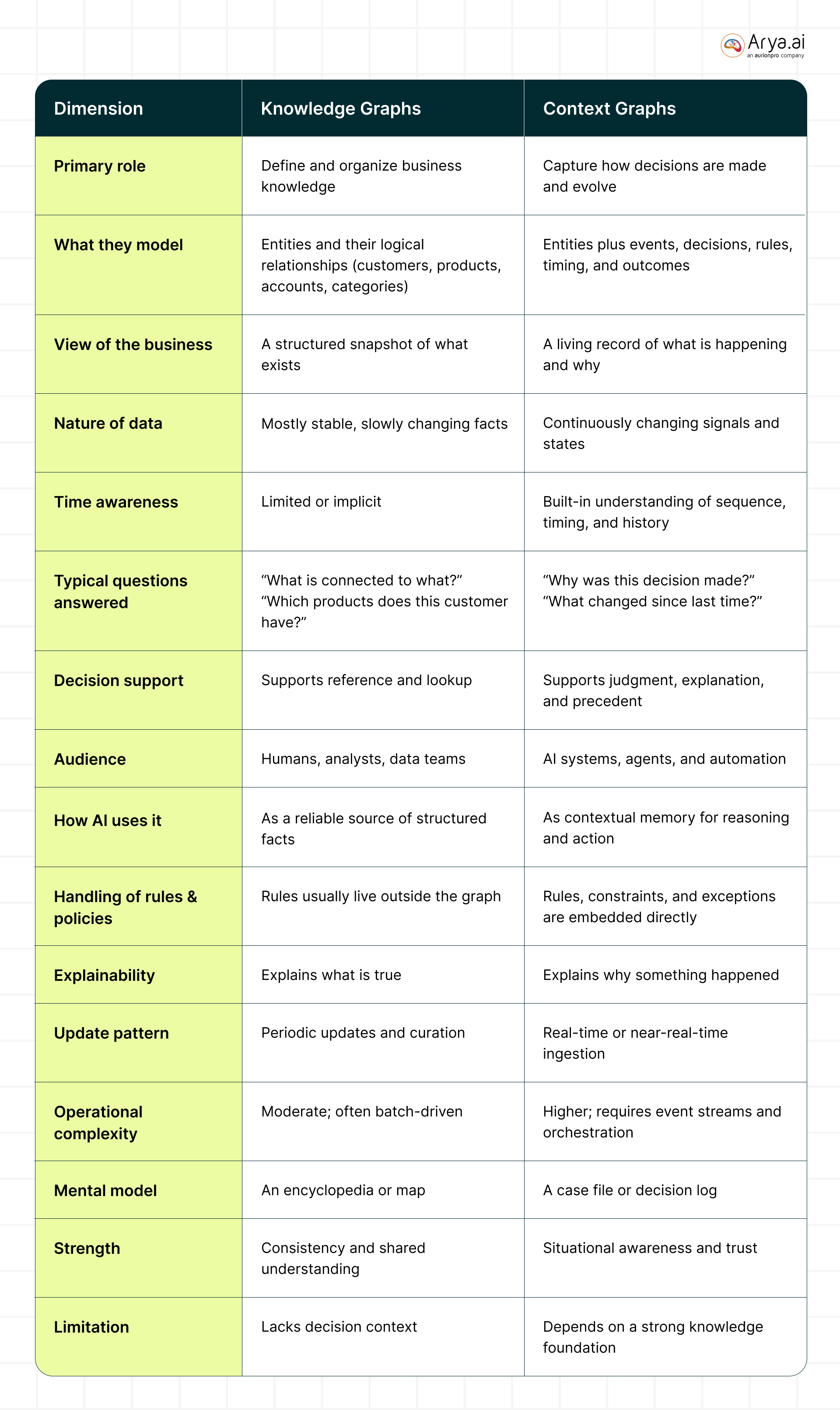
How Graphs Improve Enterprise Decisions: Actioning vs. Decisioning
Graphs change how enterprises move from insight to action — but not all graphs play the same role.
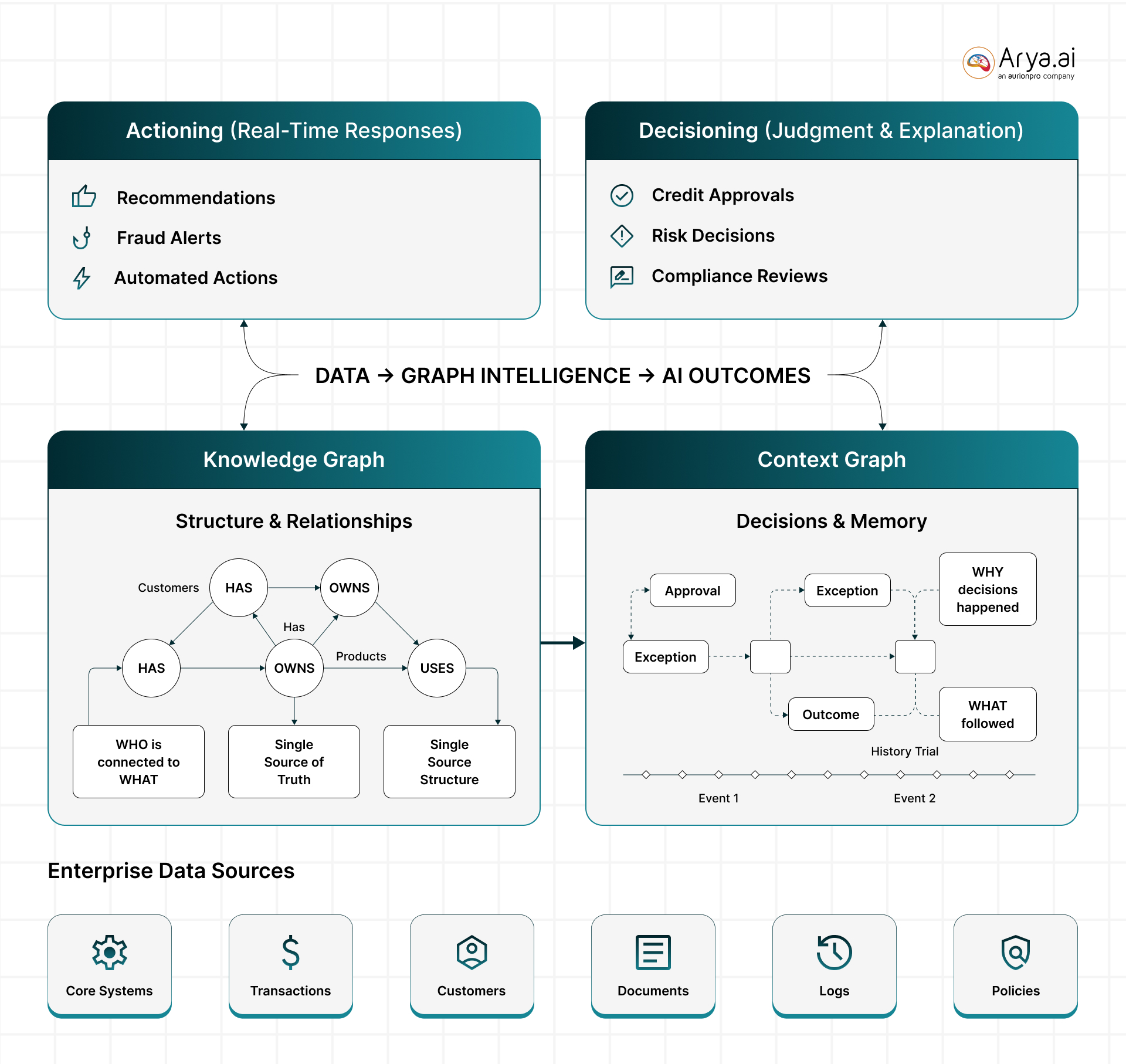
Data flows into graph intelligence, which drives two distinct classes of AI outcomes: actioning and decisioning.
At a high level, knowledge graphs strengthen decision support: they help humans and AI see the full picture by connecting data that would otherwise sit in silos. Context graphs strengthen decision execution: they add memory, precedent, and situational awareness, letting AI systems act with judgment, not just logic. Together, they help organizations move up the intelligence curve — from observing patterns, to making informed choices, to taking confident action.
A useful way to frame this is to separate actioning from decisioning. Actioning is about triggering something to happen. Decisioning is about understanding whether it should happen, and why.
Example Scenario: Smarter Loan Eligibility with Graphs
Imagine a bank using AI to assess a loan application.
With a knowledge graph, the system finally sees the applicant as a whole, not as scattered records. It connects identity data, credit bureau reports, existing bank accounts, transaction behavior, and business affiliations into a single network. Instead of just a credit score, the bank sees that the applicant holds multiple accounts, has an active joint loan, and is linked to a business entity that once faced financial stress. These connections matter, as they reveal risks and dependencies that flat tables or rules engines would never surface.
At this stage, the AI is already smarter. It can flag indirect exposure, identify overlapping financial relationships, and highlight patterns that warrant closer review. This is where most graph-powered underwriting stops today, and it’s already a big improvement over siloed decisioning.
Now layer in a context graph.
The context graph looks at what is happening around the decision. It captures timing, policy intent, prior outcomes, and exceptions. The system knows this application arrives near quarter-end, when similar cases historically received flexibility. It remembers that a comparable applicant slightly exceeded debt thresholds two months ago, received an exception due to strong collateral, and has since performed well. It also knows the lending policy was recently updated to allow higher loan-to-value ratios for green energy projects — and that this application qualifies.
None of this context lives in a single database. Some of it exists in policy versions, some in approval logs, some in analyst notes, and some only in institutional memory. The context graph stitches it together.
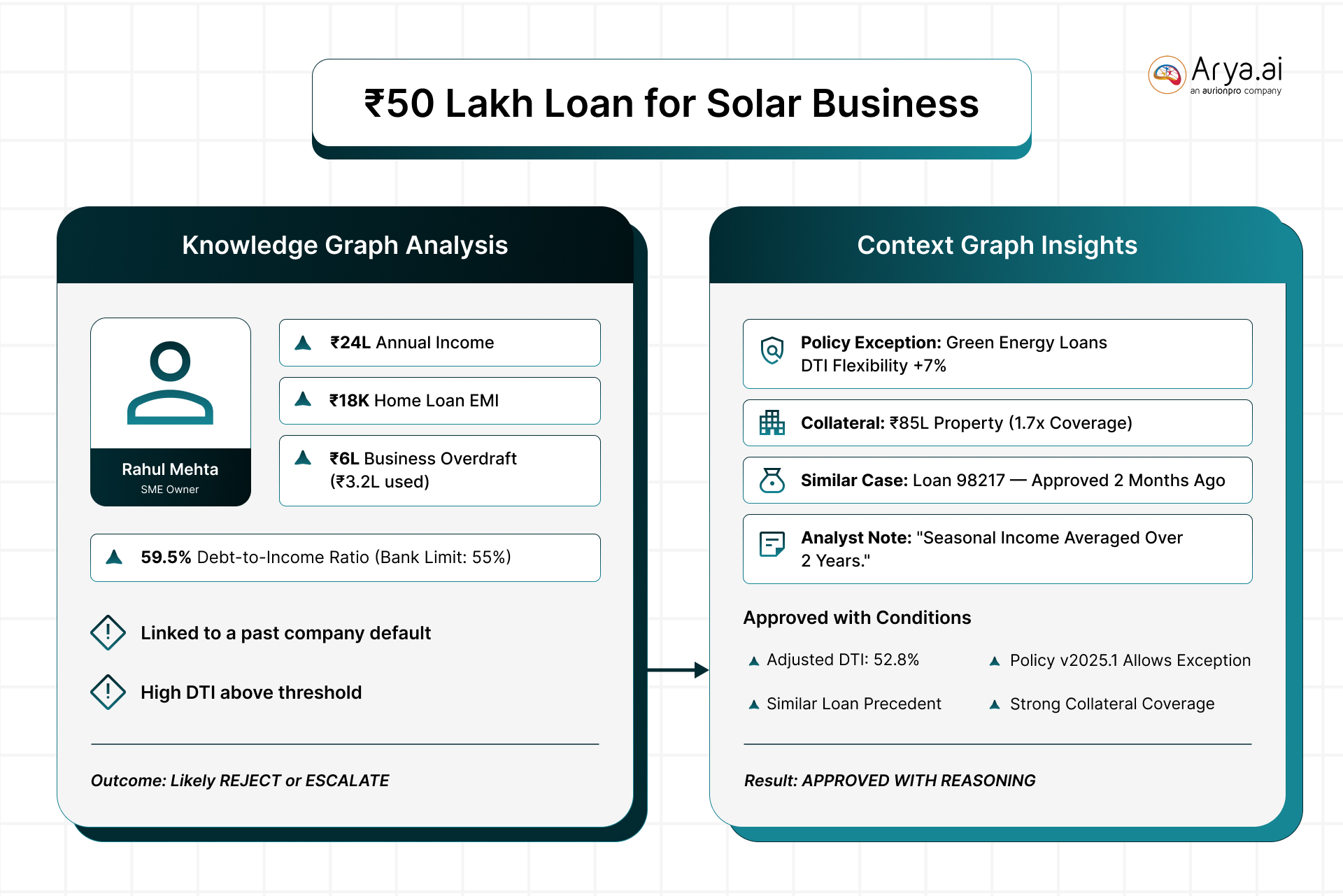
Knowledge graph analysis flags the risk; the context graph supplies the precedent, policy exception, and reasoning behind an approval.
Crucially, the decision comes with an explanation. If questioned by auditors, regulators, or internal teams, the bank can point to a clear trail: the policy in effect, the precedent referenced, the justification applied, and the outcome observed.
The Bottom Line
Knowledge graphs and context graphs aren’t competing approaches — they’re complementary layers. One gives AI a faithful map of the business. The other gives it the memory and judgment to act on that map responsibly.
Enterprises that stop at knowledge graphs get AI that’s well-informed but shallow: fast at connecting dots, weak at explaining why those dots matter. Adding a context graph is what closes that gap — turning AI from a system that answers questions into one that can be trusted to make and defend decisions.
As agentic AI takes on more autonomous work in 2026, that trust layer stops being optional. The organizations that build it now will be the ones whose AI systems earn a seat at the table for decisions that actually matter.
Share this post


Table of contents
Low-Code AI Automation Starts Here – Try Arya Apex


.png)


.png)
.png)
.svg)


