


.png)

From being a mere credential problem, financial fraud has grown more complex, worsened by fraudsters exploiting advanced technologies. Today, AI-driven fraud has forced financial institutions to take measures to address deepfake- and synthetic-identity-based malpractices.
Account-takeover rate rose 37% year-on-year, while 8.3% of digital account-creation attempts were suspected of fraud. The UK illustrates another development. UK Finance reported that criminals stole almost £1.28 billion through payment fraud in 2025.
Unauthorised fraud losses declined 5%, but authorised push-payment fraud increased 19% to £576.4 million. In other words, controls are getting better at stopping criminals from pretending to be customers, while criminals are increasingly persuading genuine customers to carry out the fraud themselves.
That distinction is central to understanding the potential and limitations of device intelligence.
What exactly is device intelligence?
Device fingerprinting and device intelligence are not quite the same thing.
Device fingerprinting attempts to establish: What device is this?
Device intelligence attempts to establish: How trustworthy is this device and this session right now?
A fingerprint can combine attributes such as browser, operating system, device model, screen configuration, fonts, IP address and other characteristics into an identifier. Device intelligence adds contextual signals concerning the device environment, network, history and sometimes user behaviour.
The important progression therefore looks something like:
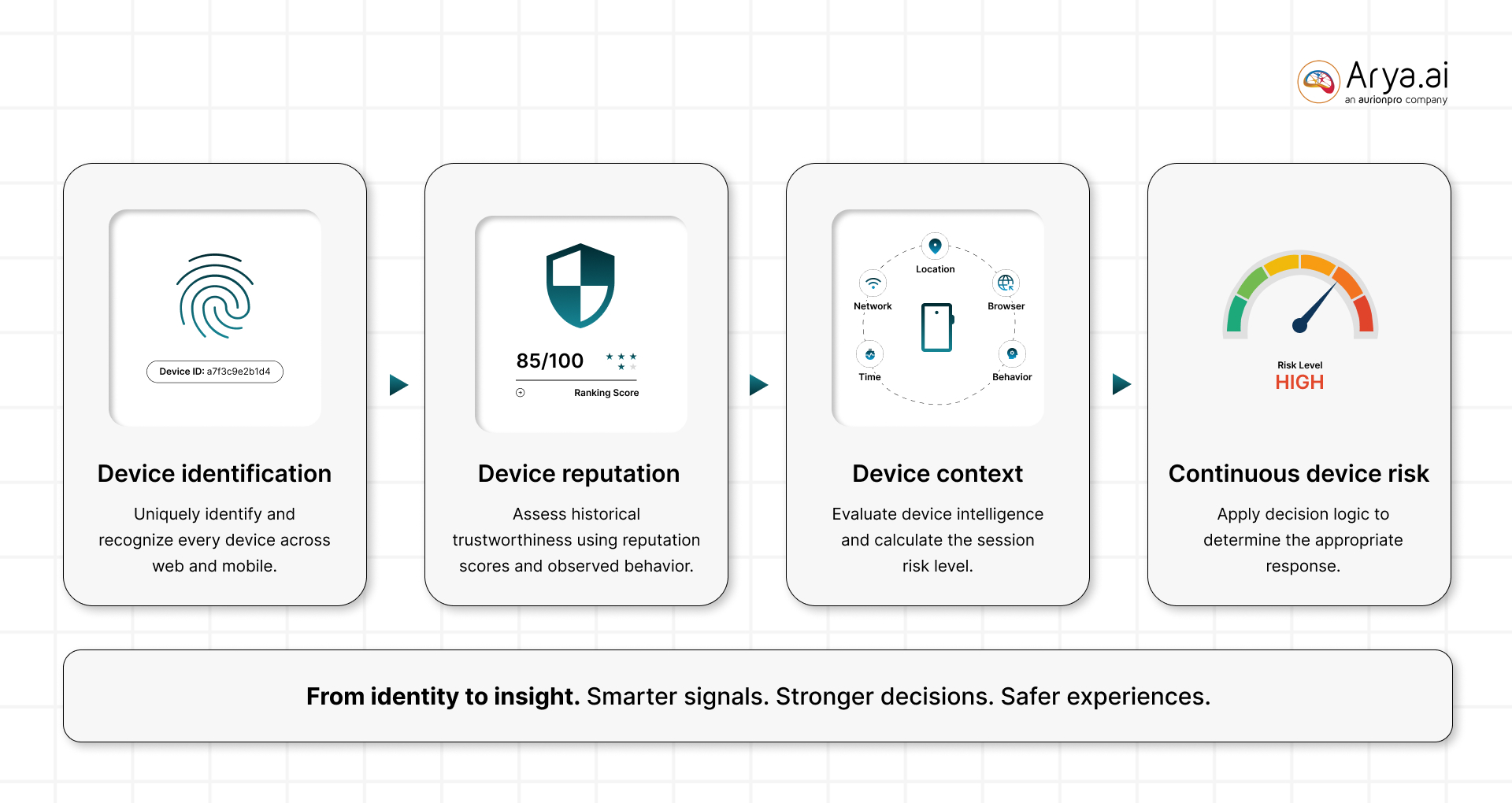
The last two are particularly important for modern fraud.
What does a device actually reveal?
A fraudster may possess the correct name, password, card details, ID document or OTP. But they still need a technical environment to interact with the bank.
That environment creates another body of evidence.
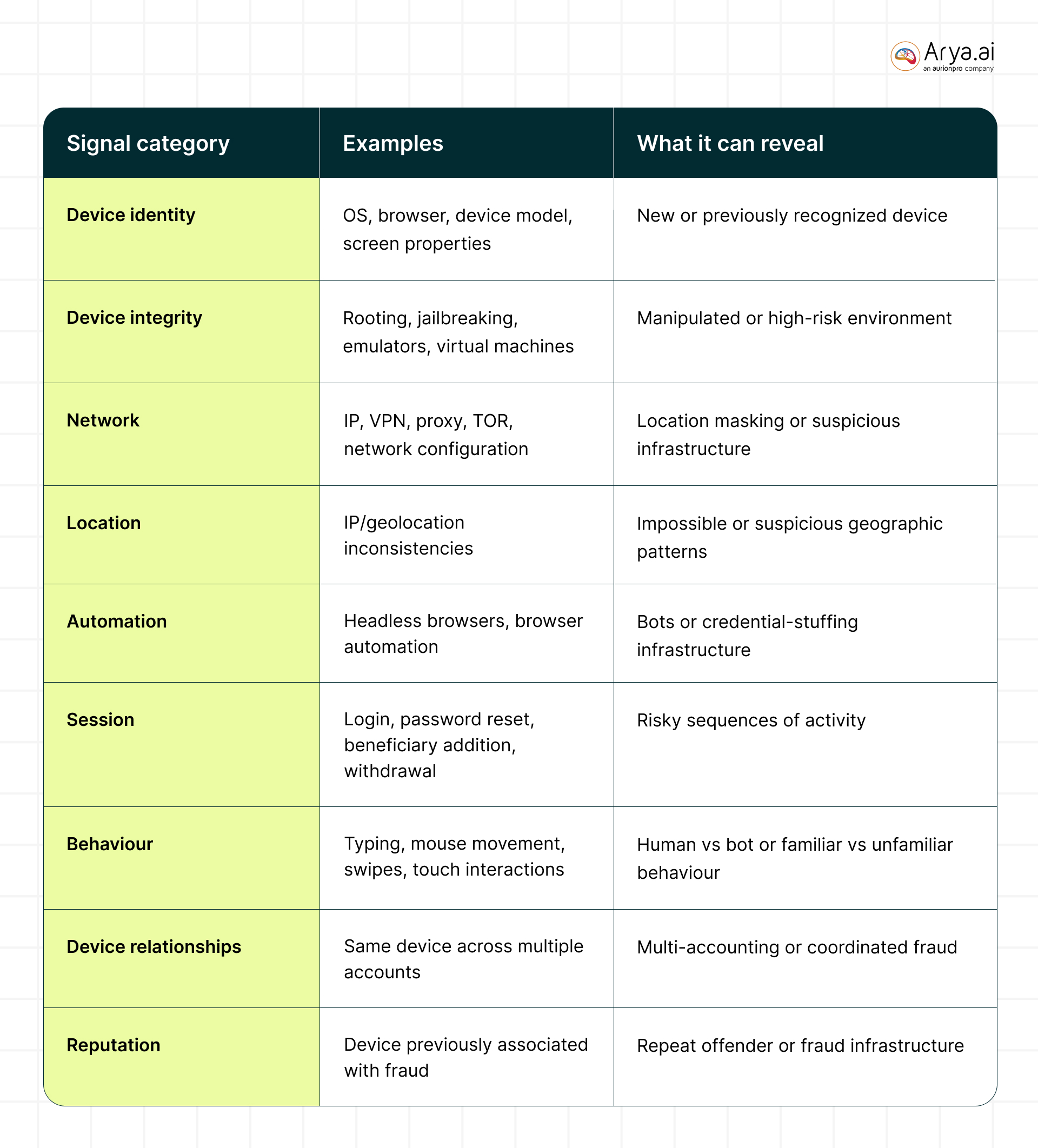
None of these signals necessarily proves fraud individually. The value comes from combining them.
How device intelligence actually prevents fraud
There is an important distinction here:
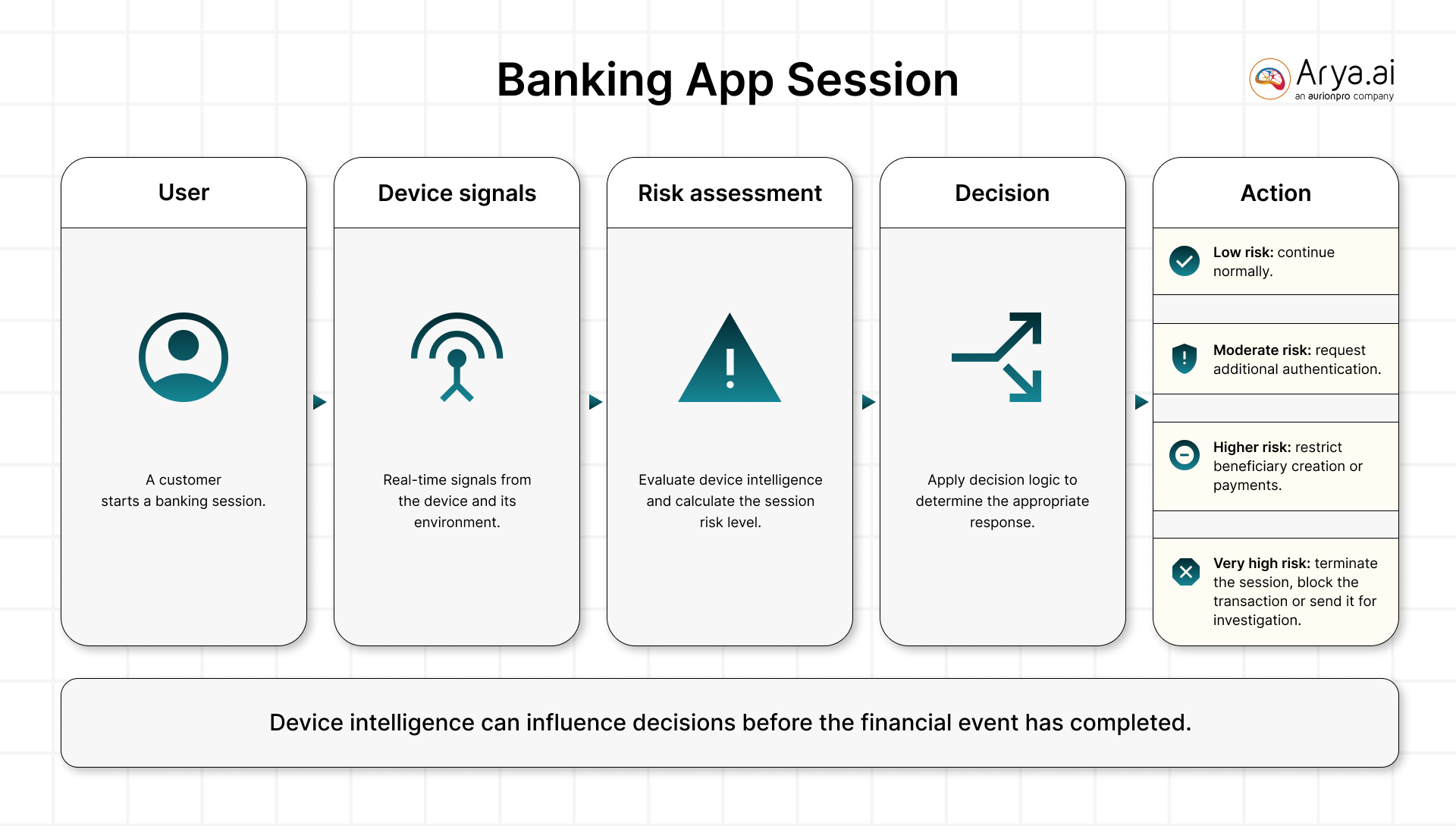
Device intelligence detects risk, but it is the surrounding decision system that prevents the fraud.
This is where detection becomes prevention.
Applicable Use Cases of Device Intelligence
Account takeover
Imagine someone logs into your banking account. It’s likely the attacker possesses the correct login credentials and a stolen OTP. Without device intelligence, the attacker can access your account, but device intelligence observes the peculiarities:
New device + unusual geography + residential proxy + password reset + new beneficiary + unusually rapid navigation
This is one of the strongest device-intelligence use cases.
Credential stuffing and automated attacks
Fraudsters increasingly automate login attempts using databases of leaked usernames and passwords. At the individual login level, those attempts can appear unremarkable. Across devices, however, patterns emerge:
- several devices → hundreds of credentials
- 30 apparently different browsers → near-identical device configuration
- hundreds of registrations → same emulator/proxy infrastructure
Device and network signals therefore provide another way to detect automation, even when credentials are technically valid.
Multi-accounting and fraud rings
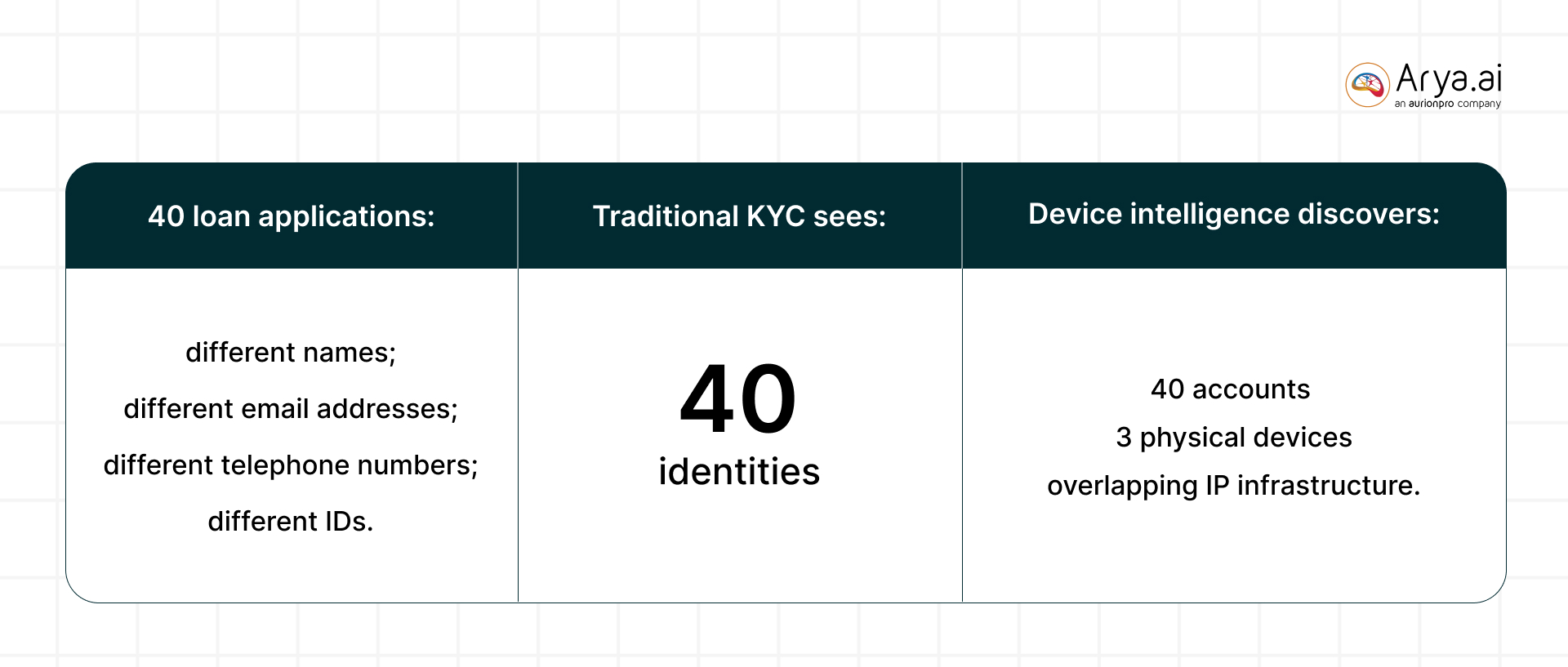
Suddenly the unit of analysis changes from the applicant to the network behind the applicants. This becomes substantially more powerful when device relationships are fed into graph/network analytics.
Tampered Trusted Device
This is probably the most important counterargument to the device intelligence stops fraud narrative. Fraudsters have realised that instead of trying to imitate the customer's device, they can operate through the customer's real device.
For instance, a remote-access scam can give a criminal control over the trusted device. In this scenario, the criminal must convince someone to install malware. Customers are cautioned against clicking on suspicious links and downloading apps from untrusted sources.
Because if a criminal accesses a device remotely, suddenly, the device ID, IP, location, etc., become all correct. And a recognised device is no longer necessarily a trusted device.
Consequently:
Persistent device recognition is insufficient. Continuous device intelligence becomes much more important.
Instead of asking: Have we seen this phone before? It needs to be: Has something changed since the customer logged in? A static fingerprint misses the attack. Continuous device and behavioural intelligence has a chance of detecting it.
However, there are cases of authorised push-payment fraud, where the victim deliberately authorises the payment to the scammer. From the device perspective, nothing out of the ordinary has occurred. Therefore, device intelligence will not be effective against all forms of financial fraud, and it cannot be treated as a complete fraud-prevention solution.
Fraud Detection Framework Hierarchy
.jpg)
Think of fraud intelligence in five progressively richer layers: identity, authentication, device, behaviour, and context and relationships. A modern system arguably needs all five, and device intelligence is only part of the picture.
Device Intelligence Is a Layer of Trust
Device intelligence can prevent financial fraud, but its effectiveness depends on what kind of fraud is taking place and how the intelligence is used.
Its greatest advantage is the additional context it creates around an interaction. Credentials may be correct, but a new device, unusual network, emulator, suspicious location or connection to several other accounts can reveal risk that identity and authentication controls alone may miss.
This makes device intelligence particularly valuable against account takeover, credential stuffing, automated attacks, multi-accounting and organised fraud networks. But device intelligence also has limits. A recognised device may be compromised through remote-access tools, while in authorised push-payment scams the genuine customer may be using their normal device and completing the transaction themselves. In such cases, knowing the device is not enough.
This is why device intelligence should not be viewed as another standalone fraud-detection tool. It works best as one layer within a broader fraud intelligence framework combining identity, authentication, device, behaviour, transaction context and relationships.
The larger shift, therefore, is from verifying whether an identity or device can be trusted to continuously assessing whether the interaction itself can be trusted.
As financial fraud becomes more sophisticated, no single signal will provide the strongest defence. It will come from connecting signals across the customer, device, session, transaction, and network, and using that context to make real-time risk decisions.
Share this post


Table of contents
Low-Code AI Automation Starts Here – Try Arya Apex


.png)




.png)
.png)
.svg)


