


.png)

The most experienced underwriters can tell from reading a file which business is falling apart and which struggling owner will still find a way to pay back the loan. On most days, making that judgment is the quickest part of their day.
The slow part is everything that comes before it: preparing the file.
A borrower emails three months of bank statements as sixteen separate PDFs, all out of order. For preparing the case, underwriters must also collate material on the involved stakeholders and documents related to the business.
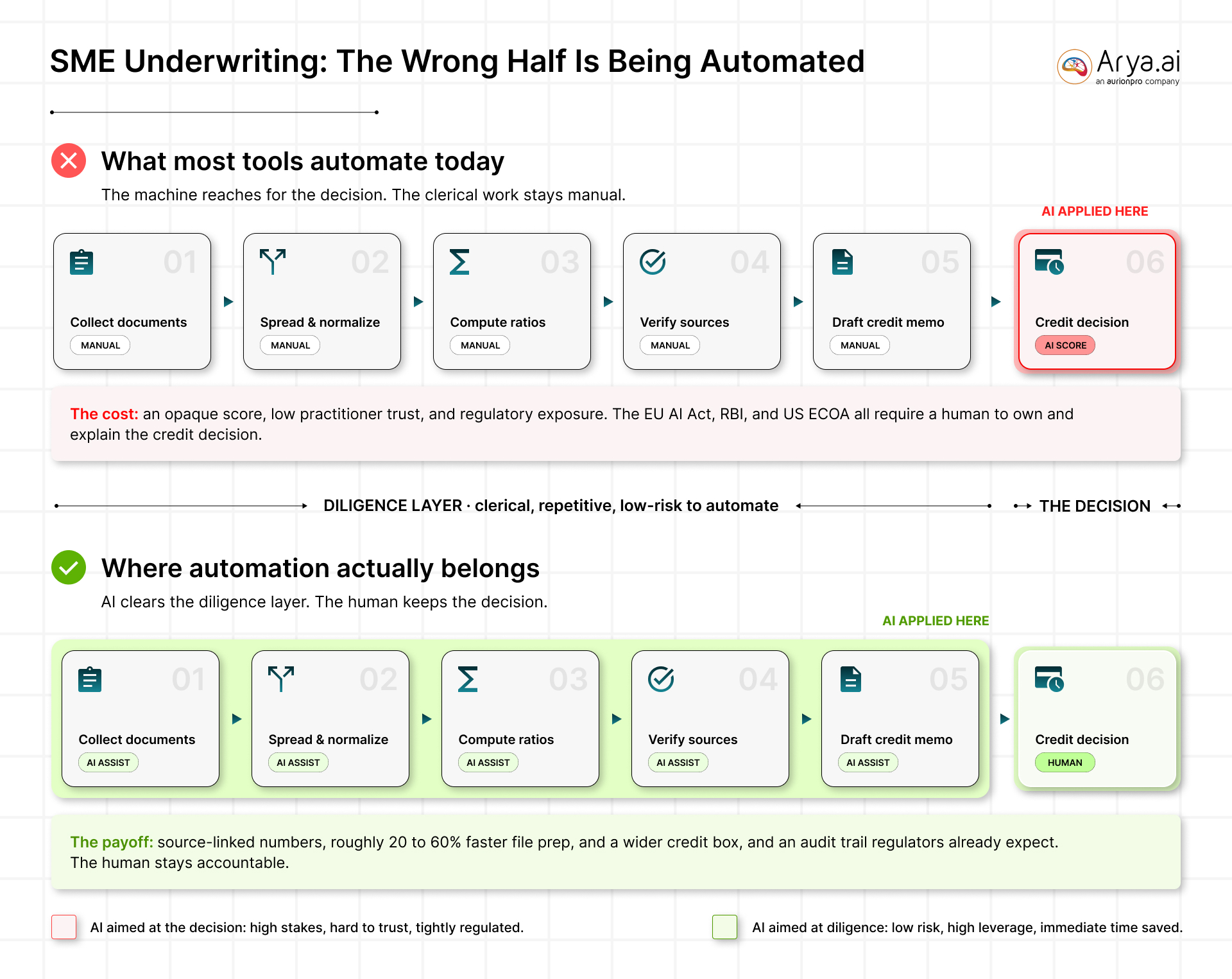
This unveils something odd about small-business lending. The rare, valuable skill, sharp credit judgment, takes less time than the grunt work behind it. And yet nearly every "AI in lending" pitch tries to automate the one part that was never the problem: the decision itself.
That's the wrong half to fix first. The industry has fallen for the idea of an intelligent machine that says yes or no, when the people doing the actual work want the opposite. Such an AI system making credit decisions also invites scrutiny from regulators. For instance, the EU, being one of the pioneers in drafting AI-related regulations, has drafted the EU AI Act, which views credit decisions as high-risk.
The cost of getting it wrong
Walk any fintech expo floor from New York to London to Singapore and the dominant promise is the same: instant decisioning, an AI-generated risk score, straight-through approval with the human removed from the loop. It demonstrates beautifully. It also flatters a real appetite inside lenders to cut costs.
At a recent industry roundtable on SME lending, the pain point that surfaced most sharply wasn't the credit decision; it was the documents. Allica Bank's Chief Product Officer put it bluntly: enormous amounts of time are lost comparing, exchanging, and hunting for data inside PDFs. Automate that, the panel agreed, and lenders can redirect their people toward the complex judgment calls that actually need a human. The pressure to clear this runway is real, and it is growing.
The trouble is that the decision is both the hardest thing to automate well and the most expensive thing to get wrong. Look past the marketing at what lenders have actually put into production, and the gap between ambition and reality is stark.
McKinsey's work on generative AI in the credit business found that the most mature deployments cluster around what it calls concision: summarising long documents, digitising PDFs, and answering quick questions. When it comes to synthesising information for the credit decision itself, no surveyed bank had reached full deployment, and only around a quarter had even started piloting. In North America, barely one in eight institutions had deployed any credit use case at all. The industry has one foot on the accelerator and the other firmly on the brake, and the brake is the decision.
This is often dismissed as caution or cultural resistance. It is closer to good sense. Experienced credit teams have watched enough models drift, enough alternative-data signals turn out to be proxies for something they were not allowed to price, and enough vendors overpromise, to know that a decisioning engine is a liability until it has earned trust. They are right to hold that line. The question is what to build in the meantime.
What actually consumes the day
Nothing consumes a credit team's time more than the friction in the grunt work. Most assume it is the deep analytical work, but it is the friction of preparing a file that takes time.
The cost before making a decision
The Mortgage Bankers Association's latest performance data puts the cost of producing a single mortgage at about 11,100 US dollars, and industry analysts reading that same data describe the figure as stubbornly stuck around 11,000 despite years of technology spending.
The reason is labour. Compensation has made up more than two-thirds of direct origination cost for fourteen consecutive quarters, while technology accounts for about 4%. Lenders have bought the tools, but files still move by hand, and people fill the gaps in the process.
That number is a mortgage benchmark, but the shape of the problem is identical in commercial and SME books. Every hour an underwriter spends stitching documents together is an hour priced into a loan that a small business ultimately pays for.
Where the labour goes
Then look at where those hours go. Documents arrive in the wrong order and the wrong formats, and reassembling them is a daily tax before analysis even begins. Financial statements have to be manually spread into a common shape. EBITDA often has to be derived line by line, adding back depreciation and amortisation, before you can even attempt a payment-capacity calculation.
Ratios that any spreadsheet could compute in a second get worked out manually because the data is not yet in a usable state. And behind all of it sits the single most common frustration in the job: chasing information that should have arrived in the first place, then chasing it again.
Gruntwork for a reason
None of this work requires eighteen years of experience. All of it is high-volume, low-judgment, and low-risk to automate. This is exactly the territory where AI should deliver, and it already does. McKinsey's analysis of multi-agent systems applied to credit memo preparation found analyst productivity gains of 20 to 60 percent and roughly 30 percent faster decision-making.
Read that carefully. The speed did not come from a machine making the decision. It came from a machine assembling and drafting so that the human could reach a decision sooner. The value was in the diligence, and the human kept the judgment.
Reframe the opportunity: build the diligence layer
Once you accept that the decision should stay with the human, the real opportunity comes into focus, and it is larger and more durable than any scoring engine.
The wedge is for document ingestion and normalisation. Auto-classifying, merging, and chronologically ordering a pile of bank statements is a task with zero judgment, daily pain, and almost no downside risk if it goes slightly wrong. Solving it removes friction from every single deal and buys immediate credibility with the people who will decide whether to trust the rest of the system. This is the least glamorous feature imaginable, and it is the right place to start.
Every derived number needs a one-tap path back to the source document. An underwriter should be able to tap a figure and see the raw bank statement, confirm that the asset value is right, that the bureau record matches the entity, and that the statement belongs to the correct subject. Verification behaviour is instinctive for good credit people, and a system that shows sources rather than only answers is a system they will actually adopt.
Around all of this, proactive adverse-media and news monitoring with clickable links surfaces the "by the way, this borrower has a history" signal before it becomes a problem, and an in-app assistant answers the ad-hoc trend and ratio questions that otherwise mean opening three spreadsheets.
Notice what every one of these features has in common. None of them makes the decision. All of them clear the ground so the human can make it faster, more consistently, and with a cleaner audit trail.
The economic case is bigger than efficiency
It would be easy to file this under cost-cutting. That undersells it. The prize is access to credit at a scale the current process cannot reach.
The IFC and the SME Finance Forum put the global finance gap for micro, small, and medium enterprises at roughly 5.7 trillion US dollars, a figure that grew 27 percent between 2015 and 2019, far outpacing GDP growth. Between 40 and 43 percent of formal SMEs in developing economies have unmet financing needs. More than half of SME trade-finance requests are rejected, and the small businesses that do secure credit routinely pay materially higher rates than large firms for it.
A large share of that gap is not a risk-appetite problem. It is a cost-to-serve problem. A small ticket cannot justify the same manual diligence hours as a large one, so it gets a cursory review, a decline, or simply falls to the bottom of the queue. The economics of attention, more than the economics of risk, quietly exclude a vast band of viable borrowers. Compress the diligence hours, and those economics change.
Files that were previously uneconomic to underwrite become worth the effort, and the credit box widens without lowering standards. McKinsey estimates that generative AI could add between 200 and 340 billion US dollars a year to global banking, the bulk of it through productivity rather than smarter risk-taking. The near-term prize is throughput and consistency, and both come from the diligence layer, not from a cleverer score.
What lenders and NBFCs should actually do
For credit and risk leaders weighing where to place their bets, the sequencing matters more than the ambition.
Start scoreless. Lead with aggregation, normalisation, and ratio automation, and introduce a risk score only once its accuracy is provable and explainable. A shaky score launched early destroys the credibility of everything shipped alongside it, and it is far harder to rebuild trust than to earn it slowly.
Make provenance non-negotiable. If a derived figure cannot be traced back to its source in one tap, it is not ready. Build the red-flag engine around objective, checkable signals first: county court judgments, days beyond terms, defaults, disqualified directors, sustained negative multi-year trends, group-level distress, and customer-concentration risk.
Automate the drafting and keep the human as editor. Fit the workflow to how credit teams already operate, with delegation-of-authority routing where a junior drafts, a senior co-signs, and anything above authority escalates, plus a genuine light-touch mode for small tickets that need a red-flag scan rather than a full spread.
And treat trust as something you compound. Nail the diligence layer, prove it in production, and you build both the practitioner confidence and the audit trail that the EU AI Act, the RBI, and US fair-lending law all increasingly demand. That is what earns the right to automate more of the decision-making later, if and when the accuracy is truly there.
The half is worth building
The vendors racing to replace the underwriter are solving the problem that looks most impressive in a demo. The lenders who win will solve the problem that shows up every morning at nine o'clock: the sixteen out-of-order PDFs, the EBITDA derived by hand, the memo written from scratch, the information chased for the third time.
Give experienced credit people their judgment time back, and everything the industry actually wants follows. Decisions get faster. Files get more consistent. The credit box widens to reach borrowers the old economics quietly excluded. And the compliance posture already matches where regulators are heading, because the human stayed in charge the whole time.
Automate the diligence. Leave the decision where it belongs.
For AI-led credit underwriting, explore Cred AI.
Share this post


Table of contents
Low-Code AI Automation Starts Here – Try Arya Apex


.png)




.png)
.png)
.svg)


