


.png)

The technical architecture that successful enterprises run on has taken years to build.
The core banking platform that standardised processes wasn’t picked on a whim. Leaders tested different platforms, defined new objectives, toiled over fixing the failures, and then picked one that would be valuable in the long-term.
Most importantly, they made it flexible enough to accommodate and discard new processes as the operations evolve.
With agentic AI on the precipice, the architecture enterprises spent decades cementing is now what stands between them and the next phase of value creation.
And most leaders believe they only have two ways through it.
- The first is to bolt agentic AI directly onto legacy infrastructure: Treat the new agent as one more service calling into the existing estate and hope it holds. It's the fastest way to a working demo, and the least durable way to run anything at scale.
- The second option is to tear the architecture down and rebuild it around agentic AI from the ground up. It's the more honest answer to "how do we actually make this work?" But honesty here is expensive. A rebuild is measured in years and tens of millions of dollars. And while it's underway, the very architecture that has carried the enterprise this far sits sidelined rather than improved.
There is a third path, and it doesn't force enterprises to choose between speed and rigour: orchestration.
Instead of replacing the architecture, orchestration sits above it: a coordination layer that lets agentic AI reason and act across the systems already in place.
How Orchestration Works in an Enterprise
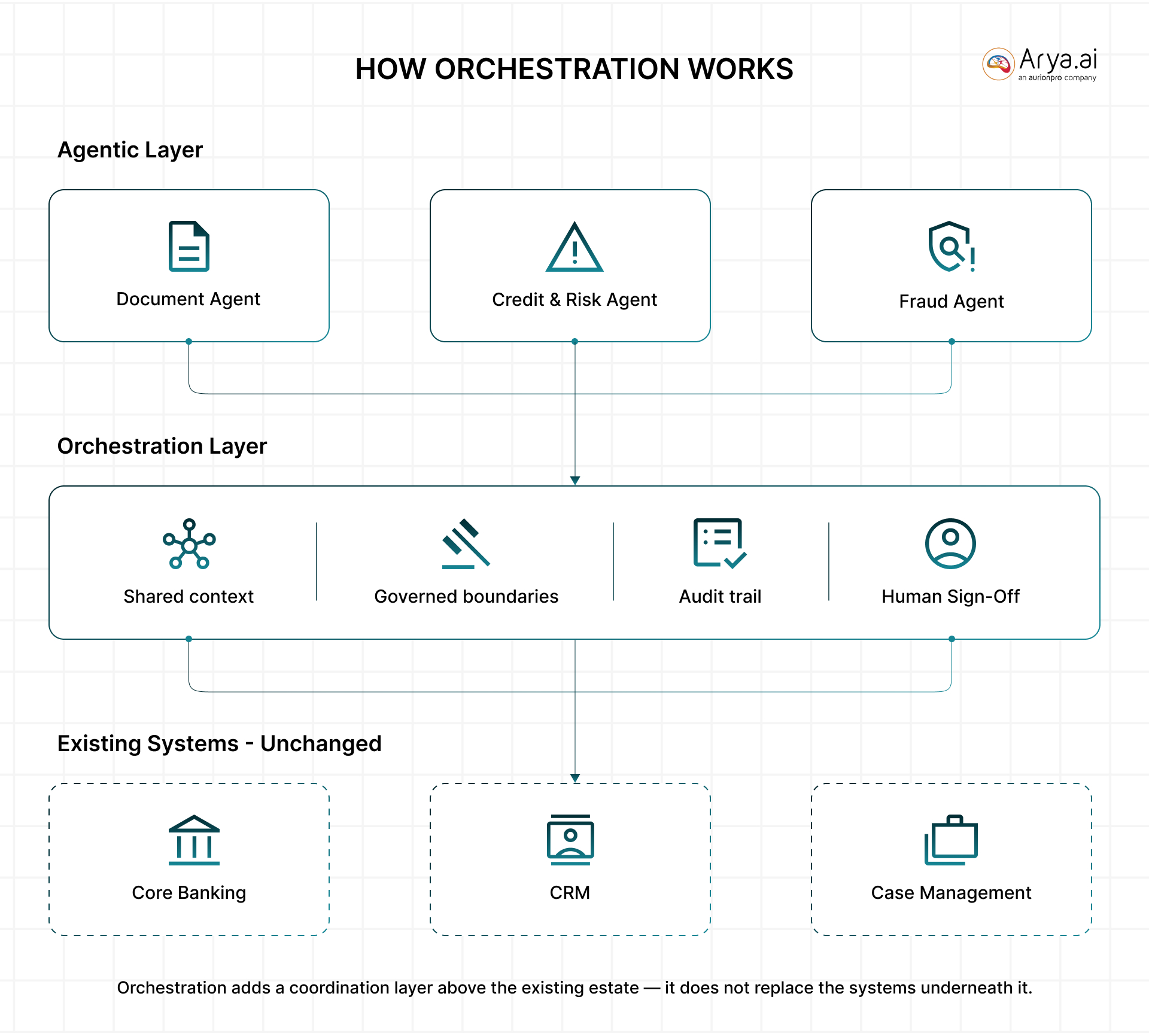
Orchestration coordinates AI agents and legacy systems into one accountable agentic workflow. The entire control plane of agents – how they act, access context, write systems – is managed with orchestration.
Picture a commercial loan application. Before the application even reaches the core banking systems, a range of checks must take place: document gathering, credit bureau data, fraud and anomaly detection, stakeholder verification, cash flow analysis.
Orchestration handles this as one cohesive workflow, without touching the core systems. However, for orchestration to work here, three things have to be true:
- Agents need a shared memory of the task, so a document-verification agent isn't re-asking a question a credit-check agent already answered three steps earlier.
- Every agent needs a defined boundary: One allowed to read a customer's transaction history isn't automatically allowed to change their credit line, and the orchestration layer is what enforces that separation.
- Every one of those boundaries needs a route back to a human being for decisions that carry enough financial or reputational weight to require one.
The architecture enterprises already built keeps doing exactly what it has always done. Agentic AI just gets to work through it, instead of around it.
What makes orchestration effective
Every enterprise trying to put agentic AI to work is really solving for three variables at once, and getting even one wrong undoes the other two.
- Compute has to stay low enough to justify the investment. Inference now accounts for roughly 85% of the average enterprise AI budget, and agentic workflows can burn through many times more tokens per task than a single chatbot exchange, simply because agents reason in loops instead of answering once and stopping. When an agent costs more in inference than the labour it replaces, the ROI turns negative before the project gets a fair hearing.
- Latency has to stay minimal, because a slow agent is worse than no agent at all. Enterprises are already restructuring compute strategy around this single constraint. As inference has moved from experimental pilots to always-on production traffic, the cost and scale of running it continuously have exposed how unprepared most existing infrastructure really is, according to recent analysis from Deloitte.
- Auditability must be prioritised. It establishes the operational record behind it: the specific system, model version, dataset, and human approver involved.
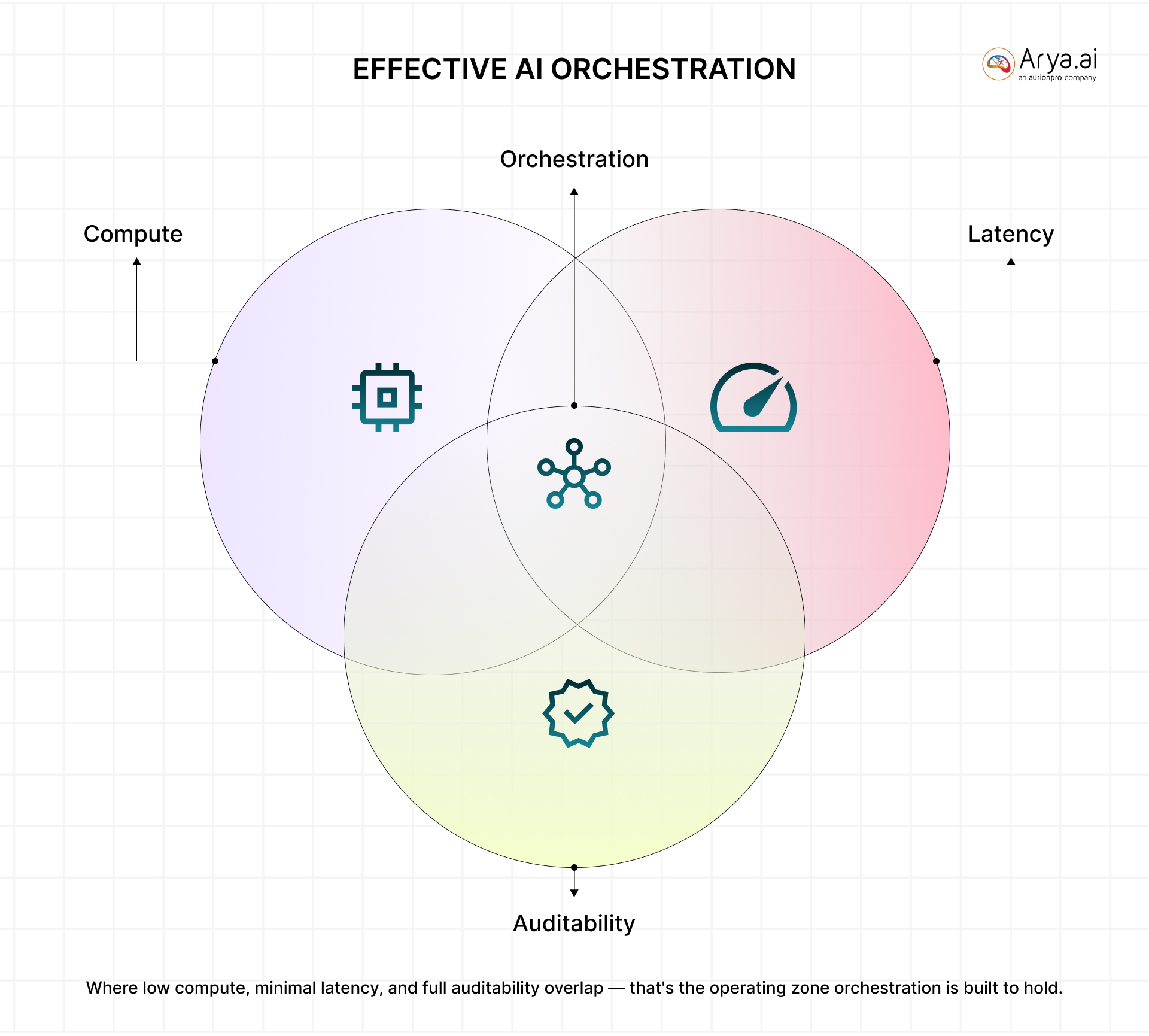
Compute, latency, and auditability don’t have to be three separate problems.
Orchestration is what lets all three land together instead of trading off against each other:
- Managing compute: Orchestration routes each sub-task to the smallest capable agent rather than defaulting every call to one large general-purpose model, which keeps compute proportional to the value being created.
- Managing latency: It parallelises independent steps and reuses shared context instead of re-deriving it, which is what keeps latency down.
- Managing auditability: And because coordination requires recording who did what, on which system, and on whose authority, the audit trail is a byproduct of the coordination layer doing its job.
Orchestration breaking barriers that stop agentic AI from reaching production
Data barriers
Somewhere between 80% and 90% of enterprise data is unstructured. It lives in contracts, emails, scanned forms, and call transcripts. Recent joint research from Harvard Business Review and Hyland puts the share of enterprises with genuinely well-connected data at just 27%, even though 94% of leaders agree that connected data is essential to making AI work.
Orchestration doesn't wait for that problem to be solved upstream. It treats extraction and classification as a first-class step inside the workflow itself: a dedicated agent reads, structures, and routes the content before the decisioning agent ever touches it, with the same governance controls applied to that step as to every other one in the chain.
Regulations
The second barrier is using agentic AI in regulated industries. Orchestration solves this the same way it solves compute and latency: by making the record of who-did-what a structural feature of the coordination layer, not a report someone assembles after the fact.
Conclusion
The architecture question enterprises have been wrestling with was never really "bolt on or rebuild." It was "how do we let the system keep evolving without losing what we've already built." Orchestration is the answer that was there all along. The core banking platform, the CRM, the case-management system — none of it needs to go anywhere.
What changes is what sits above it: a layer that lets agentic AI reason across the estate, act within clearly governed limits, and leave a record good enough for the next auditor, the next regulator, and the next CFO asking where the return actually came from.
Share this post


Table of contents
Low-Code AI Automation Starts Here – Try Arya Apex


.png)




.png)
.png)
.svg)


