


.png)

A particular kind of institutional optimism accompanies the early adoption of any transformative technology. Banking has seen this before: core banking modernisation, cloud migration, the first wave of digital lending. Each time, the technology works, but the surrounding architecture does not.
The current wave of enterprise AI is following the same pattern, only faster. The models are genuinely extraordinary. They can read a credit file and synthesise a risk memo. What they cannot do, or what no single model can do, is coordinate across the full depth of a complex financial workflow. Without coordination, agents cannot reason across specialised data domains or produce an auditable record that holds up to regulatory scrutiny.
This happens because of the architecture. Fortunately, financial institutions are beginning to understand that multi-agent orchestration as the foundational design principle for AI can build durable systems.
The Limits of the Monolithic Assistant
The god-agent model (a single, heavily prompted large language model tasked with handling classification, retrieval, analysis, drafting, and policy enforcement in one pass) doesn’t work. It is seductive in its simplicity, but it is also a structural dead end.
The failure modes are predictable. A single model's context window, even with 200,000 tokens as standard, cannot hold a complete corporate credit file alongside the bank's underwriting policy, current market context, regulatory requirements, and the borrower's full relationship history without degrading in accuracy. The richness of the inputs competes with the precision of the outputs.
Then there is the economic argument. Different tasks in a banking workflow reward different model capabilities. Triage and routing tasks are well-served by fast, cost-efficient models. Complex reasoning over unstructured financial documents requires more capable, expensive inference.
Structured data extraction benefits from specialised models trained specifically for that purpose. A monolithic deployment either overpays for routine work or underperforms on the tasks that matter most. Neither is acceptable at the scale of a large financial institution.
Why Banking Is the Defining Domain for Multi-Agent Systems
No industry is better suited to multi-agent orchestration than banking. The structural characteristics of banking and financial institutions’ workflows are precisely the conditions under which distributed, coordinated intelligence outperforms any single model. This means that workflow-level productivity gains compound into hundreds of basis points of operating improvement.

Consider the corporate credit decision workflow above. It draws on bureau data, KYC and KYB verification, AML and sanctions screening, income and cash-flow analysis, document forensics, financial model assessment, policy and covenant evaluation, and qualitative business-risk judgment. It’s a complex reasoning chain, and no single model can excel at all of these tasks.
Every action requires an explanation
Building on the same corporate credit decision example. Each decision that AI makes must be auditable for a regulator. An opaque model that produces a single output cannot meet these requirements. By contrast, a multi-agent system that records each specialist's inputs, model version, retrieved context, and confidence score can.
How Multi-Agent Orchestration Architecture Works
In a well-designed multi-agent system, four roles define the architecture.
- The orchestrator breaks a goal into sub-tasks, routes data to the right specialists, manages sequencing and dependencies, and assembles the final output. It is the intelligence layer above the intelligence.
- Specialist sub-agents are scoped to single functions: credit-score retrieval, document extraction, fraud pattern matching, covenant analysis, risk memo drafting.
- Tools are the deterministic interfaces specialists call, such as bureau APIs, core banking systems, sanctions lists, document OCR pipelines, and internal policy engines.
- Memory layers maintain context across the workflow: short-term session state, long-term institutional knowledge, entity-specific history, and live external data.
Orchestration patterns follow recognisable structures. Hierarchical patterns, a planner delegating to specialists, offer the most flexibility and are the standard for enterprise deployments involving dozens of agents. Production systems are almost always hybrids: hierarchical at the top, parallel in the evidence-gathering middle, sequential in the review and approval stages.
The key challenge in multi-agent orchestration is coordinating autonomous systems to accomplish complex goals that exceed what a single agent can achieve. The orchestration layer meets that challenge and enforces the governance, separation of duties, and explainability that banking requires. This is a critical insight: in a multi-agent system, institutional control sits not with the most capable model in the network. It is the orchestrator.
Credit Underwriting: The Canonical Use Case
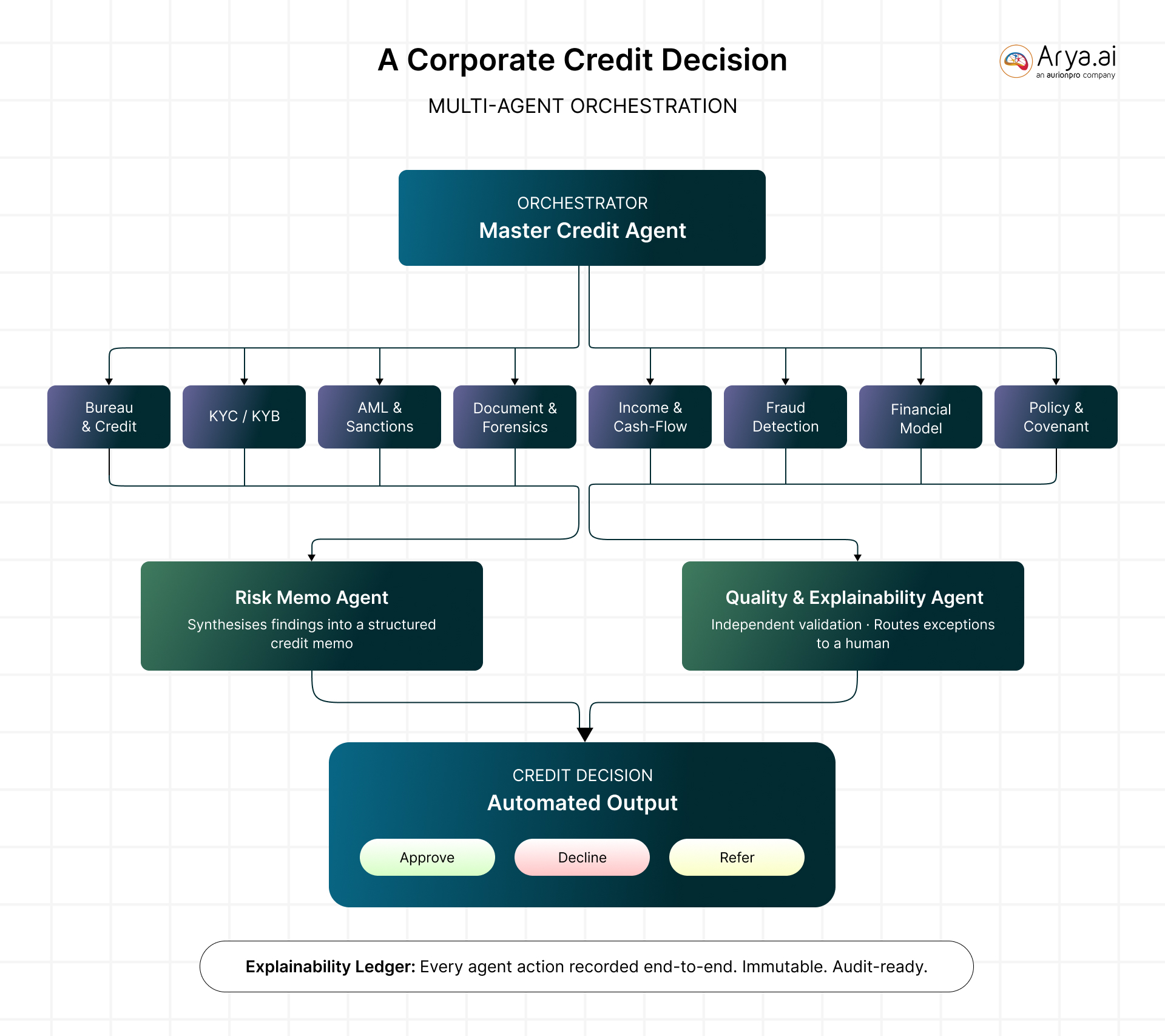
Credit underwriting is the clearest illustration of why orchestration is not optional for banking workflows of any complexity. Walk through what a well-designed multi-agent credit system actually looks like.
- An Intake and Document Agent handles OCR and structured-data extraction from pay stubs, tax returns, bank statements, financial statements, and corporate filings. It flags document anomalies and potential manipulation.
- A KYC and KYB Agent verifies identity and beneficial ownership against authoritative sources: company registries, sanctions lists, and adverse media databases.
- A Credit Bureau Agent pulls and normalises bureau files, computes scores and reason codes, and surfaces the signals most predictive for the specific product and borrower segment.
- A Fraud and Synthetic-Identity Agent runs pattern matching against known fraud typologies, behavioural anomalies, and graph-based signals that identify relationships between entities, not just individual node attributes.
- An Income and Cash-Flow Verification Agent ingests open-banking transaction feeds for individual borrowers and normalises financial statements for businesses, generating forward-looking cash-flow projections rather than backwards-looking averages.
- A Policy and Eligibility Agent applies the bank's underwriting criteria: debt-to-income thresholds, exposure limits, jurisdictional restrictions. Based on the data, it then flags policy exceptions for escalation.
- A Risk Memo Drafting Agent synthesises the full file into the bank's standard credit memo format, with a structured rationale.
- A Quality and Explainability Agent functions as the effective-challenge layer: it evaluates the memo for completeness, consistency, and policy adherence, produces a human-readable rationale with confidence scoring, and routes low-confidence cases to a human underwriter.
None of these agents can carry the workflow alone. More importantly, the orchestrator governs the workflow and maintains the audit trail. This is where human-in-the-loop controls are enforced for overseeing the collective output of these agents.
The Strategic Imperative
Model capabilities are increasing every day, so why doesn’t this translate into success at the enterprise level?
Here’s how banks can get it right:
- An auditability ledger records all the inputs, model version, retrieved context, decision path, outputs, and policy evaluations. The record should also withstand regulatory examination and customer disputes.
- An agent inventory and risk taxonomy applies the same governance discipline to agents as to human employees and systems. Each agent is registered, tiered by materiality, assigned a named accountable owner, and given explicit privilege limits.
- Human-in-the-loop controls at crucial decision points are non-negotiable in the current regulatory environment. Credit denial, transaction reversal, and customer impact above defined thresholds require a human checkpoint.
- Continuous behavioural monitoring detects drift, flags exceptions, and tests resilience. An agent that performs correctly at deployment may degrade silently as data distributions shift or as the bank's policy environment changes. Static validation at deployment is not sufficient governance.
Conclusion
The Monetary Authority of Singapore's Project MindForge, updated in March 2026, represents the most operationally detailed regulatory framework for agentic AI in financial services to date, addressing multi-agent systems, third-party agent integration, and automation bias. The regulatory direction is clear: the orchestration layer is where compliance lives.
In the near term, the priority is selecting high-friction, multi-step workflows with measurable cycle time and quality benchmarks, and building the orchestration layer. Building the architecture is equally important as deploying models because the workflows demand distributed intelligence. Coordination is the capability. Everything else is a component.
Share this post


Table of contents
Low-Code AI Automation Starts Here – Try Arya Apex


.png)




.png)
.png)
.svg)


