


.png)

A model can classify a transaction and summarise a document, while an agent can go further by calling tools and choosing actions. But a large organisation does not operate as a collection of independent tasks.
Banks operate through long-running, regulated workflows in which customer context, permissions, policy, data lineage, approvals, systems of record, model outputs, and human decisions must remain coherent.
As AI moves from “answering” to “acting”, those coordination requirements become part of the runtime itself. That is the architectural case for an AI operating-system layer.
A model creates intelligence. An application creates a capability. An AI OS turns multiple capabilities into an institutionally governed workflow.What AI is in a banking system
A useful starting point is to separate AI, an AI model, an AI application and an AI agent, because the architecture gets confusing when all four are treated as synonyms.
For banking architecture, this is what it may look like:
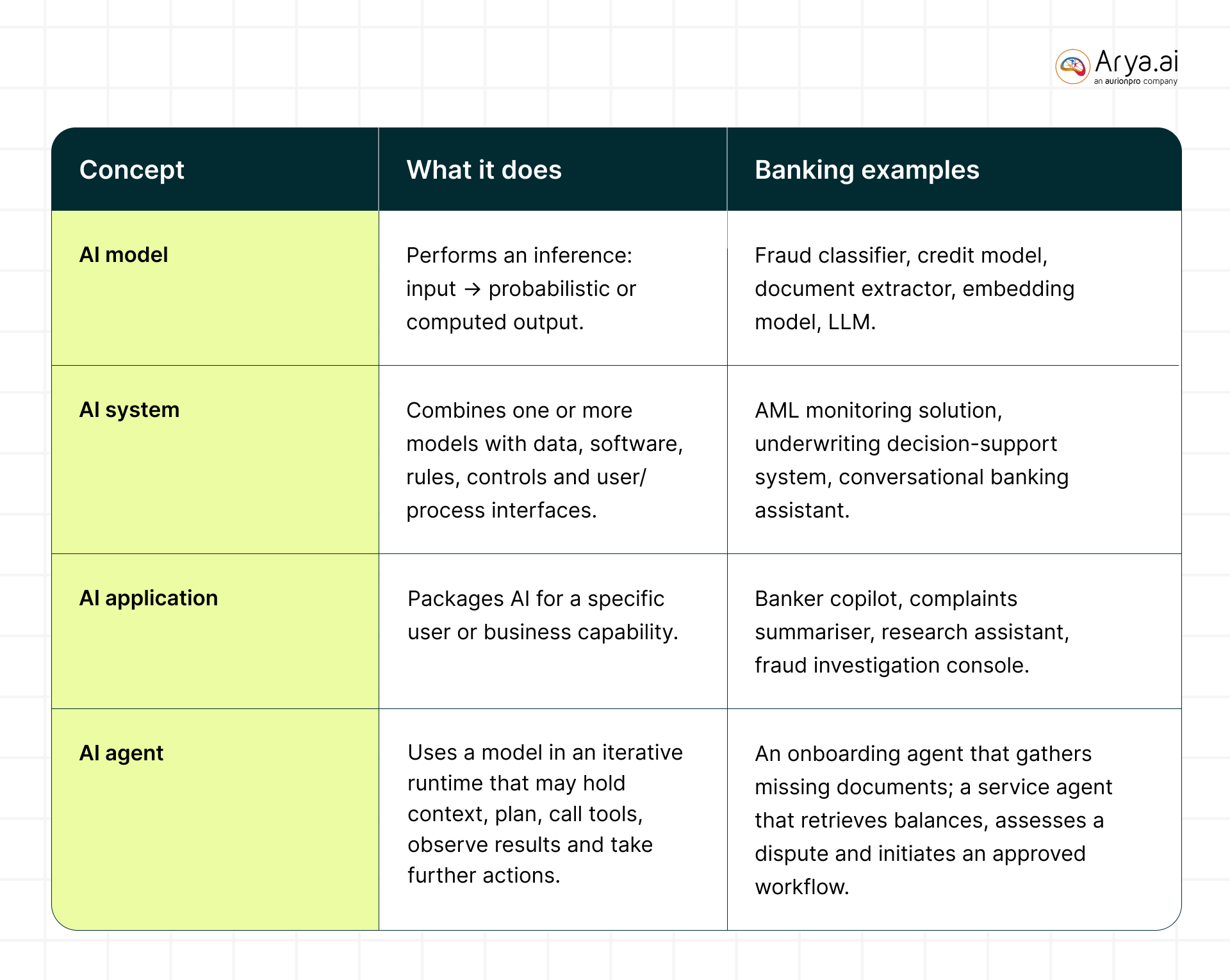
This distinction becomes important when moving from AI that knows to AI that acts. The relevant unit of architecture is consequently no longer just the model. It is increasingly the decision-and-action system surrounding the model.
Composition of the AI stack
The cleanest way to understand the need for an Enterprise AI OS is to define what each layer should and should not handle.
Infrastructure and compute
At the bottom is the physical and cloud infrastructure: CPUs, GPUs and other accelerators, memory, networking, storage, containers, cloud services and on-premises infrastructure.
Its job is to provide compute, storage, networking, availability and performance. AI workloads increasingly depend on specialised hardware, cloud infrastructure, external data and pretrained models.
Models and intelligence
Above the compute layer sits the model estate: foundation models, small language models, domain models, embeddings, re-rankers, vision and speech models, traditional machine-learning models and financial/statistical models.
This layer owns inference capability. Depending on architecture, it may also encompass inference serving, fine-tuning, model registries, evaluation artefacts and associated MLOps functions.
A model's purpose is fundamentally to answer questions such as:
- What is this?
- What is likely to happen?
- What does this document mean?
- What should I generate?
- Which option appears most appropriate?
It should not independently become the authoritative repository of customer state, institutional policy or delegated authority. This separation matters because model behaviour can change, models can be probabilistic, and financial institutions increasingly consume third-party models.
Applications, agents and APIs
Applications turn intelligence into a specific capability. They include copilots, chat interfaces, underwriting assistants, research tools, fraud agents, servicing agents and APIs through which an AI capability is exposed.
This is where domain-specific experience and task logic usually belong. A mortgage copilot knows what a mortgage officer is trying to accomplish. A fraud investigation application knows the analyst's task.
The AI OS
The AI OS is the shared runtime control plane underneath or around these applications and agents. Rather than answering the business question itself, it governs how intelligence is assembled into execution.
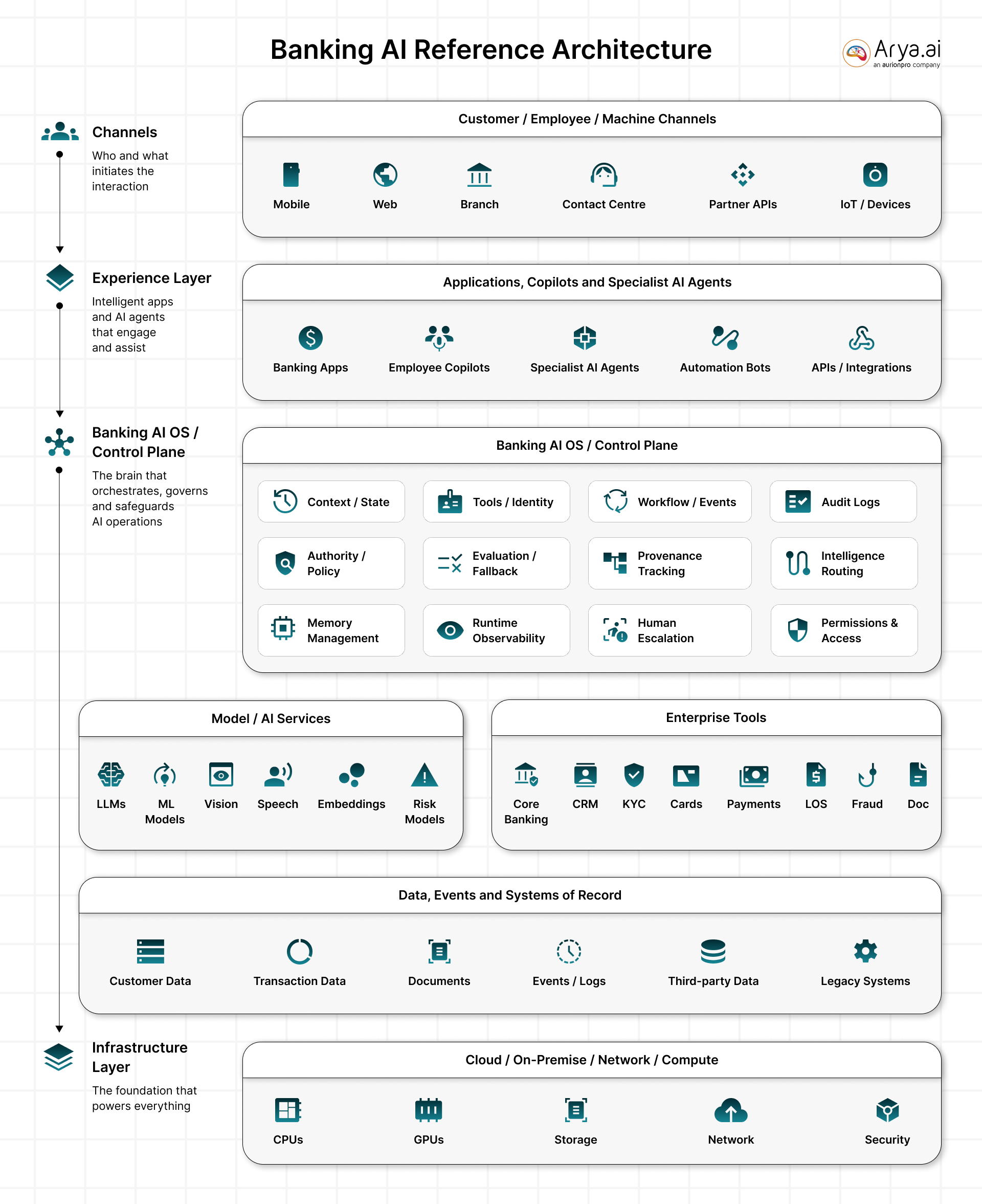
A simplified reference architecture is:
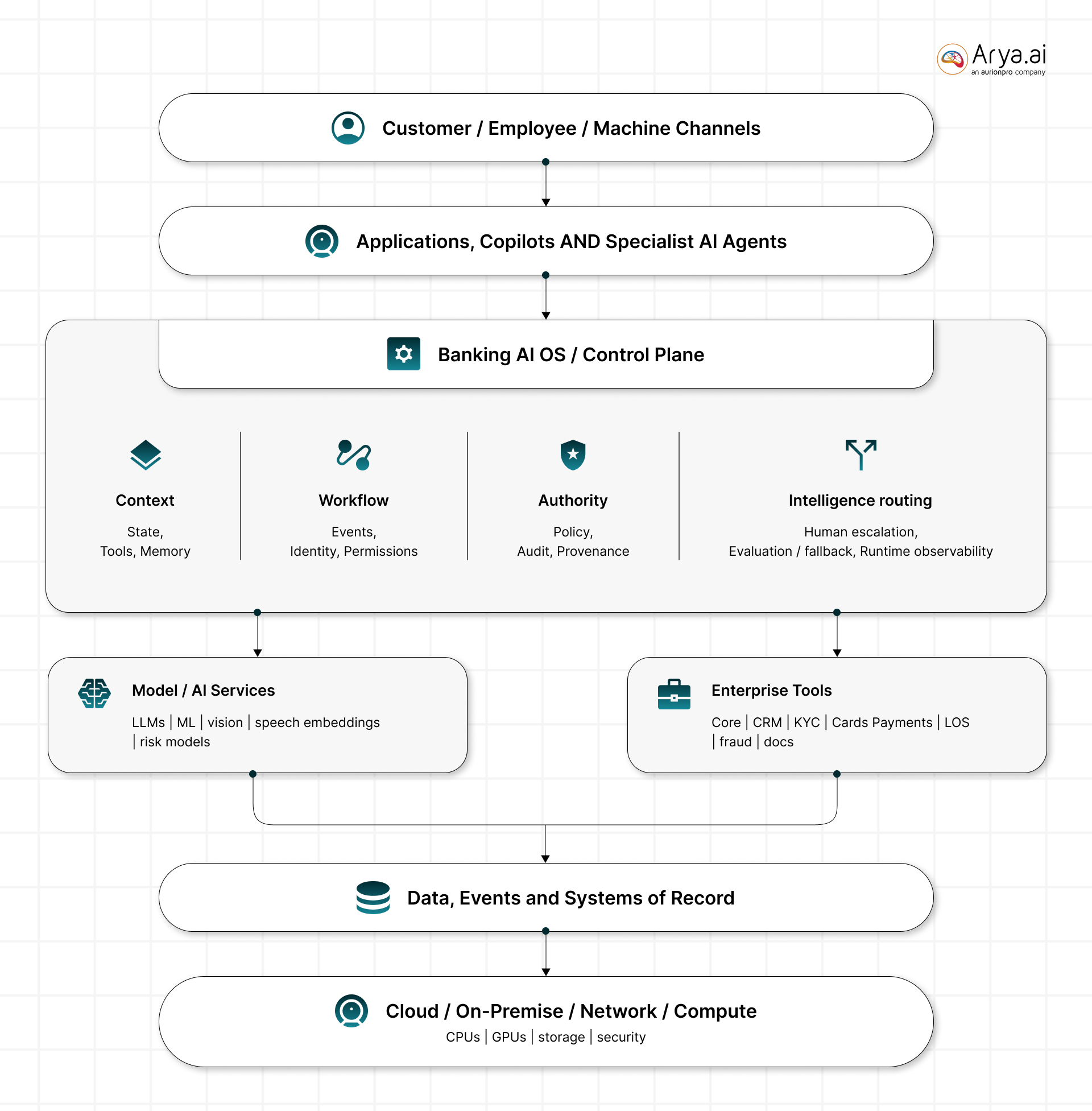
The banking version extends this concept because the scarce resources are not merely compute and memory. They include trusted data, institutional authority, regulated actions and human attention.
Let’s map it:
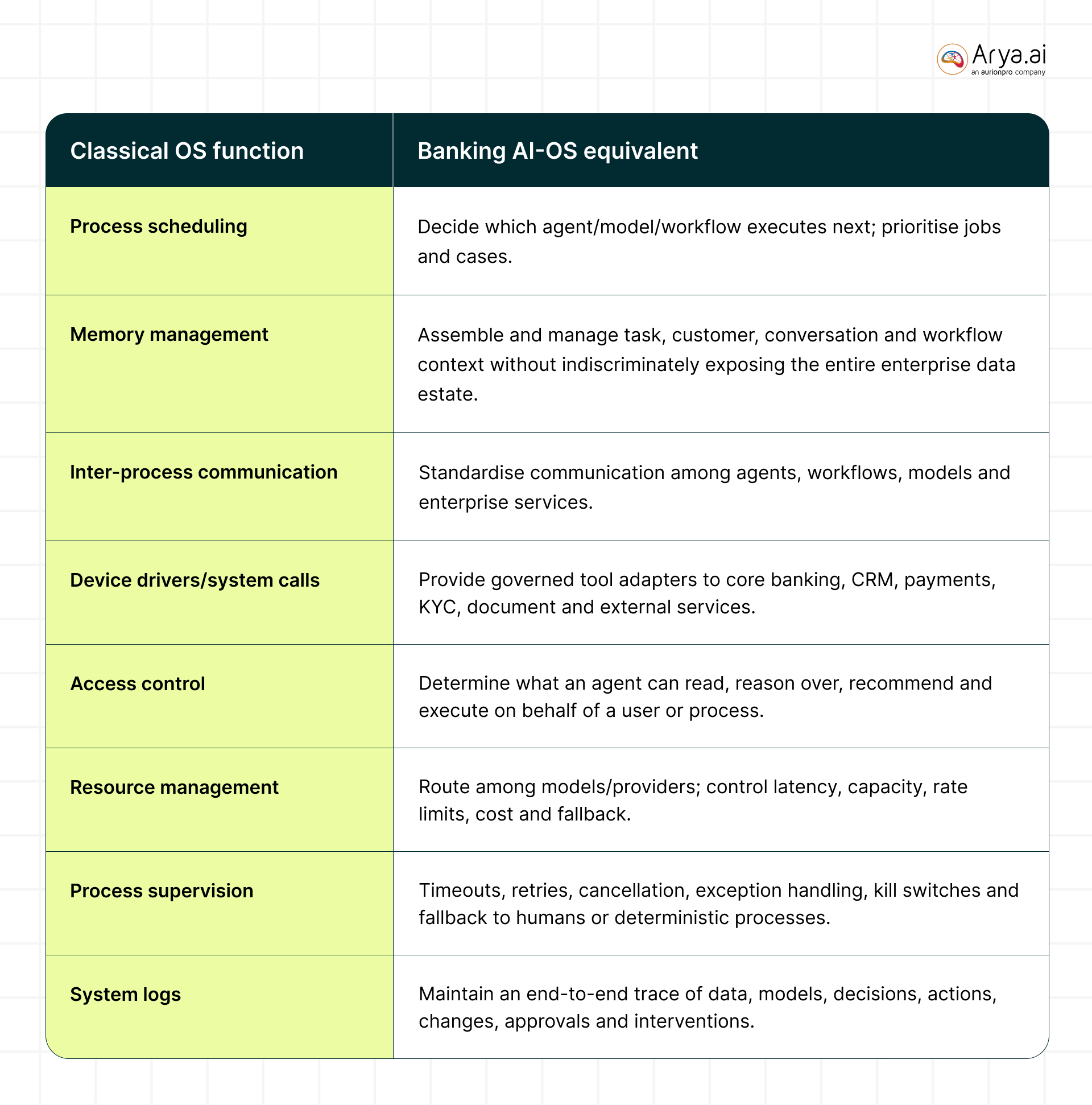
There is, however, one crucial difference from a traditional OS: the AI OS should not become the new system of record.
Customer balances should remain authoritative in the core banking or ledger system. CRM facts should remain governed by the appropriate customer system. Documents should remain in controlled content repositories. Risk and finance data should remain governed by their data platforms.
The AI OS assembles authorised context from those systems, carries workflow state and writes back through controlled interfaces. This distinction is essential because data governance is not solved merely by adding an orchestration layer.
The AI OS therefore does not eliminate the need for modern data architecture. It makes governed data reachability operational for AI.
Why isolated AI and APIs eventually hit a ceiling
Isolated AI is useful. The case for an OS layer should not be made by pretending otherwise.
For instance, a document-extraction model can reduce manual keying, or a transcription API can accelerate contact-centre work. The ceiling appears when the required outcome spans multiple decisions, systems and time horizons.
An API answers inference questions, but an OS answers coordination questions. This is why APIs and an AI OS are complements rather than substitutes. APIs are analogous to callable capabilities; the OS determines when, why, under whose authority and with what state those capabilities are used.
Local optimization versus workflow optimization
Suppose a loan process contains ten meaningful stages and AI improves document review at one stage by 80%. That can be valuable, but the end-to-end customer experience may remain largely unchanged if the application still waits in queues for policy checks, KYC review, risk assessment, missing-information follow-up, approvals, account creation and communication.
This is the difference between task productivity and workflow productivity.
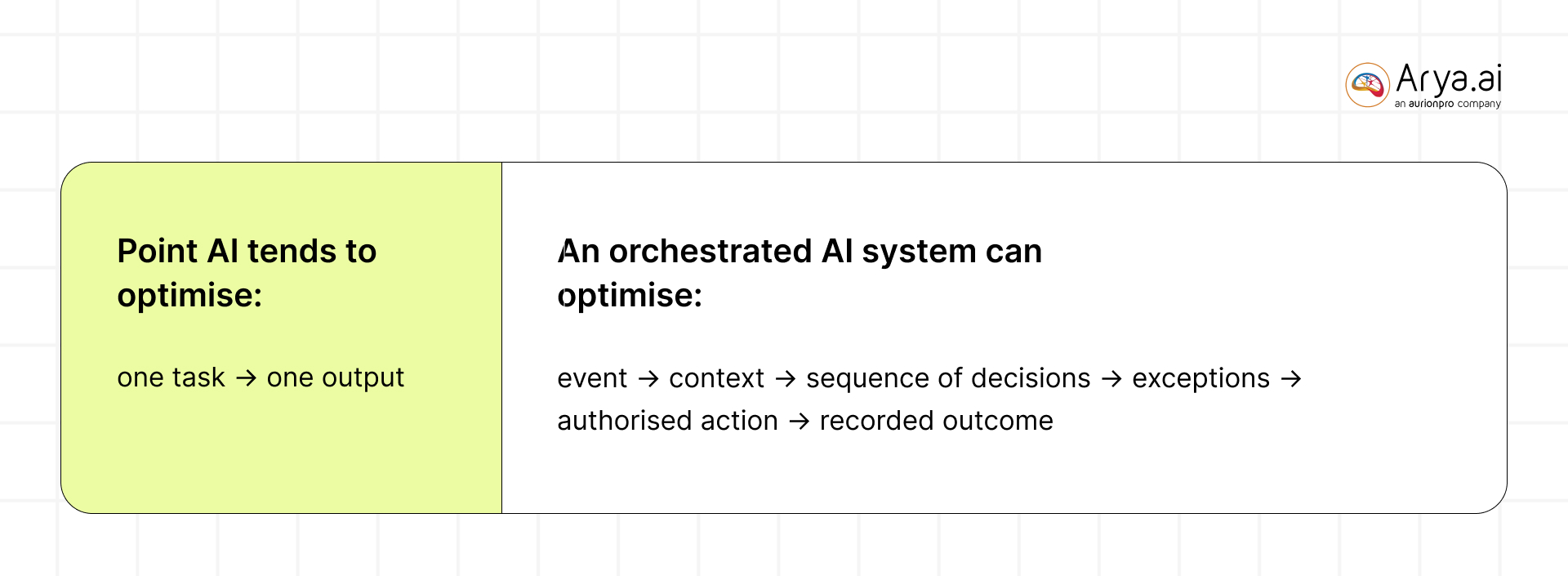
Stateless intelligence versus a stateful institution
Banking workflows persist for weeks. A business onboarding process may last for days, while an AM case can accumulate evidence over time. An institutional AI therefore needs more than conversation history; it needs a durable workflow state.
The relevant “memory” contains several different things:
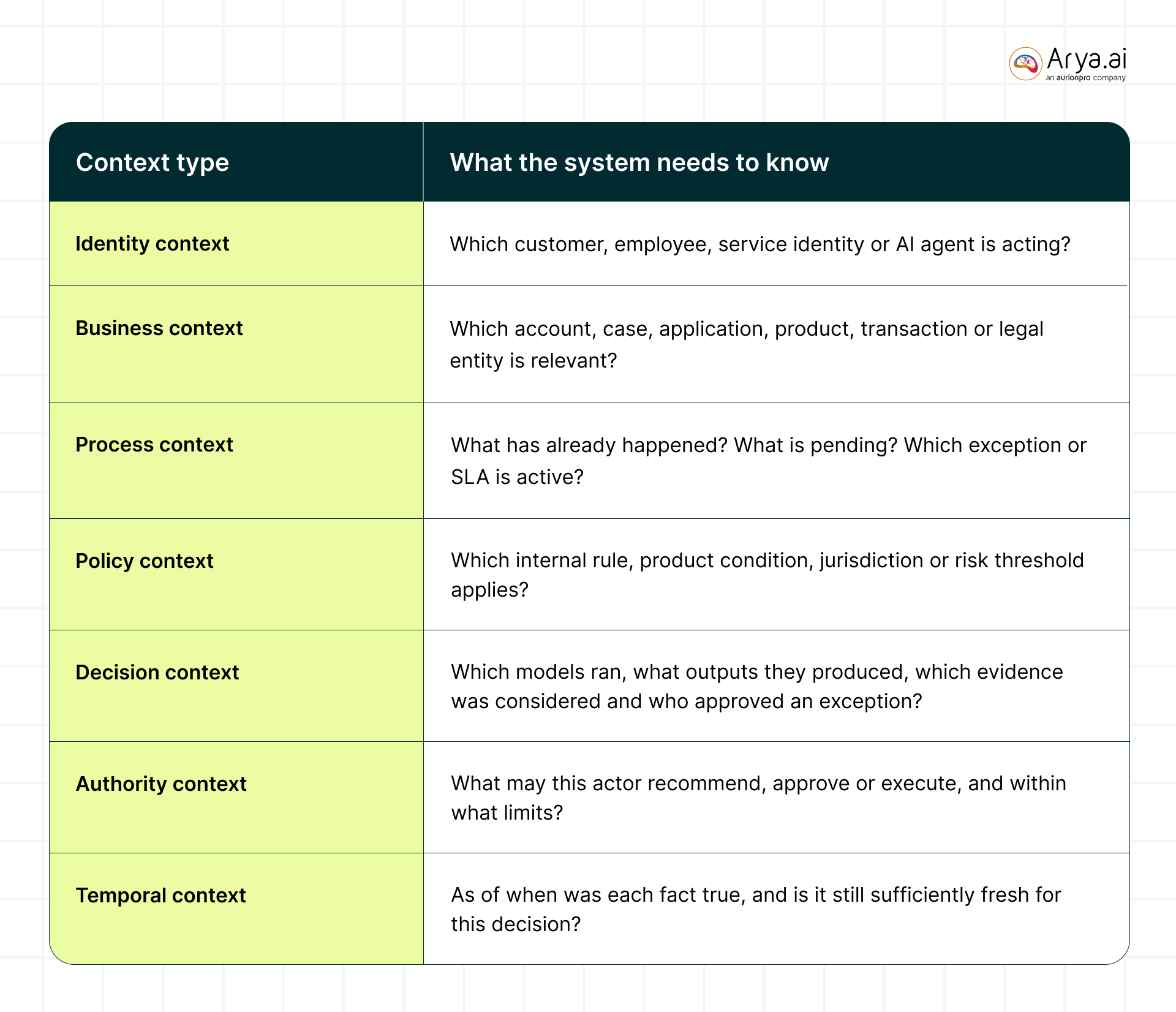
A crucial design principle follows: “shared memory” in a bank must not mean “make all data visible to every agent.” It should mean controlled retrieval of the minimum relevant context according to identity, purpose, policy and workflow state.
Why banking makes the OS layer particularly important
A financial institution faces an unusually strong combination of regulated decisions, monetary actions, sensitive information, third-party infrastructure and systemic consequences. That makes coordination failure materially different from a bad recommendation in a low-stakes consumer application.
A bank needs controlled context, not merely more context:
In banking, context has to be both reachable and governed. The same customer may exist across core banking, cards, CRM, lending, KYC, fraud, payments and document systems. AI OS determines which context this agent may use for this purpose at this point in this workflow.
A general-purpose LLM should therefore not be expected to infer institutional truth from a giant unfiltered retrieval corpus. The control plane should assemble an explicitly scoped context package — customer, case, applicable policy, entitlements, source provenance, timestamps and prior decisions — before the model reasons.
A bank needs an authority layer
Analysis and execution are different security domains. An agent might be sufficiently capable to conclude that a disputed transaction should be refunded. That does not mean it should possess unrestricted authority to move money.
A banking AI OS consequently needs to separate at least three concepts:
- Capability: what the model or agent can technically do.
- Entitlement: what data and tools the identity can access.
- Authority: what action it may legitimately execute in this specific case.
This keeps controls such as transaction limits, maker-checker rules, segregation of duties, human approval, customer consent, jurisdictional policy, and purpose restriction outside the model's discretionary reasoning.
A bank needs deterministic controls around probabilistic reasoning:
Many AI models are probabilistic; banking controls often cannot be. The model may be allowed to reason: “Which information should I inspect next?” But certain execution rules should remain deterministic: “No payment above this threshold can execute without the required authority.”
The model may draft a customer response. The policy engine should determine whether the communication can be sent.
A bank needs a complete decision trace
Logging only the model's final natural-language response is insufficient for many consequential processes. A bank may need to reconstruct how the information flows when a decision is being made.
Below is a reference architecture that entails the channels, experience layers, OS layers, and more. But, most importantly, it includes a decision traceability flow. As context graphs gain prevalence, we will have to add an additional step: how the decision was recorded.
What a banking AI OS must actually contain
A credible banking AI OS can be decomposed into five interconnected planes.
The context plane
This plane converts fragmented enterprise information into authorised, task-specific context. This is not necessarily one physical knowledge graph or database. Large financial institutions will usually retain multiple authoritative systems. The important architectural property is that agents receive a consistent semantic contract rather than each inventing its own interpretation of bank data.
The execution plane
This is the workflow engine for humans, agents and conventional systems. It should support event-driven and durable workflows, task scheduling, sequencing, parallel execution, waits, callbacks, state transitions, retries, idempotency, compensation and timeouts.
The authority plane
This is arguably the most important banking-specific addition. It should combine enterprise IAM with policy enforcement suitable for delegated AI action: The strongest design is deny by default, grant narrowly and evaluate at execution time. An agent can be given broad reasoning ability while receiving narrow transactional authority.
The intelligence plane
A bank is unlikely to have only one model. The intelligence plane therefore needs to abstract multiple models and model types behind governed interfaces. The routing decision might consider task, materiality, data sensitivity, jurisdiction, latency, cost, approved vendors and required explainability.
The assurance plane
The assurance plane makes the entire environment observable and governable. It should also support evaluation, anomaly detection, model/runtime monitoring, incident response, replay and controlled decommissioning.
Conclusion
In the simplest analogy, infrastructure is the machine. Models are the intelligence. Applications and agents are the workers. APIs are the callable interfaces. Core systems and data platforms hold institutional truth.
The AI OS supplies the shared memory, coordination, authority and supervision that lets all of them operate as one bank.
The architectural objective should therefore not be to put AI everywhere. It should be to make AI reachable enough to be useful, constrained enough to be safe, coordinated enough to complete workflows, and observable enough to remain accountable. That is why an AI operating layer becomes more valuable as models themselves become more capable.
Share this post


Table of contents
Low-Code AI Automation Starts Here – Try Arya Apex


.png)




.png)
.png)
.svg)


