


.png)

Experimenting with Gen AI models is well underway in financial institutions. The results, however, haven’t echoed the gusto with which leaders approached GenAI pilots.
Studies, too, state that enterprises haven’t extracted tangible value out of Enterprise projects. In our article, “Adoption High, Transformation Low: What Does This Tell Us About Gen AI in Enterprises?”, we’ve explicitly discussed why enterprises are still unable to extract value out of GenAI.
The fact remains that general-purpose models don’t truly understand the context in which enterprises operate. There are entities, decisions, exception rules, ideas inside people’s heads, etc. A general-purpose model that has no understanding of this cannot deliver the results leaders expect.
Knowledge graphs can possibly solve the relationship between entities and systems by establishing a node-based relationship between them. This gives LLMs the route and an understanding of what goes where and who owns what. But what about the decisions? This is the problem that context graphs can solve.
What Is A Context Graph?
A context graph is the next evolutionary step beyond a knowledge graph. Where a knowledge graph maps entities and their relationships, a context graph enriches that structure with the full operational layer:
- When things happened
- Why decisions were made
- How confident are we in the data
- Who verified it
Think of it in three layers:
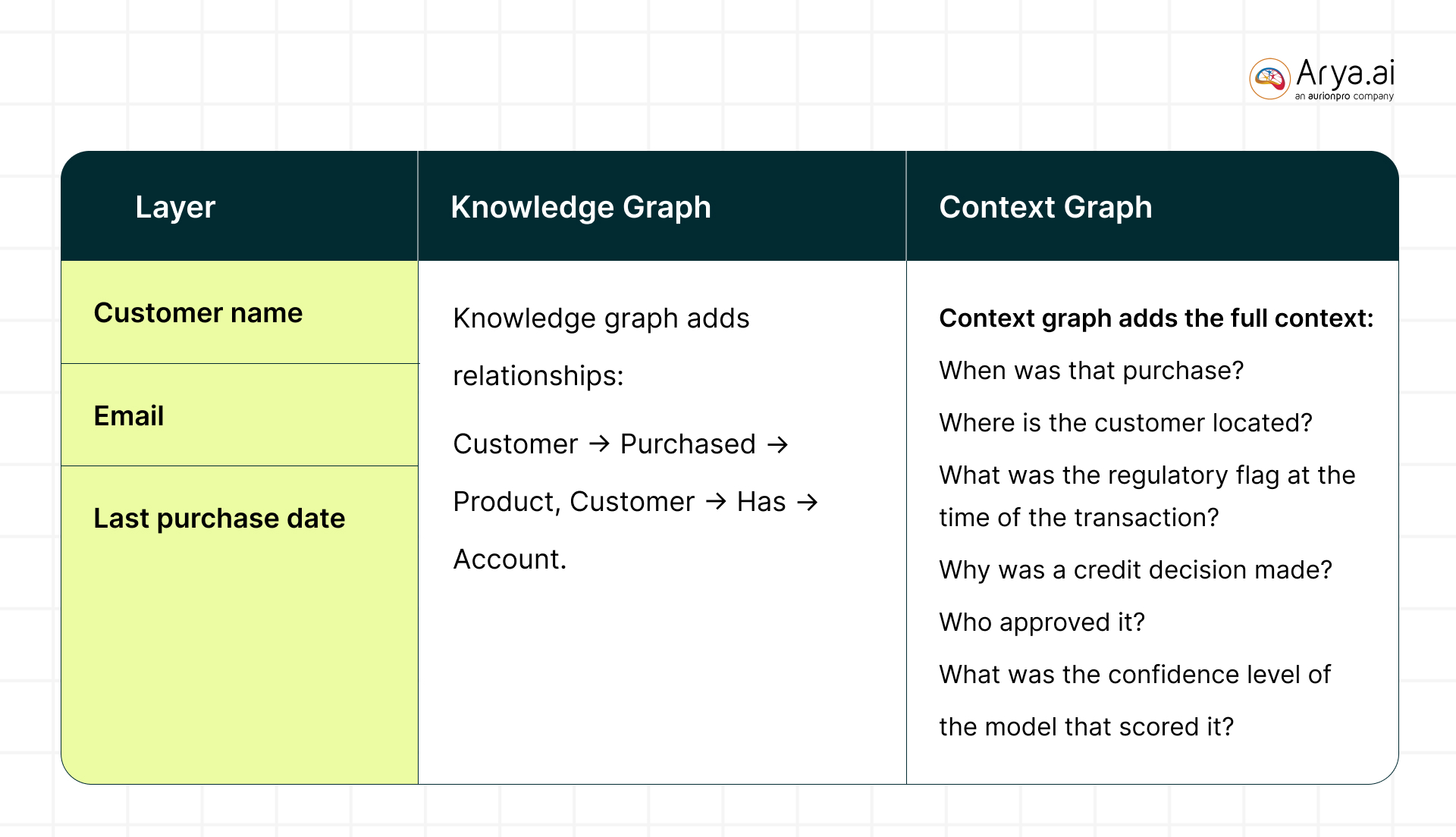
In technical terms, context graphs are triple-based knowledge representations (subject–predicate–object) that are purpose-engineered for consumption by AI systems and autonomous agents. Unlike traditional knowledge graphs optimized for human browsing, context graphs are designed to be token-efficient, hallucination-resistant, and queryable by language models in real time.
The defining characteristics of a context graph are:
- Temporal awareness: Relationships have validity periods; data is versioned over time.
- Decision traces: Every consequential action is linked to the reasoning and evidence that drove it.
- Provenance metadata: Every data point carries a record of its origin, transformation history, and verification chain.
- Governance policies: Rules about data access, sensitivity, and regulatory handling are embedded directly into the graph.
- Operational signals: The graph reflects how data is actually used, not just how it is defined.
Foundation Capital has described context graphs as potentially "the single most valuable asset for companies in the era of AI." Calling it a trillion-dollar opportunity is truly valid, as the graph illustrates how an institution thinks and decides.
Why Financial Institutions Are The Perfect Host For Context Graphs
Banks, insurers, and capital markets firms sit on extraordinarily rich relational data. Yet most of it is locked in siloed systems that prevent any single view of risk, customer, or counterparty. Financial institutions are precisely the environment where context graphs unlock the most value, for several compounding reasons:
The data is inherently graph-shaped.
Money flows in networks. Customers belong to households, businesses, and ownership chains. Transactions connect accounts, merchants, and geographies. Beneficial ownership structures are recursive. Context graphs are the natural representation for all of this — far more so than flat tables or document stores.
Regulatory obligations demand context.
Compliance is about proving why a decision was made, when you knew something, and how you responded. Context graphs embed the audit trail directly into the data structure, making explainability a structural property rather than an afterthought.
AI adoption is accelerating, and context is the bottleneck.
Large language models are increasingly being used for summarization, customer service, document processing, and decision support. But LLMs hallucinate and fail at multi-hop reasoning without grounding. Context graphs provide that grounding: a structured, verifiable substrate that AI agents can query to reason accurately about complex financial situations.
Key Opportunity Areas For Context Graph In Financial Institutions
Let’s address the areas where context graphs can have the greatest impact:
Fraud Detection and Financial Crime
Fraud schemes exploit network relationships, such as shell companies, mule accounts, synthetic identities, and layered transactions. Traditional rule-based systems detect linear patterns. On the other hand, context graphs detect structural anomalies: rings of connected accounts, unusual timing patterns across entity clusters, and beneficial ownership chains that converge suspiciously.
Graph Neural Networks (GNNs), treating accounts as nodes and transactions as edges, consistently outperform classical methods on complex fraud typologies. And critically, context graphs provide the temporal trace, like how the network evolved, which is essential for proving prosecutable cases.
The convergence of fraud and AML onto unified graph platforms is already happening. Institutions that centralize monitoring across all interaction channels, with a shared graph of entities and relationships, catch fraud that siloed teams miss.
Credit Risk and Customer Intelligence
Context graphs can build richer customer profiles by integrating data from payment histories, employment records, spending behavior, social and business relationships, and even macroeconomic signals. These can not only be linked but also versioned over time. This can make credit risk assessment a dynamic relationship-aware model.
Not just for retail customers, this is true for corporations, too. For corporate banking, context graphs can map supply chain relationships, ownership structures, and counterparty exposures. A systemic view of the corporate allows credit officers to get the holistic picture, and not just individual borrower risk.
AI-Powered Customer Service and Personalization
What used to be a simple information retrieval mechanism via rule-based chatbots can be enriched with context graphs. A customer looking to deep dive into their loan status can find a full history of the loan product, service interaction, risk profile, regulatory context, relationship managers' history, and so on.
Be it a chatbot or anything else, context graphs are the memory layer that not only makes agents more reliable but also provides a better experience to the customer. At any given point in time, customers can get structured and verifiable knowledge.
Regulatory Reporting and Explainability
Financial institutions are reluctant to use AI systems whose reasoning is opaque to their users due to regulatory pressure and sensitive customer data in question. Context graphs embed the chain of evidence and reasoning that led to an outcome directly into the data structure.
This transforms explainability from a manual reconstruction exercise into a live query. For regulatory reporting (CCAR, DFAST, Basel IV capital calculations, IFRS 9 provisioning), context graphs enable institutions to trace the lineage of every figure in a return back to its source.
Agentic Workflow Automation
Agentic AI has been described as the next big transformation in the banking and financial services sector. Autonomous finance will be the one where systems gather evidence, draft case files, validate decisions, and escalate exceptions with minimal human intervention.
Context graphs are the substrate these agents operate on. Without a rich, queryable context layer, agents cannot reason reliably about complex, multi-entity situations. Early deployments of agent-based KYC and AML workflows have shown dramatic reductions in onboarding cycle times while preserving the auditability that regulators require.
The Strategic Case: From Cost Centre To Competitive Advantage
Automation without intelligence can only work in certain segments of operations in any enterprise. Compliance, risk, and fraud are some of the most crucial levers for financial institutions, and these levers require intelligent automation.
Institutions that invest in context graph infrastructure are discovering that the same technology that reduces regulatory exposure also accelerates revenue. Context graphs can help make better credit decisions, lower fraud losses, faster onboarding, and more personalised service.
Foundation Capital estimates context graphs represent a trillion-dollar opportunity at the enterprise level. For financial services specifically, the value drivers are:
- Reduced fraud and AML losses: Graph-based detection closes the gaps that siloed systems leave open.
- Lower false positive rates: Smarter entity resolution reduces the operational cost of investigations.
- Faster regulatory response: Embedded decision traces and provenance reduce the cost of responding to supervisory requests.
- Better AI outcomes: Gounded, context-aware AI agents outperform ungrounded LLMs on every financial task that requires precision.
- Institutional knowledge preservation: Context graphs capture why decisions were made, not just what the outcome was. This is an organisation's accumulated intelligence, made queryable.
What Stands In The Way
There are three main challenges:
- Most banks have legacy systems that were never designed to emit structured, graph-compatible data.
- Data quality problems compound because building a context graph requires significant investment in data engineering, entity resolution, and governance.
- Context graphs require teams to share a common model of their entities and relationships, which cuts across traditional departmental boundaries.
But these are not novel problems. They are the same data modernization challenges banks have been working on for years. The difference now is that context graphs provide a destination that is explicitly optimized for the AI-native future.
Conclusion
Context graphs represent a structural shift in how financial institutions can represent, reason about, and act on their data. For financial institutions, the timing is right, and the competitive gap between institutions that can operate with full contextual intelligence and those that cannot is widening.
The institutions that build context graph infrastructure now will have a decisive advantage: not just in the specific use cases they deploy first, but in their ability to compound that advantage as every new AI capability they adopt has a rich, structured, trustworthy substrate to operate on.
Share this post


Table of contents
Low-Code AI Automation Starts Here – Try Arya Apex


.png)




.png)
.png)
.svg)


