Walk down any UK high street, and you will pass independent grocers, family-run bakeries, barber shops with three chairs, and hardware shops that have served the same postcode for generations. These businesses hold the local economies together.
So when one of them needs a few thousand pounds to replace a broken chiller or cover a slow winter, the speed and fairness of that credit decision matters enormously. But the decision lands the wrong way for many of these businesses.
The shape of the problem
The numbers tell a great deal about the problem:
Loan rejection is growing
The UK government's small business access to finance review discovers that loan success rates for firms applying for bank finance now sit below 50% on average, down from around 67% just before the pandemic. Allica Bank’s Rebooting SME Finance research puts the shift in sharper historical terms: SME loan rejections have risen from somewhere between 5 and 10% three decades ago to roughly 40% today.
SME confidence is draining
Rejection is only part of the story. Confidence has drained away too. According to figures cited in the government review, only 34% of small businesses planning to apply for finance are confident their bank will agree to it, down from 56% in 2019.
That collapse in expectation feeds a well-documented behaviour that economists call the discouraged borrower. Research on UK firms found that 72% of businesses previously rejected for a loan were reluctant to apply again, even when generous government-backed schemes were available. A firm that stops asking never appears in any rejection statistic, which means the true gap is wider than the approval data suggests.
Access to finance is a direct barrier to growth
British Business Bank points out that roughly 700,000 small businesses have cited access to finance as a major barrier to growth. Allica's estimate of the structural credit gap that has built up since the financial crisis reaches as high as 65 billion pounds.
Whichever figure you favour, a large and creditworthy slice of the small business population is going unserved.
Why are the smallest loans the hardest to make
Responsible Finance's analysis of unmet demand found that more than 97% of small businesses with unmet finance needs are seeking loans below 100,000 pounds, and many need considerably less. Instead of being relatively easier, these figures make the requests uneconomic under traditional processes.
Serving smaller loans is a cost issue
The cost of assessing a loan application, pulling documents, checking accounts, verifying identity, and forming a credit judgment is broadly the same whether the loan is for 15,000 pounds or 150,000 pounds.
When the manual cost to serve is fixed, lenders quite rationally chase the larger tickets where the margin justifies the effort. The small loan gets deprioritised simply because of the economics of manual assessment don't work.

Two further barriers stack on top of this.
- A thin credit history: A sole trader or a young shop often has little of the formal credit footprint that scorecards were built to read. Seen through a traditional bureau lens, the business is close to invisible, and invisibility reads as risk.
- Automated rejections: Mainstream lenders automatically reject such requests, driven by rigid rules around credit scores and minimum trading histories. A viable business with an unusual shape gets filtered out at the gate.
This is the trap. The businesses that most need small, fast, short-term credit are precisely the ones the old model finds least profitable and hardest to read.
Who is already stepping in
Challenger banks
The British Business Bank's Small Business Finance Markets 2025/26 report found that gross bank lending to SMEs rose 9% to 68 billion pounds in 2025. Challenger and specialist banks accounted for 60% of SME lending, up from 39% in 2012.
Non-banking lenders
Widen the lens to include non-bank lenders, and more than two-thirds of overall SME lending now comes from outside the traditional banks.
Community development financial institutions:
Community development finance institutions, or CDFIs, are also clear proof that underserved businesses are fundable. CDFIs are mission-driven lenders that deliberately take on the applicants that mainstream finance turns away.
Responsible Finance reports that 99% of the small businesses CDFIs lend to had previously been declined by another lender. Around half of that lending goes to the most deprived parts of the country, and the typical loan sizes, from roughly 1,000 to 250,000 pounds, map exactly onto the small-ticket demand described above.
AI looped in to fix the slow process:
The catch is capacity. Relationship lending is human, careful, and slow, and CDFIs run lean. The same fixed cost-to-serve problem that pushes big banks away from small loans presses hardest on the very lenders whose entire purpose is to make them.
It is telling that the sector's recent capacity-building programme, backed by Lloyds and the government, explicitly earmarks grants for CDFIs to invest in AI to streamline and speed up their application processes. The people closest to these businesses know exactly where the bottleneck is.
What changed: turning invisible businesses visible

The single biggest enabler of a better model is data that small businesses already generate every day. The UK's Open Banking framework, which lets a business share its current-account transaction data securely and with explicit consent, has become key infrastructure.
In fact, Open Banking now delivers around 1.6 billion pounds in annual benefit to UK SMEs, and identifies up to a further 570 million pounds a year in economic opportunity tied specifically to better use of real-time data in lending decisions.
This matters because transaction data answers the question a thin credit file cannot. A bureau score largely measures a borrower's past willingness to pay. Cash-flow data measures present ability to pay: the rhythm of takings, the seasonality, the regular outgoings, the resilience of the balance after wages and suppliers are paid. It also surfaces stress earlier, since a dip in income or balance often shows up weeks before it would ever register as a missed payment at a credit bureau.
Specialist lenders have built real businesses on exactly this. iwoca assesses small firms by analysing up to 90 days of bank-account transactions, making previously invisible businesses fundable. The raw material for a fairer, faster decision is already sitting in the applicant's account, waiting to be read.
Where AI earns its place: the lean-team multiplier
Data alone does not solve the capacity problem. Ninety days of transactions is a lot to read by hand, and reading it manually simply moves the bottleneck rather than removing it. This is where AI does its most useful work, and it is worth being precise about what that work is.
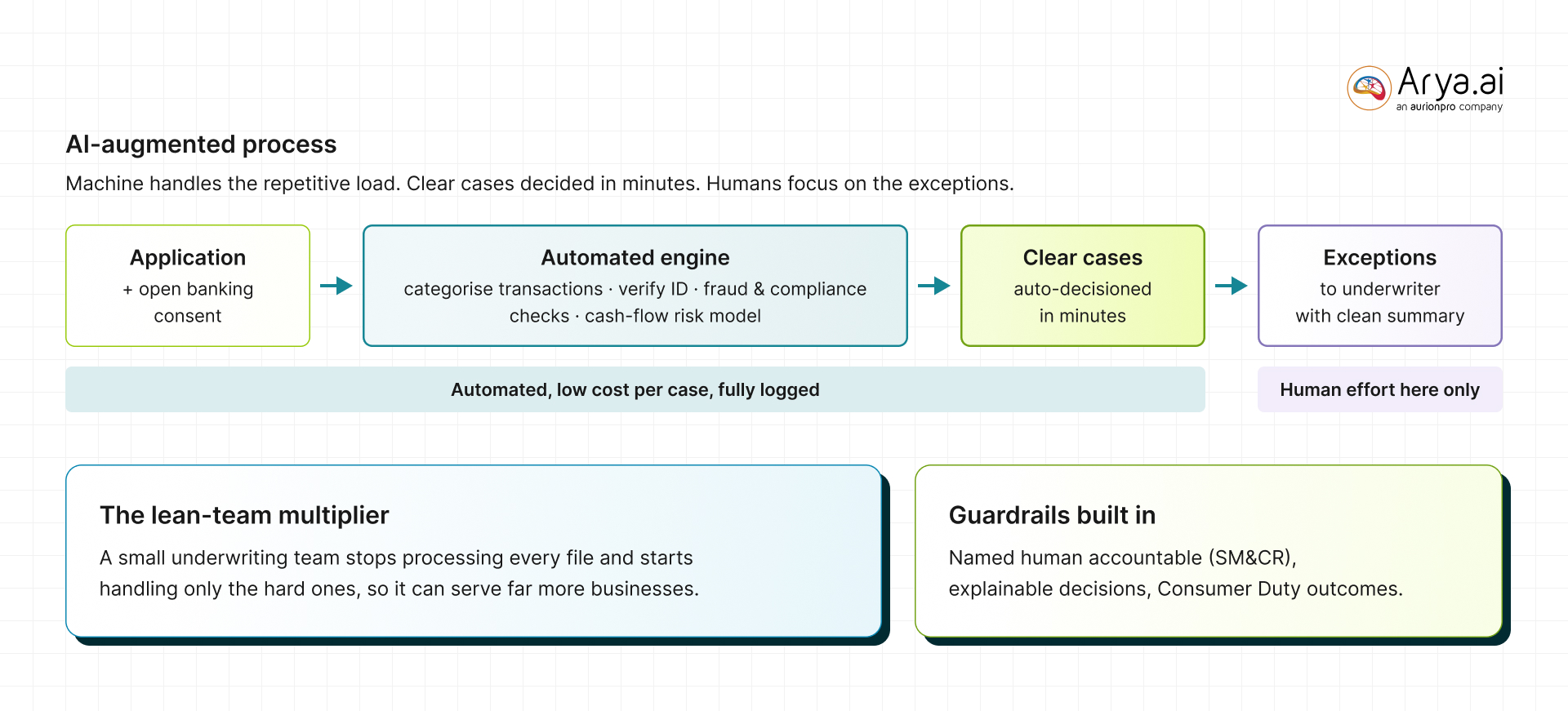
The point of automation here is not to replace the underwriter's judgment. It is to remove the repetitive load that consumes an underwriter's day so that judgment can be spent where it counts. In a well-designed workflow, the machine ingests the open banking feed, categorises every transaction, verifies identity and income, checks the business against fraud and compliance signals, and produces a structured cash-flow picture with a risk assessment attached.
CredAI, our AI credit underwriting suite, automates the assembly work that sits underneath every small-business decision. It reads the documents an applicant uploads, from bank statements to certificates of incorporation, and extracts what an underwriter would otherwise key in by hand. It pulls company records from Companies House, screens applicants against sanctions lists, and fetches borrower credit data from Experian.
What it deliberately leaves alone is the decision. The underwriter still makes the call, now working from a clean, verified picture rather than a stack of PDFs. With the gathering and sorting done in the background, the human judgment that lenders and regulators require is reached faster. For a lean team serving high-street firms, that turns a backlog of small applications into decisions.
A multiplier, not a headcount cut
Automation multiplies a lean team rather than shrinking it. If the fixed manual cost of assessing a small loan is what made it uneconomic, collapsing that cost makes the small loan viable again.
A five-person underwriting team that could only process the applications in front of it can now say yes to many more of the businesses it was always meant to serve.
For a challenger bank chasing growth, that is a competitive edge. For a CDFI whose mission is capped by its capacity, it is closer to a lifeline.
Doing it within the guardrails
None of this works if it trades one problem for another. Faster decisions built on opaque models would simply relocate unfairness, and regulators have been clear about the bar.
UK: existing rules already apply
The Financial Conduct Authority has chosen not to write AI-specific rules, holding that its existing frameworks already apply. In practice, that means two things:
- Consumer Duty: Firms must deliver fair value and avoid foreseeable harm.
- Senior Managers and Certification Regime: A named human stays accountable for outcomes. Handing a decision to an algorithm does not dilute a manager's liability, and "the model decided" is not an acceptable explanation.
The FCA and the Information Commissioner's Office announced in 2025 that they would develop a joint code of practice for automated decision-making, with explainability at its centre.
EU: credit scoring is high-risk
Under the EU AI Act, credit scoring is classed as high-risk, carrying obligations around documentation, decision logging and human oversight. The EU's Digital Omnibus on AI pushed those obligations from August 2026 to December 2027. UK lenders serving European customers, or simply planning ahead, should build to that standard now.
Automation strengthens the audit trail
For lenders, this is encouraging rather than restrictive. Done well, automated cash-flow underwriting improves auditability, because every factor in a decision is logged and every case can be reconstructed. In a manual process, that reasoning lives in an underwriter's head.
The discipline lies in the design:
- Accountability: Keep a named human responsible for every decision.
- Fairness: Test models for bias.
- Explainability: Make each decision explainable to the business that received it.
- Monitoring: Track outcomes continuously instead of sampling a handful of files after the fact.
A practical view
The high-street credit gap has never been a gap in demand or in willing lenders. It has been a gap in economics. The businesses were fundable, and the sums were modest. What stood in the way was the cost of reading a small, thinly documented business quickly enough to say yes at a price that made sense.
That obstacle is now removable. Open banking makes the small business legible, and AI makes reading it affordable at scale. A lean underwriting team can serve a far larger book without sacrificing care or compliance.
The lenders best placed to seize this are the ones already leaning toward these firms: challenger banks taking share year after year, and CDFIs whose purpose is to fund the businesses others decline.
The high street has spent a long time being told, quietly and at the gate, that its numbers do not add up. With the right data and the right tools, they finally do.
Share this post


Table of contents
Low-Code AI Automation Starts Here – Try Arya Apex