The lending industry celebrates the 2.6-day average disbursement window, but getting to a ‘yes’ isn’t the most difficult part. It happens once the money goes out the door, and a strange institutional quiet sets in. That quiet is where the losses live.
A loan that was sound at origination can deteriorate for months before anyone notices. A borrower can stay current on every payment while their business hollows out. By the time a loan is classified as non-performing, typically after 90 days of missed payments, the window for a low-cost intervention has usually closed.
For alternative lenders and SME bankers, this is the uncomfortable truth that rarely makes the pitch deck: underwriting controls who you let in, but portfolio management controls what you lose. And post-disbursement monitoring is still the weakest, most manual part of the lending lifecycle.
Why the post-approval phase is where SME portfolios break
SMEs run lean by design, and that agility is often their edge. But leaner cash buffers and more concentrated customer bases also mean that shocks outside their control, such as a tariff change or a dip in demand, reach them sooner than they reach large corporates. Through 2025, defaults among small businesses rose in the United States as new tariffs compressed margins, while net interest margins for community and regional banks drifted toward 3% and below.
SME deterioration is rarely a single dramatic event. It is a slow accumulation of weak signals: softening monthly receipts, stretched payables, a dip in debt-service coverage, a delayed filing. Under IFRS 9 (the international accounting standard for financial instruments), this is the migration that matters: the slide from Stage 1 to a Stage 2 "significant increase in credit risk" happens long before Stage 3 impairment. European supervisors generally treat an NPL ratio above 5% as a warning line; in the US, well-run banks sit between 0.5% and 2%. Whether a portfolio stays in that band is decided less at underwriting than by how quickly the lender sees stress coming.
The traditional monitoring toolkit is built to look backwards. Periodic credit reviews are snapshots assembled from data that is already weeks or months stale. Spreadsheets track covenant dates, relationship managers watch the few accounts they know well, and origination scores quietly age into irrelevance. By the time a review flags a problem, the lender is managing a workout rather than preventing one.
That lag is the core defect, and it is expensive. Reactive monitoring raises write-offs, diverts capital into loan-loss provisions, and constrains new lending. A bank with a $2 billion book that lets its NPL ratio drift up by just half a percentage point can add tens of millions in non-performing assets, and the provisioning hit that comes with it.
What AI actually changes after the loan is live
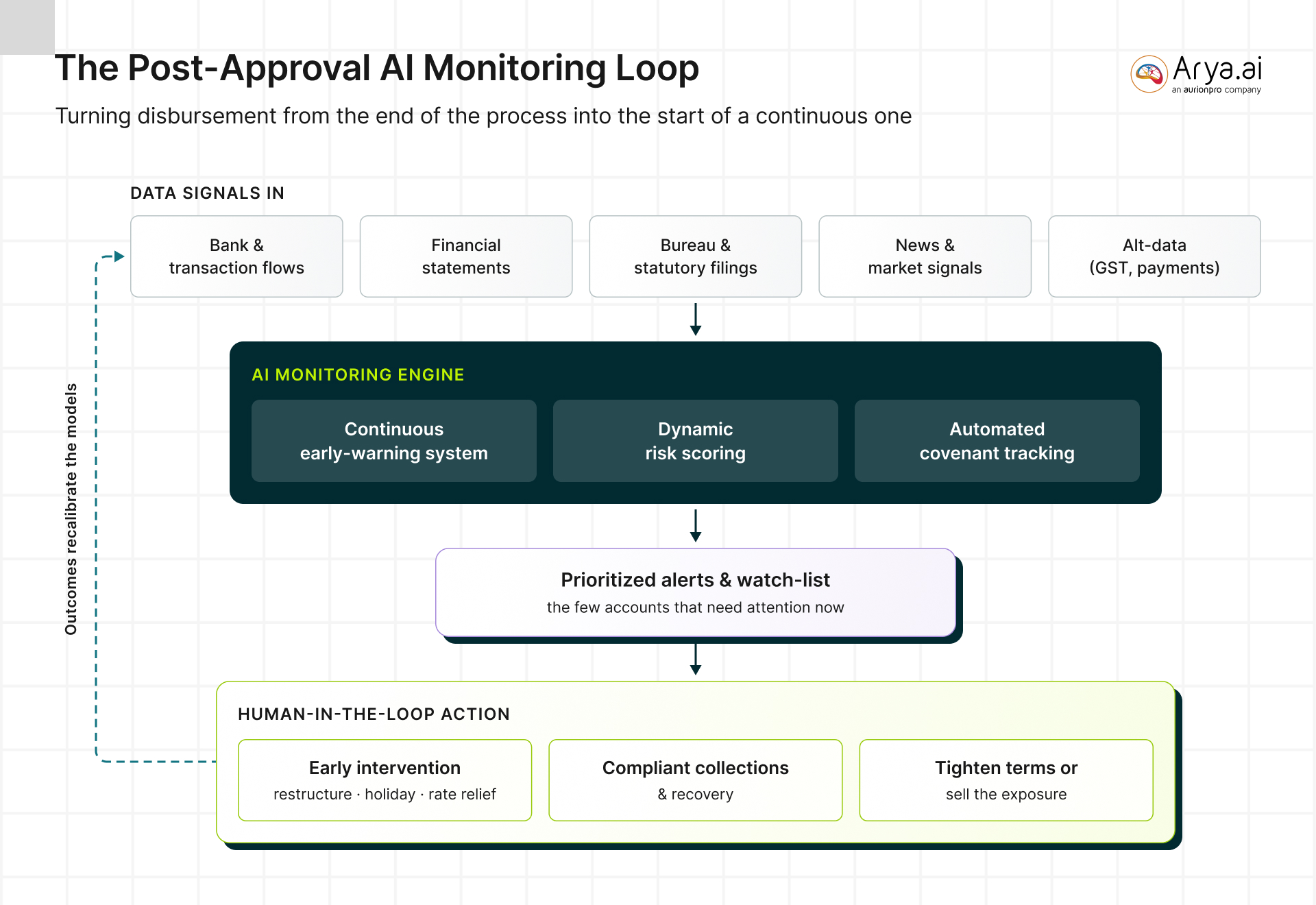
This is where AI is delivering some of its clearest returns. Instead of a reactive approach, AI continuously monitors a portfolio and catches deterioration before it gets out of control.
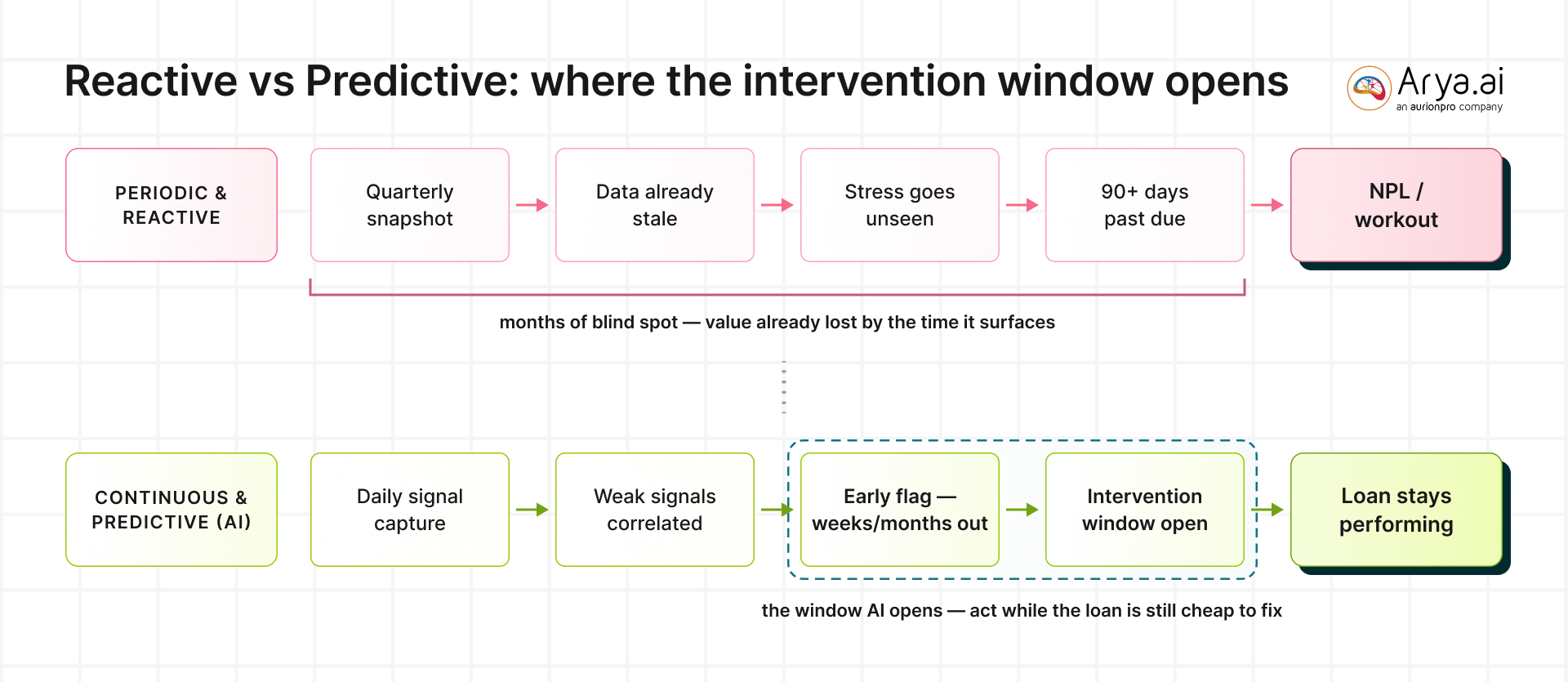
A few capabilities map directly onto where SME portfolios break.
Continuous early warning systems
Machine-learning early warning systems (EWS) monitor account behaviour, financial statements, transaction flows, and external feeds such as news, filings, and bureau data. The advantage is correlation. An AI system can flag the borrower who still pays on time but shows declining revenue, management turnover, and delayed filings, a pattern single-metric monitoring misses because the payments look fine. Weighing weak signals together surfaces deterioration weeks or months earlier and separates a liquidity wobble from genuine insolvency.
Dynamic, always-on risk scoring
A static origination score is a photograph; an AI-driven risk profile is a live feed, rebuilt as ratios, receivable days, cash-flow trends, and bureau patterns change. For alternative lenders working with thin-file SMEs, this ongoing behavioural profile is often more predictive than anything available at underwriting.
Covenant monitoring without the paper chase
A loan agreement is a set of continuous promises: keep DSCR above a threshold, LTV under a ceiling, statements on time. Break one and a borrower is in technical default without ever missing a payment. Because tests run on trailing data, a single bad quarter can breach a covenant before the spreadsheet is updated. Consider a borrower with a 1.25x DSCR covenant whose income dips after a soft leasing quarter and a large repair. An AI monitoring system flags the trend two months before the test date, while the ratio is still at 1.24x and falling.
Smarter, more compliant collections
When stress turns into delinquency, AI reshapes recovery too. Traditional collections is wildly inconsistent: some teams recover 35% of an assigned portfolio while others manage 15%. AI platforms prioritise accounts by likelihood of recovery, choose channel and timing, and predict which treatment works best, whether a payment holiday, a restructure, or a settlement. They also enforce contact-frequency limits across every channel, which no human call centre can reliably police.
Proactive intervention, not just detection
Seeing trouble early matters only if the lender acts while value remains: a restructuring, a temporary rate cut, a payment holiday, tighter terms, or a sale of the exposure before default crystallises. Detection without a workflow is just a more expensive way to be surprised.
The regional picture: same problem, different rulebook
The challenge is universal, but the regulatory framing varies by market.
In the United States, the pressure is commercial. Community banks, which issued roughly 38% of SME credit in 2025, face compressed margins and rising defaults at once. AI here is a margin-defence play: it catches deterioration before charge-offs that thin margins cannot absorb.
Across the UK and Europe, the emphasis is supervisory. The European Banking Authority has pushed institutions toward maintaining and regularly evaluating early warning indicators, and IFRS 9 effectively requires lenders to detect "significant increases in credit risk" before impairment. Headline NPL ratios look benign, but supervisors and rating agencies warn that Stage 2 migrations reveal stress the lagging ratios hide. Explainable, auditable AI monitoring is becoming a compliance expectation.
In India, the dynamic is volume, velocity, and conduct. NBFCs and banks face rising SME delinquencies, and the Reserve Bank of India has tightened expectations on early warning frameworks and collections conduct, including limits on contact frequency (commonly two to three attempts per borrower per day), cooling-off periods, and bans on contacting unauthorised third parties. AI does double duty here: it spots deterioration in fast-moving digital portfolios and enforces conduct rules more consistently than distributed human teams.
Doing this well: the parts the vendors won't put on a slide
Institutions that get durable value get four unglamorous things right.
- Explainability is non-negotiable: A risk manager must be able to tell the credit committee, the auditor, and the regulator why a borrower was flagged. Black-box scores create governance risk that outweighs their predictive edge; every alert should be traceable under Basel, IFRS 9, and local central-bank norms.
- The system is only as good as its data plumbing: Continuous monitoring depends on clean feeds: loan ledgers, bank-transaction data, bureau pulls, statutory filings, and in many markets GST or digital-payment data. A real-time system fed stale data is worse than an honest quarterly review, because it manufactures false confidence.
- Keep a human in the loop where it counts: AI is exceptional at surfacing the twenty accounts out of two thousand that need attention this week. It should not decide alone whether to restructure a fifteen-year banking relationship. Done right, it reallocates human judgment rather than replacing it.
- Beware the false-positive tax: Early systems drowned teams in alerts, and credible deployments now report cutting false positives substantially, though those numbers are typically vendor-reported. An alert system that cries wolf gets ignored, and an ignored system is worse than none.
The reframe
SME lending has long treated the loan decision as the moment of truth and everything after it as administration. That framing is increasingly indefensible. With thin margins, rising defaults, and supervisors expecting forward-looking risk detection, the winners will pour as much rigour into the years after disbursement as they now pour into the minutes before it.
AI is what makes that economically feasible. It watches every account every day, flags trouble while it is still cheap to fix, and hands human experts a prioritised list instead of a haystack.
The problem with SME lending doesn't end at approval. The good news is that, for the first time, neither does the lender's ability to see and shape what happens next.
Share this post


Table of contents
Low-Code AI Automation Starts Here – Try Arya Apex