What takes up most of a credit underwriter's time?

- Most elapsed time labelled "underwriting" is preparation work: extracting data, reconciling it across documents and chasing what is missing. Judgment is the last and shortest stretch.
- Lenders already say so. In a 2025 survey of 350 US and UK lending executives, inaccurate or incomplete applicant data was the most cited barrier to assessing small businesses (PYMNTS Intelligence).
- Credit memo work can absorb up to 40% of a corporate relationship manager's time, according to DBS.
- Hiring more underwriters adds capacity to the wrong layer. Preparing the file before it reaches a human shortens decisions without touching who makes them.
- Regulators in the EU and India expect verified information and accountable human decisions. Automating assembly fits that expectation. Automating judgment does not.
Ask a lending operations leader why decisions take too long, and the answer usually points at credit. The queue sits with underwriting. The SLA breach is logged against underwriting. The hiring request comes from underwriting.
The diagnosis is understandable. It is also mostly wrong.
When you follow a file through its life, the underwriter's actual judgment is a small part of the elapsed time. The larger part goes into getting the file into a state where judgment is possible. Someone has to pull figures out of PDFs. Someone has to make those figures agree with each other. Someone has to ask the borrower for the page, signature or explanation that is missing, and then wait.
That work is real, and it matters. It is just a different job from underwriting. Treating the two as one is why so many turnaround programmes disappoint.
What does "underwriting time" actually measure?
Most loan origination dashboards measure the span between "application received" and "credit decision". Everything inside that span gets attributed to the credit function. The underwriter becomes the visible bottleneck because the file is sitting in their queue.
Look inside the span, and four kinds of work appear before any credit judgment happens.
What gets recorded as underwriting time: intake, extraction, reconciliation and document chasing come before judgment and decision.
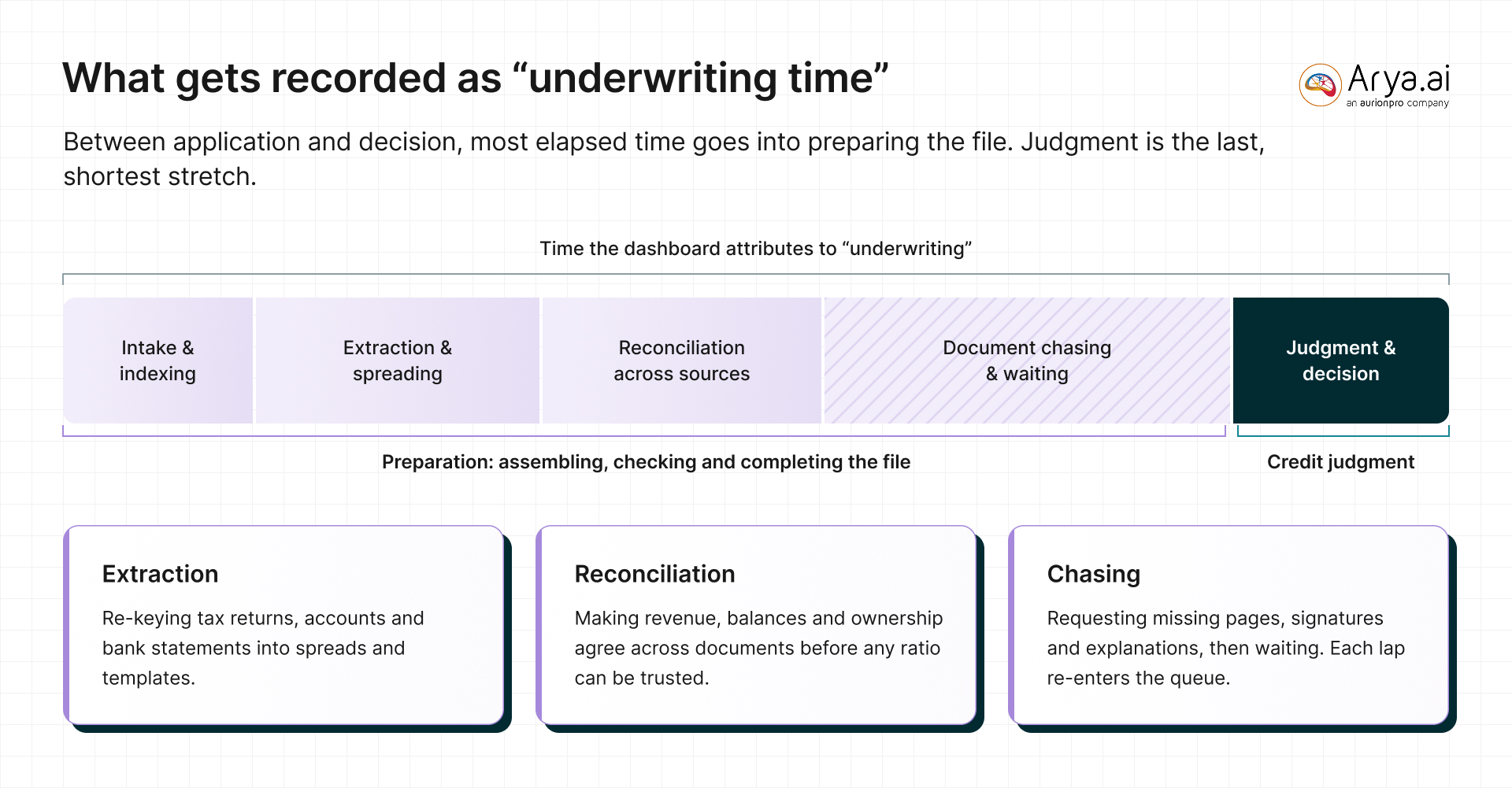
McKinsey's survey of senior credit risk executives at 24 institutions, including nine of the ten largest US banks, describes the same picture in commercial banking. The first line spends significant time collecting information, running analyses and writing memos before a credit decision. The use cases those executives prioritised are revealing. They include reviewing documents for missing data, drafting requests to customers for clarification and compiling information into memo sections. Every one of those is preparation.
Banks are starting to put numbers on it. When DBS rolled out an agentic credit memo tool to around 1,500 relationship and credit risk managers in August 2026, it said memo preparation and related credit activities can take up to 40% of a relationship manager's time. The bank set a target of cutting that time by at least 30%. That is a target rather than a measured result, and independent commentary has made the same point. The baseline is still telling. At the upper end, four working days in ten go to assembling the case.
Extraction: the re-keying tax
The first hidden layer is extraction. Borrowers send financial statements, tax returns, bank statements, management accounts, invoices and ID documents. They arrive as scans, phone photos, password-protected PDFs and spreadsheets in house formats. Before any ratio exists, a person turns those documents into structured data.
In commercial lending, this is called spreading. An analyst keys statements into a template, maps line items to a standard chart of accounts and checks that the totals foot. It is skilled work. It is still clerical in nature. A strong analyst and an average one produce the same spread. The difference between them only shows up later, in the judgment.
Mortgage economics show what this layer costs at scale. Freddie Mac's 2024 Cost to Originate Study found that the average cost to originate a retail mortgage had risen about 35%, or roughly $3,000, in three years to around $11,600. Its 2025 update put the figure at about $11,800. Personnel accounts for around two-thirds of production cost, and the study noted that underwriting remains one of the more manual parts of the process. The most efficient quarter of lenders originated loans at roughly $6,900. The least efficient quarter spent about $16,500. The gap between them comes from how loans are produced, and the study ties it closely to process and technology choices.
Reconciliation: making documents agree
Extraction gives you numbers. Reconciliation tells you whether you can trust them.
Revenue on the management accounts should line up with deposits on the bank statement. The business name on the incorporation certificate should match the account holder. Ownership on the application should match the register. Tax filings should tell the same story as the accounts. When they disagree, someone has to work out whether the gap is a timing difference, a second trading account, an error or something more serious.
This is where lenders say the real friction sits. The PYMNTS Intelligence "Keeping Score" study, produced with Markaaz and based on 350 lending executives across the US and UK, asked what stops them from assessing small businesses accurately. The top answers were all about the file.
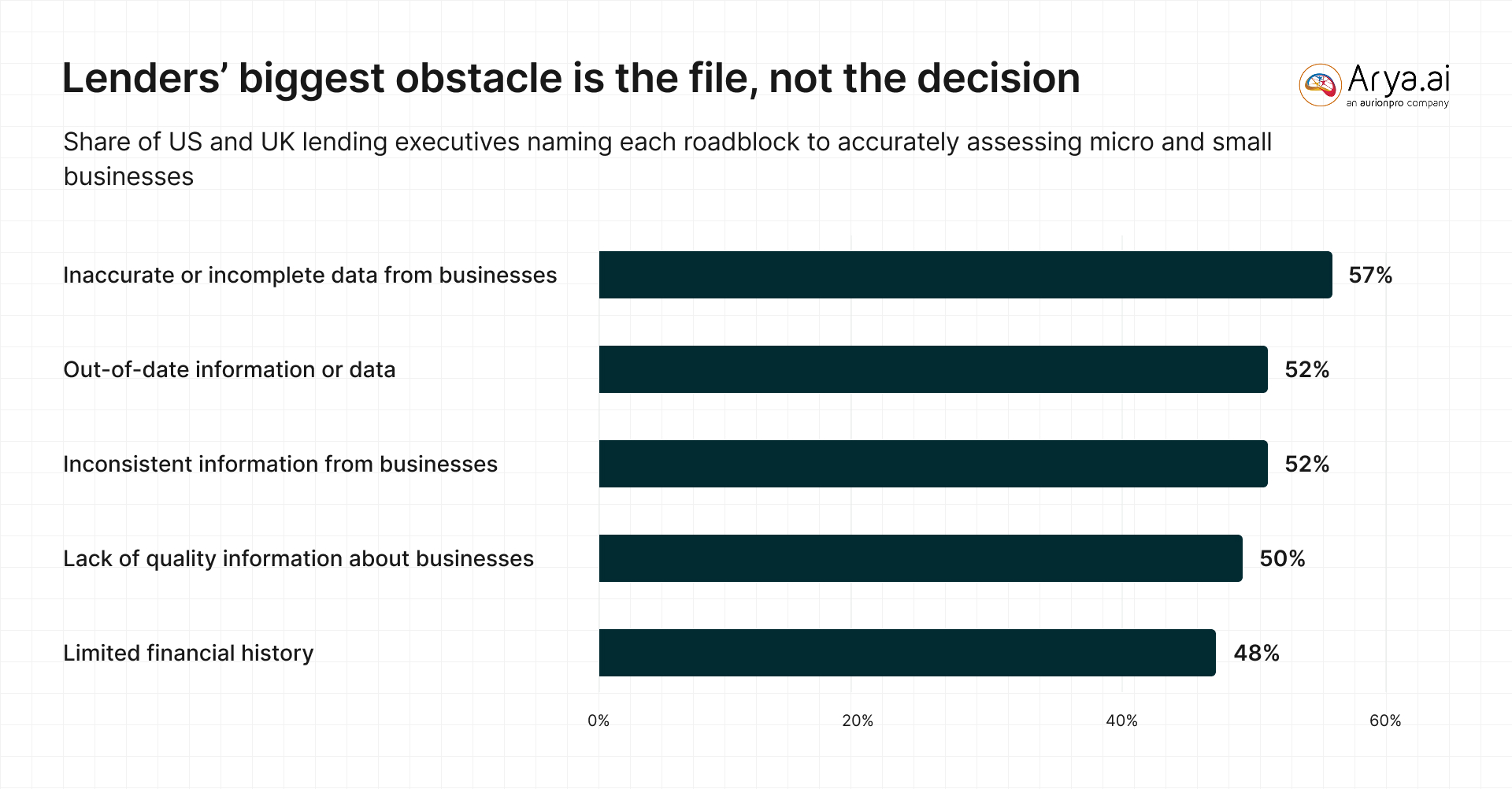
The same study found that roughly 27% of micro-business applications were rejected because the lender could not verify the business's legitimacy, about five times the rate for enterprise applicants. Another 19% were rejected for lack of information to verify creditworthiness. Some of those firms may be sound borrowers. Their files simply never reached a state where anyone could say so.
Reconciliation is also where fraud hides. Inscribe's 2026 Document Fraud Report, which is vendor-reported, says around 6% of documents on its network were flagged as fraudulent. Of 90 fraud and risk leaders it surveyed, 85.6% named bank statements as the document most vulnerable to manipulation. Altered financial figures are hard to catch by eye and easy to catch by comparison. That makes reconciliation a risk control as well as an efficiency problem.
Document chasing: the loop the clock does not see
The third layer is the most expensive because it is mostly waiting.
An underwriter opens a file and finds that a statement is missing a month. A request goes back to the borrower or the relationship manager. A reply arrives with the missing month and a new question, perhaps an unexplained transfer. The file goes back into the queue. Each lap adds a request, a reply window and another wait for attention.
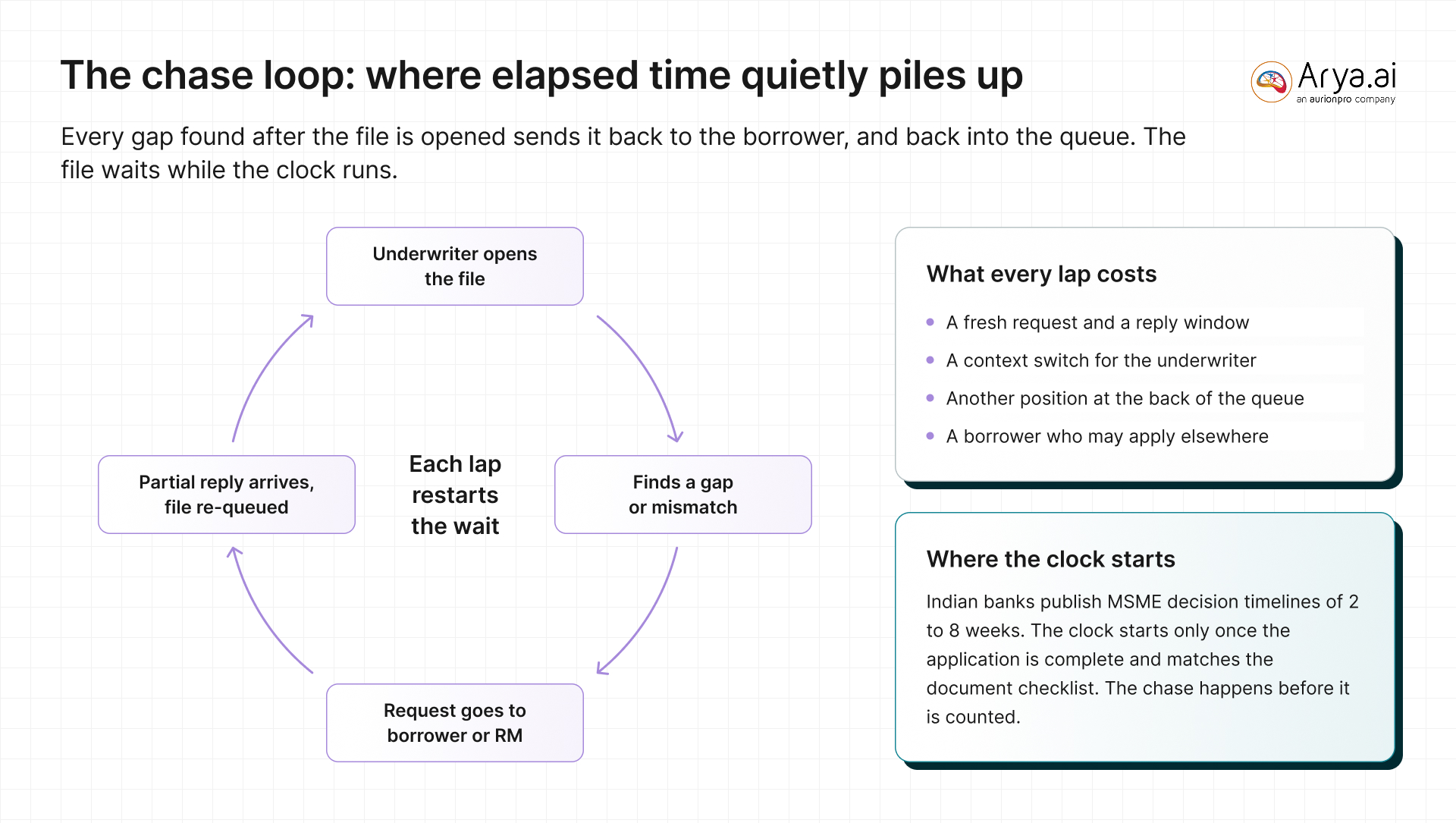
India makes the structure of this problem unusually visible. Banks there publish maximum decision timelines for MSME loans under RBI's MSME lending directions. DCB Bank's June 2026 disclosure is typical: two weeks for limits up to ₹25 lakh, rising to a maximum of eight weeks for the largest limits. The clock starts only once the application is complete and accompanied by the documents on the checklist. In other words, the chase happens before the official clock begins. A lender can meet every published timeline and still feel slow to the borrower.
Borrowers feel it everywhere. The Federal Reserve's 2025 Small Business Credit Survey, with 6,525 employer-firm responses, found that 22% of applicants received none of the financing they sought. "Difficult application process" and "long wait for credit decision or funding" remain standing categories in its list of lender challenges. The share of applicants going to online lenders has risen from 17% in the 2020 survey to 29% in 2025, and those applicants rank speed among their top reasons for choosing where to apply. Slow preparation loses borrowers as well as money.
Why does hiring more underwriters not fix it?
Because it adds capacity to the layer that is not constrained.
If most of a file's elapsed time is preparation and waiting, a new underwriter inherits the same unprepared files. They spend their first months spreading statements and writing chase emails. Throughput rises a little. The cost per decision rises with it.
US mortgage data shows how this plays out. The Mortgage Bankers Association reported in October 2025 that productivity was lower than in 2018, and that depository lenders pulled through only 55% of applications in the first half of 2025. MBA's Marina Walsh made the point directly: workers have not become less efficient, but a lot of work is being done that never ends in a closed loan. Effort spent assembling files that stall or walk away is still effort.
There is a quieter cost too. Skilled credit people did not join a lender to rekey tax returns. When the job is mostly assembly, the best judgment in the building is spent on the least valuable tasks.
What does a prepared credit file look like?
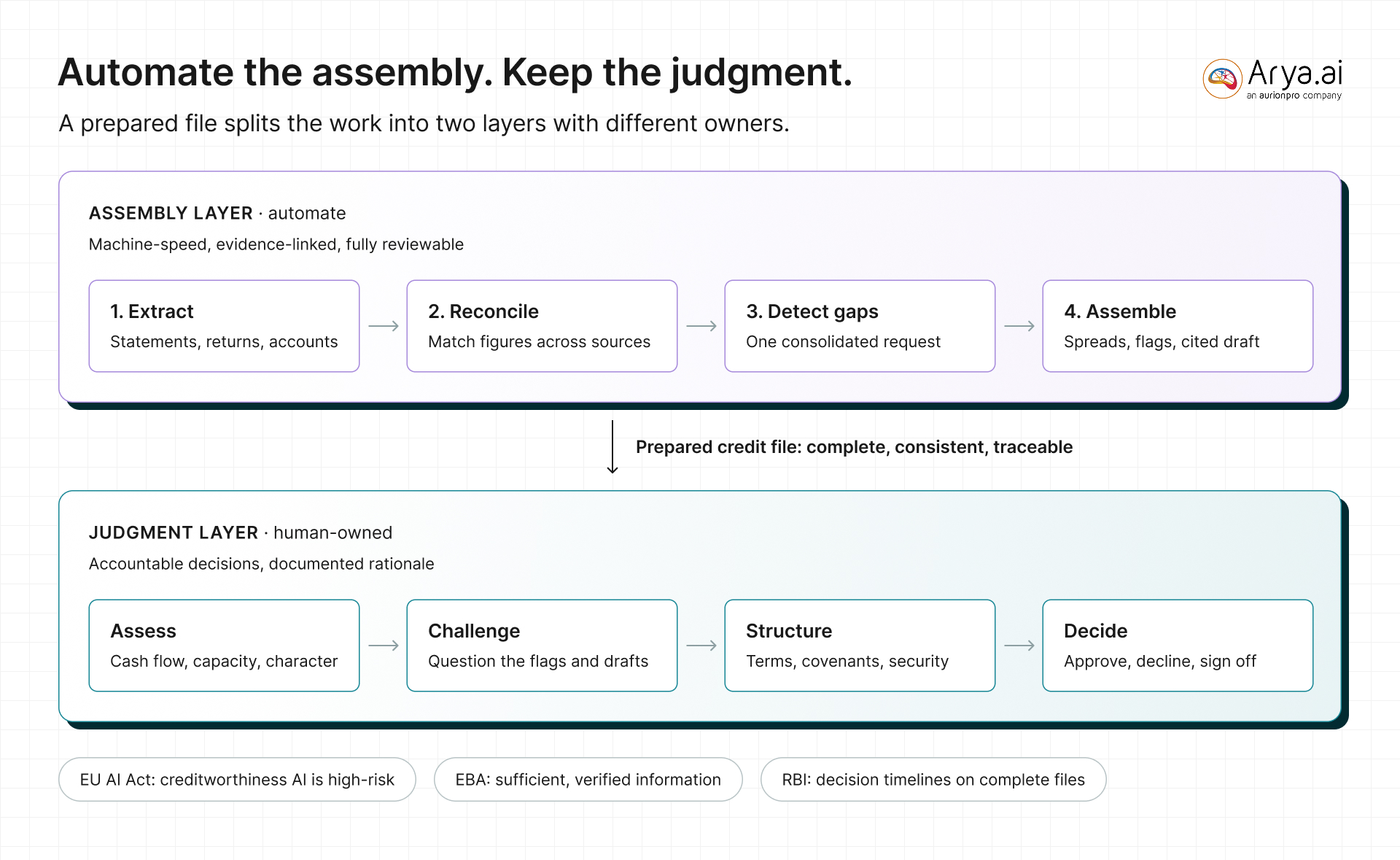
A prepared file arrives at the underwriter with four things already done. The data has been extracted and structured. The figures have been reconciled across sources, with every mismatch either resolved or flagged with evidence. Missing items have been identified and requested once, together, rather than discovered one at a time. And a draft summary exists, with each figure traceable back to the page it came from.
Public data infrastructure is making the assembly layer easier to build, especially where it replaces documents with consented data feeds.
- India. The Account Aggregator ecosystem passed 500 million fulfilled consents in September 2026 and enabled an estimated ₹3.82 lakh crore of lending in FY26, around 8.4% of retail and MSME lending by value. RBI's Unified Lending Interface exists because, as the RBI Governor put it in 2024, the data needed for credit appraisal sits in separate silos. By December 2025, 64 lenders were live on ULI using more than 136 data services.
- UK. Open Banking passed 15 million users in July 2025. Open Banking Limited notes that consented transaction data gives SME lenders a current, verified view of cash flow and reduces reliance on manually supplied documents. EY analysis commissioned by OBL puts the lending-related benefit to UK SMEs at around £171 million a year.
- US. Freddie Mac's Kevin Kauffman has pointed to a common habit that undoes the benefit: paying for automated income and employment verification and then still asking the borrower for pay stubs. Better data only shortens the chase if the process trusts it.
Data rails solve part of the problem. They do not read a scanned lease, interpret a management account footnote or explain why revenue fell in March. Most SME and commercial files will remain a mix of feeds and documents for years. The assembly layer has to handle both.
Where CredAI fits
CredAI is built for exactly this layer. It ingests the documents and data a lender already collects, including bank statements, financial statements, tax filings and corporate records. It extracts and structures them, reconciles figures across sources, and flags mismatches with links back to the source page. It identifies what is missing before the file reaches a person, so the borrower gets one consolidated request instead of a series of follow-ups. The output is a prepared, evidence-linked file and draft analysis. The underwriter still reviews it, challenges it, structures the terms and makes the decision. CredAI handles the assembly. The credit judgment stays with the lender.
Does this keep lenders on the right side of regulators?
It does, and the reason is structural.
In the EU, AI used to evaluate the creditworthiness of individuals is classed as high-risk under the AI Act. After the Digital Omnibus amendment published in July 2026, those obligations now apply from 2 December 2027. They include human oversight, data quality and documentation. Separately, the EBA Guidelines on loan origination and monitoring, in force since 2021, expect lenders to hold sufficient, accurate and up-to-date information before they lend. In India, the RBI's MSME timelines assume a complete file before the clock even starts.
Each of these frameworks asks for better-prepared files and accountable human decisions. An assembly layer that is fast, evidence-linked and reviewable serves both. A model that quietly takes over the decision serves neither.
How should lenders measure the problem?
Total turnaround hides the cause. Four simpler measures expose it.
- First-touch completeness. The share of files that are decision-ready the first time an underwriter opens them.
- Chase laps per file. How many times a file goes back to the borrower or relationship manager before decision.
- Touch time versus elapsed time. Hours of active underwriter work compared with calendar days in the queue.
- Judgment share. The proportion of underwriter hours spent on assessment and structuring rather than extraction and checking.
Most lenders that run these numbers find the same thing. Their underwriters are not slow. Their files are arriving unprepared.
Frequently Asked Questions
What is document chasing in lending?
What is financial spreading?
Can AI make lending decisions faster without replacing underwriters?
How do Account Aggregator and Open Banking reduce underwriting time?
Share this post


Table of contents
Low-Code AI Automation Starts Here – Try Arya Apex
Access 100+ plug & play AI APIs to streamline manual tasks and improve productivity. A low code solution for enabling seamless automation of processes at scale.
Start Free Trial