


.png)

When a consumer finances a laptop at checkout on an e-commerce platform, or when a small retailer draws down a credit line sized to last month's sales, they are experiencing embedded finance.
The term refers to integrating financial products (credit, insurance, payments, investment) directly into non-financial platforms and workflows, so the financial service is consumed at the point of need. Consumers never leave the app or platform.
For financial institutions (banks, insurers, non-bank lenders), embedded finance represents both an enormous distribution opportunity and a fundamentally new risk surface.
- On the opportunity side, it extends the reach of financial products into contexts where customers already transact, reducing acquisition costs while increasing conversion.
- On the risk side, it introduces a set of structural vulnerabilities that traditional risk management frameworks were not designed to handle.
Though financial institutions can capture the user at the time of the purchase, they no longer own the customer relationship because the platform controls the data. In addition, decisioning must happen in milliseconds.
What Risks Financial Institutions Are Exposed to in Embedded Finance
Embedded finance redistributes risk, and in the process, introduces new categories of exposure that require different tools and governance structures.
The most immediate risk is credit risk at velocity.
Embedded lending products (BNPL, point-of-sale financing, merchant cash advances, embedded credit lines) originate at volumes and speeds that traditional underwriting pipelines were never architected to handle. When underwriting fails at this speed, losses scale at the same near-zero marginal cost that made the product viable in the first place.
Then there is concentration risk.
When a single platform (an e-commerce marketplace, a SaaS vertical, a ride-hailing super-app) drives a large share of originations, the lending institution's portfolio becomes correlated with that platform's fortunes. Amazon's 2024 withdrawal from its SMB lending program is instructive. Even the best-positioned platforms concluded that credit risk isn't worth the customer-experience benefit.
Fraud risk is amplified in embedded contexts.
BNPL embedded at checkout is acutely vulnerable to synthetic identity attacks. The speed of approval and the absence of viable verification create an attack surface that traditional lending does not face. More importantly, platforms that optimise for conversion can systematically attract higher-risk borrowers when underwriting signals are weak.
Every risk listed above flows through the underwriting decision. If the underwriting model is accurate, fast, and well-governed, embedded finance works. If it is not, losses compound at platform scale.
Why Traditional Underwriting Doesn’t Work in Embedded Finance
Traditional underwriting has governed credit risk effectively for decades. In embedded finance, however, its architecture doesn’t work.
- For starters, lenders use this method when they have a direct relationship with the borrower.
- Secondly, the volume of decisions is manageable through manual reviews.
Nevertheless, embedded finance inverts every one of those assumptions. Consider a BNPL transaction: a consumer selects a product, chooses to pay in instalments, and expects approval within two seconds at checkout. If the credit experience involves friction, it directly contributes to cart abandonment or loss of business.
Embedded finance promises frictionless access to financial products at the point of need. Traditional underwriting, with its extensive turnaround and document-heavy processes, is antithetical to that promise. That's why financial institutions are turning to AI.
What AI-Powered Underwriting Looks Like in Embedded Finance
AI-powered underwriting in embedded finance is an architecture. It combines machine learning models, alternative data ingestion, real-time scoring infrastructure, and continuous monitoring into a system that can make credit or insurance decisions in milliseconds, at scale, and with granularity traditional methods cannot match.
The Real-Time Decisioning Engine
At the core of AI-powered embedded underwriting is the real-time decisioning engine that receives a request, evaluates it against a trained model, and returns an approve/decline/price decision within the embedding platform's latency budget.
The decisioning workflow in an embedded lending context typically follows a pattern:
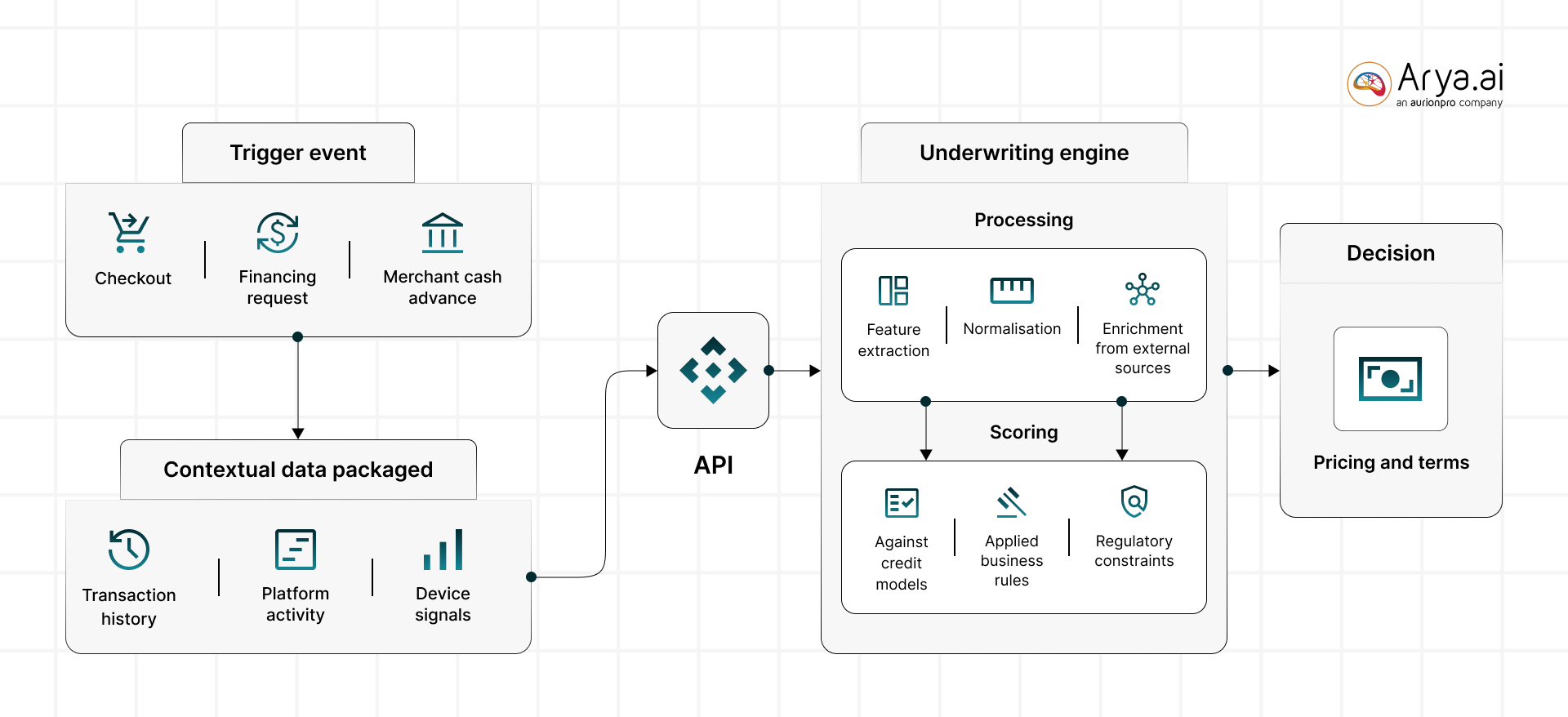
Beyond Decisioning: Dynamic Offers and Risk-Based Pricing
AI-powered underwriting does not stop at the approve/decline gate. It enables a fundamentally different approach to offer construction. Instead of a binary outcome, AI models can generate dynamic, risk-adjusted offers in real time.
This means a borrower at a slightly higher risk tier does not simply get rejected. Instead, the system can offer a controlled credit line, a shorter repayment term, a higher interest rate, or a different product altogether — all calibrated to the institution's risk appetite and the borrower's profile.
Alternative Data: Seeing Borrowers the Bureau Cannot
One of the most consequential capabilities AI brings to embedded underwriting is the ability to ingest and make sense of alternative data signals. In embedded contexts, this alternative data is often native to the platform itself.
For instance, Shopify Capital underwrites merchants using their sales history, dispute rates, and customer engagement metrics. These are not supplementary signals layered on top of a bureau score — they are often the primary underwriting inputs, because the borrowers in question may have no meaningful bureau history.
Automating the Operational Stack: KYC, Identity Verification, and Compliance
AI's role in embedded finance could extend to the operational infrastructure around it. Know Your Customer (KYC) processes, identity verification, anti-money laundering (AML) screening, and sanctions checks are themselves bottlenecks that traditional methods handle through manual review and document submission. In embedded contexts, these processes must be equally seamless.
AI-powered identity verification uses document recognition (OCR on identity documents), biometric matching (facial recognition against ID photos), liveness detection (ensuring the applicant is physically present, not a spoofed image), and behavioural biometrics (typing cadence, device fingerprints) to authenticate users in real time.
NLP models parse and extract information from uploaded documents (bank statements, tax returns, invoices) that would traditionally require human review. The regulatory requirement here is non-negotiable: financial institutions cannot bypass KYC and AML obligations simply because the product is embedded.
But AI lets these checks run in the background, in parallel with the credit decision, rather than as sequential, friction-creating steps in the customer journey. The result is a process that feels instantaneous to the user while remaining compliant with regulatory expectations.
SME Lending: Embedded Finance Promises Embedded Liquidity
If embedded consumer credit was the first wave, embedded SME lending may prove to be more transformative. Small and medium enterprises represent the backbone of most economies, yet they remain chronically underserved by traditional lending.
The reasons are well-understood: SMEs often lack the audited financial statements, multi-year credit histories, and collateral that traditional bank underwriting requires. Underwriting a $50,000 SME loan using conventional methods can cost more than the loan's margin. The result is a structural gap: creditworthy businesses cannot access formal credit because assessing their creditworthiness costs too much relative to the loan size.
Embedded finance, paired with AI underwriting, attacks this problem from both sides.
- On the distribution side, platforms where SMEs already operate (e-commerce marketplaces, payment processors, accounting software, supply chain platforms) become the origination channel. The SME does not apply for a loan; the loan finds the SME, offered at the point of need within the workflow the business already uses.
- On the underwriting side, AI models can evaluate the alternative data that SMEs generate in abundance: invoice histories, sales turnover, payment cycles, supplier relationships, digital footprint, platform ratings, cash-flow patterns from connected bank accounts via open banking APIs, and even social signals like customer reviews and engagement metrics.
APAC: The Hub for Embedded Credit Experiments
The Asia-Pacific region is where the most aggressive embedded SME and consumer credit experiments are playing out. Large platform ecosystems, high smartphone penetration, significant unbanked and underbanked populations, and more permissive regulatory environments for fintech-led lending drive this.
Sea Group's financial services arm, operating through SPayLater on Shopee, had built a $5.1 billion loan book by the end of 2024, a 64% year-on-year increase. Management has been explicit about the role of platform data in underwriting, saying proprietary Shopee data enables more effective risk-based pricing.
Grab Financial, operating across Southeast Asia, grew its loan portfolio to $1.18 billion by end-2025 using ride-hailing, food delivery, and payments data to underwrite drivers, merchants, and consumers. The growth has come with higher credit loss provisions as the portfolio scales, reflecting the inherent tension between rapid expansion and risk discipline.
Where This Is Going in 3–5 Years
Three structural shifts will likely reshape AI-powered underwriting in embedded finance over the next three to five years.
- The first is the move from point-in-time scoring to continuous monitoring.
- The second is the emergence of models suited for financial services.
- The third is regulatory convergence: AI in financial services must be explainable, governed, monitored, and subject to human oversight.
For C-suite leaders, the imperative is to move beyond the binary framing of innovation versus risk. Embedded finance and AI-powered underwriting are neither inherently safe nor inherently dangerous.
They are powerful tools whose outcomes depend entirely on the quality of the governance, the clarity of the risk appetite, and the rigour of the operational infrastructure surrounding them. The institutions that get this right will capture a disproportionate share of the embedded finance opportunity. Those that do not will learn — as several already have — that losses scale just as efficiently as approvals.
Share this post


Table of contents
Low-Code AI Automation Starts Here – Try Arya Apex


.png)




.png)
.png)
.svg)


