


.png)

There is a structural and data-driven gap in SME funding. It demands our attention because SMEs make up roughly 90% of firms and over 50% of global employment. These SMEs don’t operate by the same principles as large corporations. Still, banks underwrite them with tools designed for large companies with an established track record and collateral.
Traditional SME underwriting fails for three structural reasons:
- Thin or absent bureau data: SMEs either don’t have a usable bureau footprint or the score doesn’t paint the whole picture.
- Collateral mismatch. Collateralised loans demand real property, yet SMEs own mostly movable assets (equipment, inventory).
- High cost to serve. Traditional banks incur higher costs per customer than challenger banks and NBFCs that leverage digital channels for onboarding, servicing, and underwriting.
What counts as alternative data
Lenders should think about alternative data as a stack of signals about ability and intent to repay, layered on top of (not replacing) bureau and KYC data:
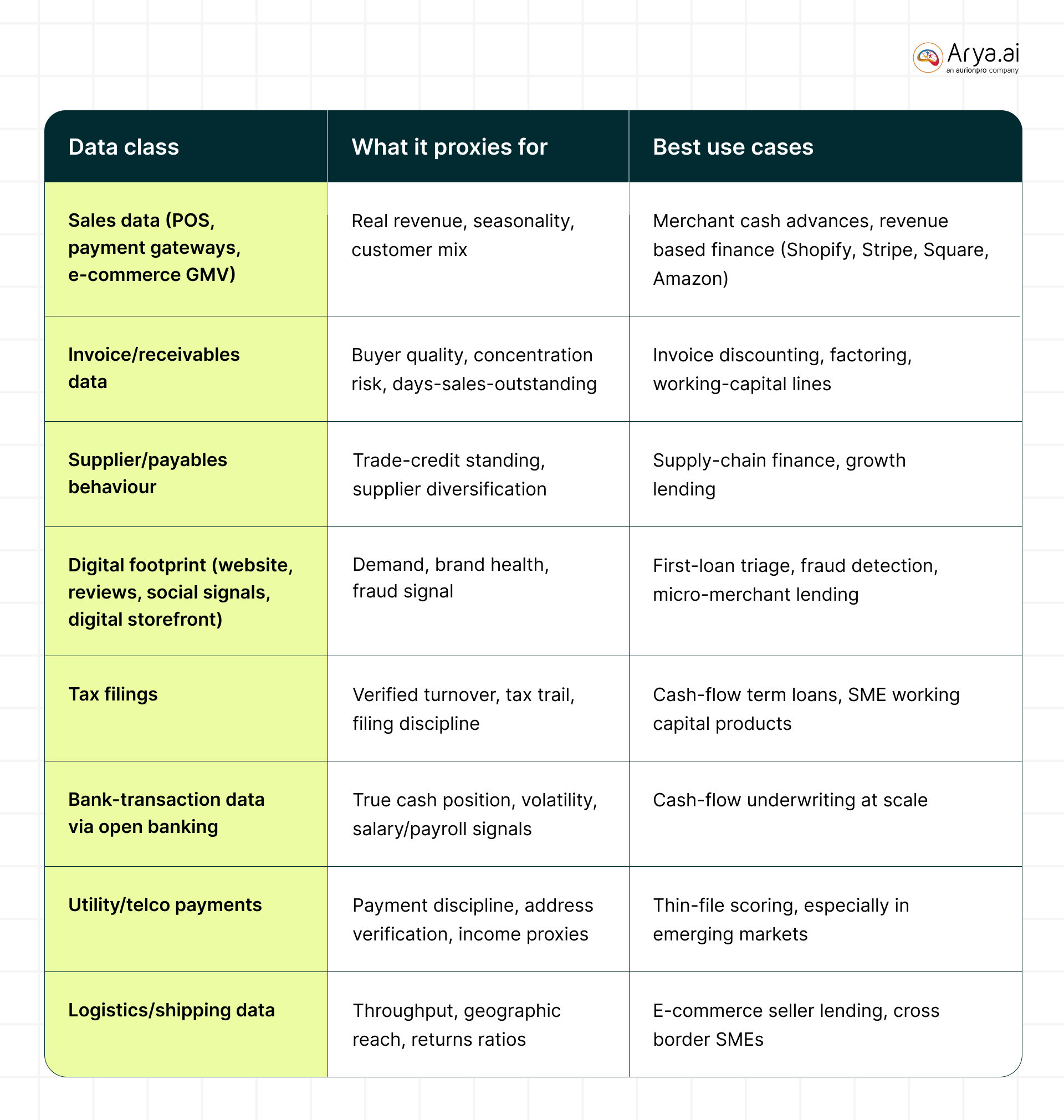
The point is not to use all of them at once. Different products, segments and geographies need different combinations. For instance, a small retailer needs telco-plus-utility-plus-mobile-money signals. On the other hand, a Shopify merchant needs GMV, refund rate, and inventory turnover signals, while an Indian textile exporter needs GST returns, bank-transaction patterns and invoice quality.
How lenders can use alternate data
Cash-flow vs. collateral:
The 2025 FinRegLab/NYU Stern study that analysed 38,000+ loans from two fintech lenders over nine years gave the clearest published evidence to date. Cash-flow signals improve risk discrimination, especially for the borrowers banks misjudge most. Moreover, the earlier 2019 FinRegLab study established that cash-flow scores were predictive across products and populations. Alternative data that gives validity to the cash flow patterns helps both lenders and borrowers equally.
Dynamic limits, not annual reviews.
Traditional underwriting for large corporations mostly involves annual review. However, alternative data allows lenders to re-underwrite continuously off processing data. Using such forward-looking models and AI empowers lenders to keep a close watch on the risks without waiting for a catastrophe to happen.
Early warning systems.
Real-time bank-transaction monitoring and supply-chain graph signals can flag distress weeks or months before a missed payment. Such early warning systems are critical in a rising-rate, geopolitically volatile environment, which can potentially be a structural risk for SME books.
Fraud detection.
Device, behavioural and graph-based signals are now embedded in loan-origination flows. Graph neural networks are particularly effective for synthetic-identity and ring-fraud detection because they exploit the structure of relationships, not just node attributes.
Portfolio risk segmentation.
Sector- and behaviour-cluster-based segmentation, fed by alternative data, lets lenders price risk granularly rather than across crude SIC-code buckets.
How AI makes sense of the alternative data signals
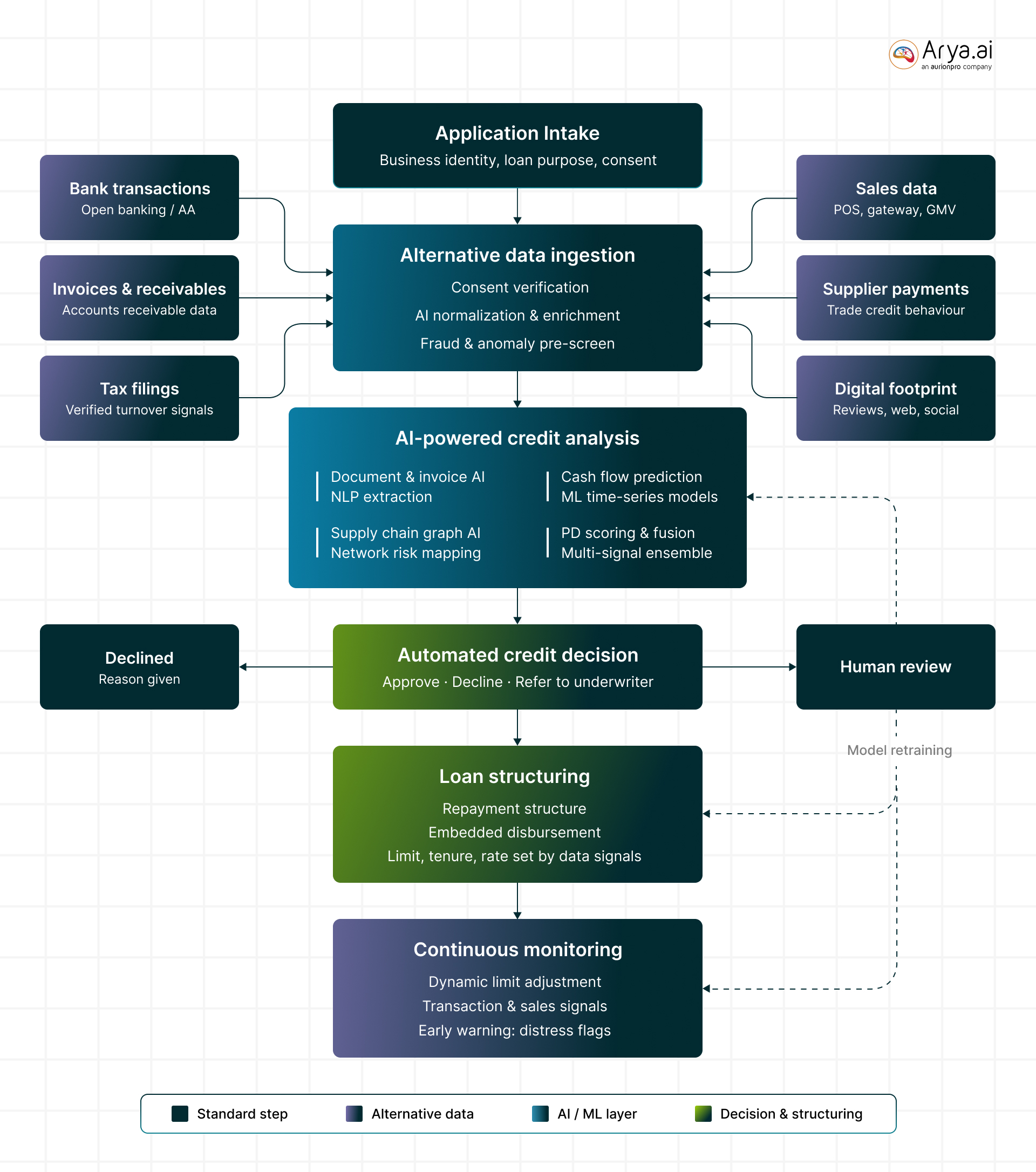
Making unstructured data legible.
A significant share of the most valuable SME credit signals lives in documents such as invoices, purchase orders, bills of lading, tax returns, and financial statements. AI, specifically the class of models trained to read and interpret language and layout, can extract structured information from these documents automatically: counterparty names, amounts, payment terms, filing dates, and anomalies that suggest manipulation or inconsistency.
What once took a credit analyst two hours per file can be done in seconds, at any volume, with comparable or better accuracy. The practical effect is that a lender can ingest the full richness of a borrower's operational history rather than a curated, borrower-submitted summary.
Seeing the network, not just the node.
Traditional credit models treat each borrower as an island. AI models that reason about relationships and connections can see a borrower inside its ecosystem: who its customers are, who its suppliers are, how central it is to its supply chain, and whether the firms around it are under stress.
This matters because an SME's creditworthiness is deeply intertwined with the health of its trading relationships. A manufacturer whose three largest buyers are all showing payment delays is a different risk proposition from one whose buyer base is diversified and stable. AI can quantify that network risk by continuous monitoring and incorporate it into credit decisions in ways no scorecard could.
Predicting forward, not just measuring backwards.
Bureau-based underwriting is retrospective by design: it tells you what happened. Cash-flow and transaction models trained on behavioural data can generate forward-looking views, like anticipated revenue seasonality, projected working-capital cycles, and likelihood of distress in the next 90 days based on current behavioural signals.
This is the difference between approving a loan based on last year's balance sheet and approving it based on a dynamic model of the business's near-term trajectory. Lenders using this approach can also set dynamic credit limits that flex as the business grows or contracts, rather than waiting for an annual review that may be months too late in either direction.
Deciding in real time, at scale.
AI-powered decisioning engines integrate document intelligence, relationship signals, forward-looking cash-flow models, fraud and identity verification, and surface a structured recommendation. This changes the competitive dynamics of SME lending fundamentally.
Approval speed is not just a customer-experience differentiator; it is increasingly the primary reason an SME chooses one lender over another.
Taken together, these capabilities represent a shift from underwriting as a periodic, document-heavy, relationship-driven process to underwriting as a continuous, data-driven, automated intelligence function.
Strategic takeaways for lending institutions
SME lenders must start treating data as infrastructure and AI as an operating capability. The quality of a lender’s alternative data is now a primary determinant of its underwriting advantage. That means decisions about which open-banking aggregators, accounting platforms, tax-data rails, and marketplace integrations to build around are strategic decisions. Depth and diversity of data inputs are the new version of risk diversification.
However, navigating these waters isn’t going to be a cakewalk. Governance and auditability should be equally prioritised, especially when it comes to credit scoring systems. Already, regulators across the globe have added rules for AI-driven credit decisions.
Lenders exploring AI for their operations should also build capabilities for model documentation, bias-testing, human-override protocols, and consent-management infrastructure. Those that treat governance as a compliance afterthought will find themselves unable to scale the very models they have spent years building.
Conclusion
The SME credit gap is dissolving as AI becomes capable of making sense of data like transactions, invoices, tax filings, payment flows, and supply-chain relationships. Lenders that don’t actively modernise their traditional approach risk losing to a digital-native competitor. Because the compounding effect of better data and better models is not linear.
The SME segment has always represented one of the most commercially attractive opportunities in financial services. The question isn’t whether to pursue this opportunity. It is how quickly they can build the data and AI foundation that makes it defensible.
Share this post


Table of contents
Low-Code AI Automation Starts Here – Try Arya Apex


.png)




.png)
.png)
.svg)


