


.png)

The risk assessment team vets a borrower’s risk appetite and credit history to decide whether they deserve a loan. It captures the present scenario for credit underwriting, which is called Point-in-Time Underwriting. However, this creates a massive gap between underwritten and realised.
PIT became the industry standard because:
- Data availability was scarce and expensive (bureau pulls cost money and were updated monthly at best)
- Financial statements for SMEs/corporates are produced only quarterly or annually
- Collateral revaluations were manual and costly
- Compute and storage made daily portfolio-wide rescoring infeasible until the mid-2010s
Below is an image illustrating how PIT unfolds for both retail and SME customers.
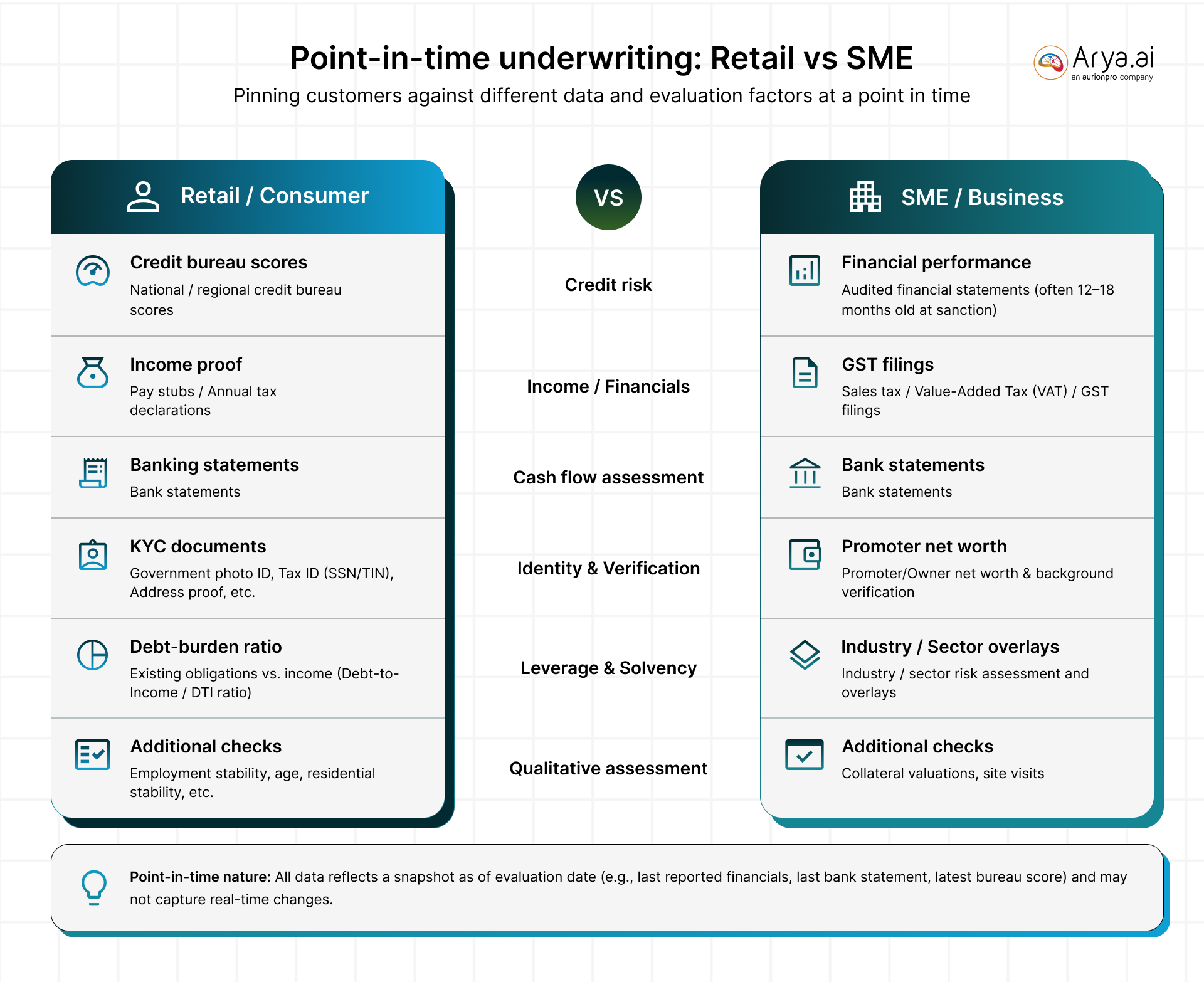
At the application stage, underwriters assess the borrowers, followed by an infrequent review, and that too in the case of SME and corporates, or only on delinquency/restructuring for retail. Each loan in the book is therefore a "snapshot" decision.
Why a “Snapshot” Decision Doesn’t Suffice Anymore?
Underwriters make snapshot decisions under the assumption that the risk would stay accurate. Between 2020 and 2026, banking books absorbed COVID-19 cash-flow shocks, supply-chain inflation, geopolitical disruptions, and unsecured-credit overheating. PIT models calibrated on 2010–2019 data systematically fail in this regimen because the assumed stationarity of risk drivers no longer holds.
Borrowers can now take on leverage at a pace that lenders simply cannot track between reviews, primarily through digital channels and BNPL platforms where new lending is invisible to the existing lender's book. CFPB data shows that 63% of BNPL borrowers had multiple simultaneous loans, and 33% had obligations across multiple lenders. None of which a PIT model can see.
This means the interval between a credit decision and its realisation has not changed. What has changed is how quickly a borrower's risk profile can deteriorate within that interval.
Risk Patterns Are Evolving Faster Than Annual Reviews Can Track
The following forces have structurally altered the risk landscape in ways that PIT underwriting cannot accommodate.
Macro volatility has become non-linear.
Rate cycles, inflation, geopolitical shocks, and geolocation-specific events interact in combinations that historical models cannot extrapolate. PIT frameworks assume a relatively stable macroeconomic backdrop between reviews. That assumption is no longer tenable.
Behavioural shifts post-COVID have permanently altered borrower profiles.
The consumer credit appetite changed shape: the rise of unsecured personal loans, multi-lender behaviour enabled by instant digital onboarding, and a younger borrower base for whom the traditional collateral-led model carries far less disciplining force.
Digital footprint has become a live risk signal that PIT models ignore.
Alternate methods of payments have become prevalent across retail and micro-merchants. Counterparty diversity, day-of-week patterns, and even bill payment behaviour are operational fingerprints. This alternative data encodes repayment capacity better than a once-a-year financial statement.
Credit cycle times have compressed to minutes.
Digital lending now delivers credit in minutes. When the origination-to-disbursement window is 4 minutes, a static assessment framework designed around a 10-day processing cycle is structurally mismatched.
Climate and ESG risks are now credit risks.
Physical and transition climate risks are now a part of traditional credit risks, and not as separate ESG considerations. Industries exposed in areas such as textiles, agri, and real estate are affected by climate and environmental changes.
The regulatory environment has already moved past the debate.
Forward-looking, macro-conditional, lifetime probability-of-default estimates — a concept that quarterly recalibration increasingly cannot satisfy. Central banks are pushing for real-time monitoring, which AI credit models can solve. However, such models are subjected to a high level of governance and, in some cases, independent validation. Let us discuss this in detail below.
AI and Continuous Credit Risk Monitoring: The Alternative
Continuous Credit Risk Monitoring (CCRM) is the operational discipline of ingesting borrower-level and portfolio-level signals on a near-real-time basis. These signals are run through a layered model stack, producing dynamic outputs, like risk scores, EWS alerts, limit and pricing recommendations, and provisioning signals. The outputs inform decisions across the loan lifecycle.
The architecture has five layers.
Layer 1: The foundation, data fabric
Account Aggregator pipes, tax filings, UPI transaction data (where consented), bureau pulls, transaction streams, news and sentiment scrapers, and climate/geospatial feeds.
Layer 2: Feature engineering and cohorting
On top of the data fabric sits the feature engineering and cohorting layer, including cash-flow features, seasonality decomposition, sector benchmarks, and peer cohorts.
Layer 3: The model layer
The model layer is where the real differentiation happens, handling cash-flow trajectory forecasting, and early warning signals.
Layer 4: The decisioning and EWS engine
The decisioning and EWS engine translates model outputs into operational triggers such as DSCR below 1.2X, revenue down 15%+ quarter-on-quarter, unusual counterparty concentration in UPI flows, covenant breach alerts, IFRS 9 staging triggers, and dynamic limit adjustment recommendations.
Layer 5: The governance overlay
Explainability (SHAP, LIME, reason codes), bias testing, model drift monitoring, and audit trails become crucial, as this is the condition under which the regulator permits the rest of the stack to operate.
Strategic Implications for CIOs and CROs
For financial institutions, the question is no longer whether to move toward continuous credit risk monitoring. It is how fast and how compliantly.
On the build-versus-buy decision
The entire CCRM stack is complicated, so building it from scratch isn't a good idea. Even if you succeed, it'll take a lot longer to ship. It's best to buy the commoditised layers (bank-statement analytics, AA orchestration, document AI, productized EWS platforms).
It’s just important to ensure these align with your repayment outcomes, policy and decisioning engine, and governance overlay. The goal is speed to the first meaningful EWS capability, not architectural perfection.
On integration
CCRM requires live APIs into core banking systems. This is the highest-friction, highest-value workstream and the one most likely to determine the pace of institutional adoption. Banks running on legacy systems face the most number of bottlenecks.
The integration surface extends beyond core banking into loan origination and management systems, bureau and fraud pipes, and AML infrastructure — each a potential point of friction and, if done well, a compounding source of signal.
On data governance
Consent architecture is the operational foundation of continuous monitoring. Regulators globally are converging on the same principles: explicit, informed, revocable consent; purpose-bound data use; minimum-necessary collection; and long-tail audit trails.
The important nuance for CIOs is that licensing data from third-party AI vendors does not transfer regulatory liability. The institution remains fully accountable for model outputs, data handling, and customer outcomes.
On talent and culture
The risk assessment function must evolve from a quarterly committee cadence to a continuous-operations model. Credit officers shift from snapshot reviewers to exception managers and ethical overseers. This is a harder change to make than the technology investment, and the one most institutions underestimate.
Synthesis: The Loan Is No Longer a Decision. It Is a Forecast.
The next five years will converge on a single architectural principle across global banking: the loan is not a decision. Rather, it is a continuously updated forecast. Origination becomes the first frame in a streaming risk model, not the only frame.
Three forces make this irreversible.
- Regulatory pressure already presupposes continuous monitoring
- The economic case is overwhelming, and visible across the lifecycle
- Competitive dynamics will force the issue.
The window for "fast follower" is narrowing. Continuous credit risk monitoring will be the floor of competent risk management, not the ceiling. Institutions that treat it as a strategic investment today will set the floor others must meet.
Share this post


Table of contents
Low-Code AI Automation Starts Here – Try Arya Apex


.png)




.png)
.png)
.svg)


