


.png)

The entire lending lifecycle for financial institutions stands to be enhanced by AI. Each step of the workflow, from application intake to post-decision servicing, can be augmented with AI. Across the lending lifecycle, the highest-ROI and lowest-regret AI capabilities tend to be:
- Document intelligence (OCR + document understanding) to reduce manual effort and errors
- Structured decision support (ML scoring + rule engines + anomaly/fraud detection) with strong validation and monitoring
- Narrative automation (Credit memo drafting, customer communications, and case summarization) only when tightly grounded in verifiable internal evidence and accompanied by human review.
The risk posture changes materially once AI is used to evaluate creditworthiness or produce credit scores. This use is explicitly treated as high-risk, which elevates requirements for risk management, documentation, human oversight, and post-market monitoring. Automating this aspect requires intelligent systems whose decisions are auditable.
Prioritization Tactics for Automating Lending Workflows
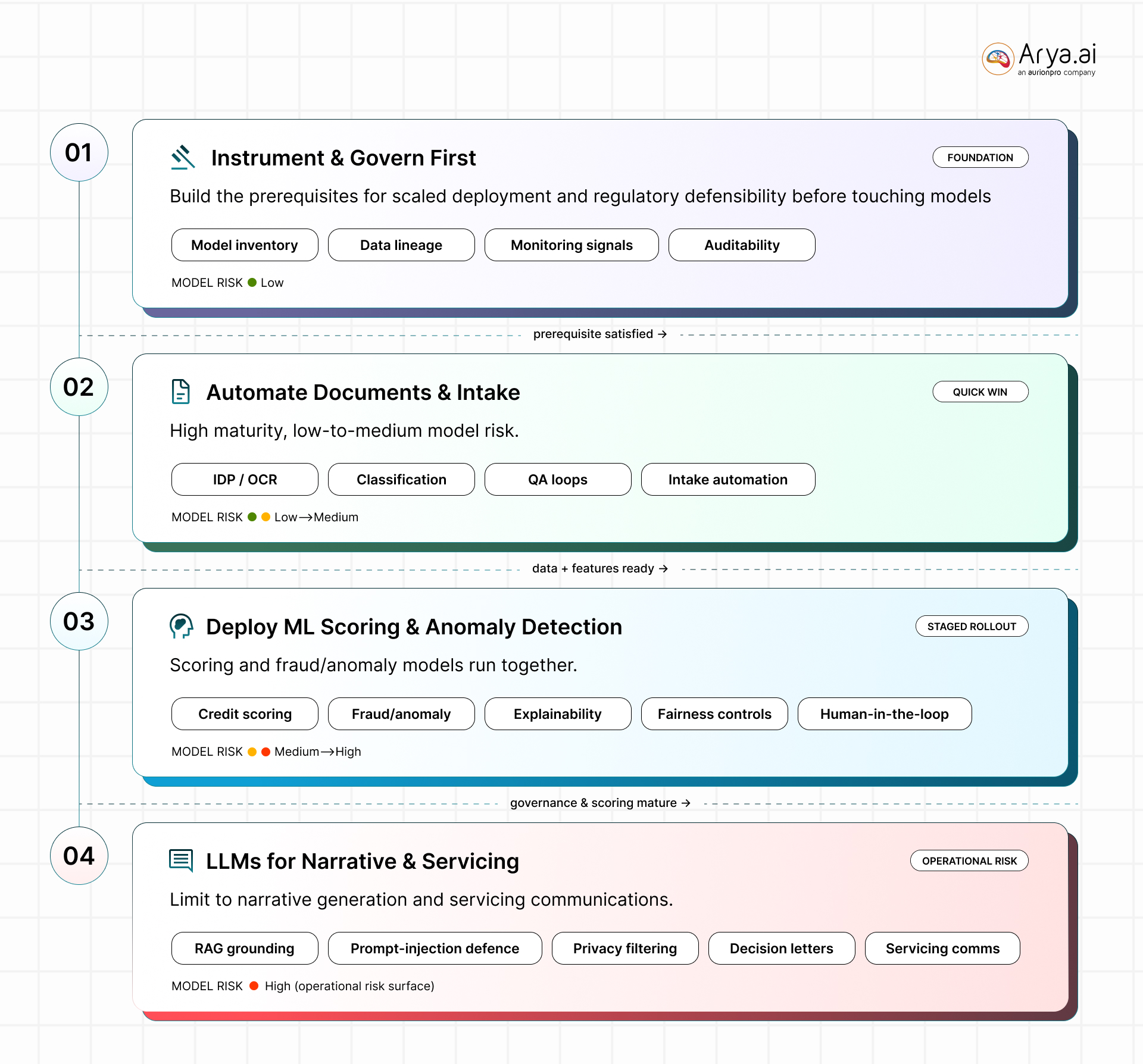
A practical “AI-augmented” target state is typically orchestrated as a workflow (case management + rules) calling specialized AI services (IDP/OCR, fraud/anomaly, scoring, explainability, and LLM narrative generation) with a shared data and governance plane (lineage, monitoring, audit trails, model inventory, and access controls).
Prioritization (generic, stack-agnostic) generally follows this sequence:
- Instrument and govern first (model inventory, data lineage, monitoring signals, auditability) because these are prerequisites for scaled deployment and regulatory defensibility.
- Automate documents and intake as quick wins (high maturity, low-to-medium model risk), using strong QA loops.
- Deploy ML scoring and anomaly detection with explicit explainability and fairness controls, staged rollouts, and “human-in-the-loop” escalation paths.
- Use LLMs for narrative and servicing communications only with strong grounding, prompt-injection protections, and privacy filtering; treat LLM components as part of the operational risk surface.
This prioritization has to be aligned with the core data sources:
- Applicant-provided structured data (identity, employment/income, liabilities, declared expenses, requested product/terms) and unstructured documents (payslips, bank statements, tax forms, financial statements, invoices, collateral documentation).
- Third-party verification and risk data, such as digital identity/KYC (where used), credit bureau files/scores, bank transaction data (often via consent-based open banking APIs), and fraud/AML signals.
- Internal data from CRM, existing relationship history, prior repayment behavior, and risk policy configurations. Lifecycle monitoring frameworks emphasize that origination and monitoring are linked through governance and credit quality objectives.
- Risk, audit, and reporting data (decision rationales, overrides, model versions, feature values, reason codes, fairness metrics, post-deployment performance), aligning with expectations for model risk management, documentation, and risk data aggregation/reporting capabilities.
Stage-By-Stage Lending Workflow Augmentation Blueprint
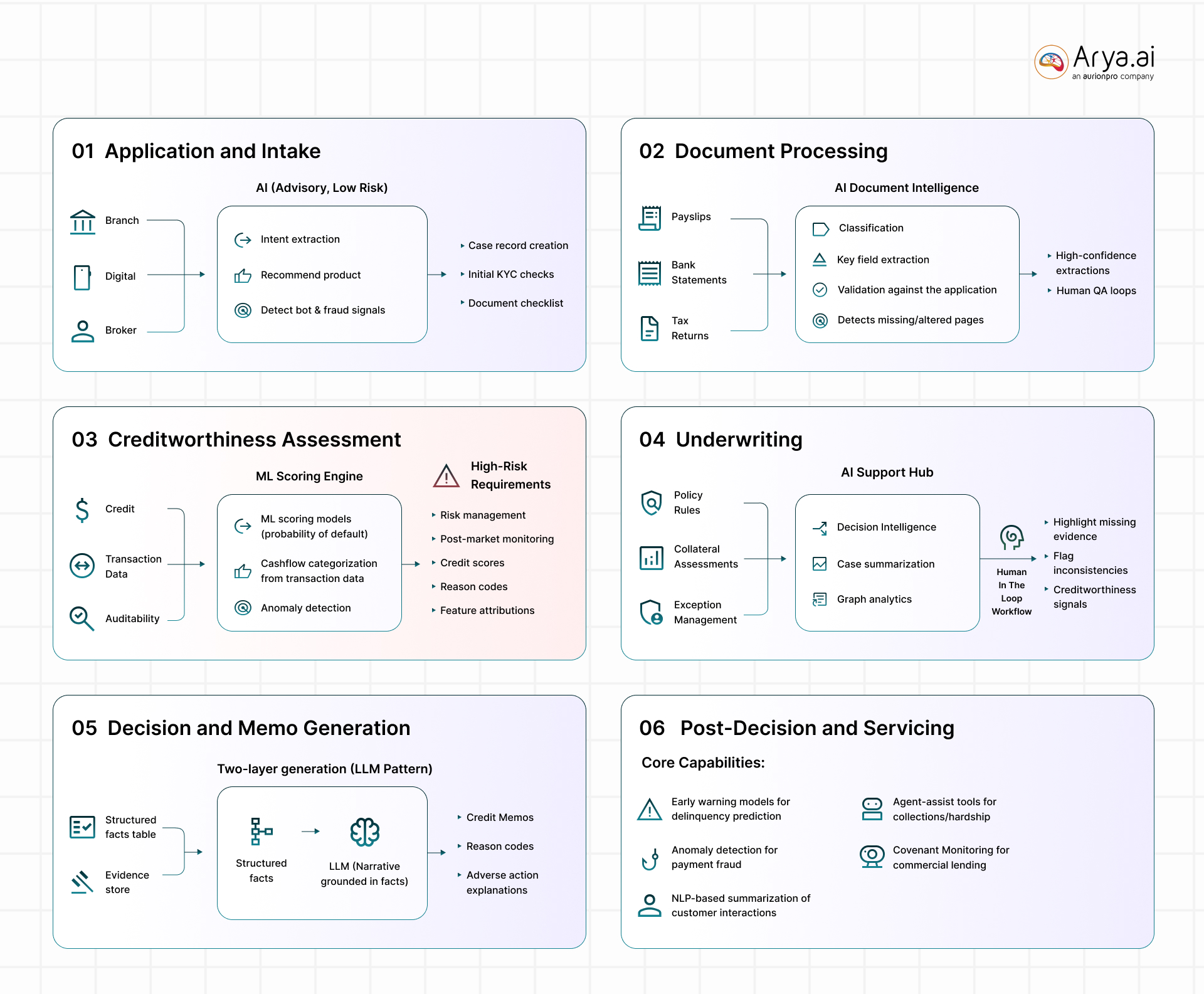
Stage 1: Application and Intake
The workflow begins when a borrower applies through any channel: branch, digital, or broker. AI augments this stage through NLP-based intent extraction in digital journeys, recommender models for product-fit suggestions, and anomaly detection to flag bot activity or early fraud signals. The system creates a case record, triggers initial KYC checks, and generates a checklist of required documents.
The key design choice here is to keep AI advisory rather than determinative. Eligibility triage and routing decisions sit at a lower risk tier than credit decisioning, which reduces compliance burden while still delivering measurable gains in drop-off rates and operational cost.
The data graph here typically includes applicant-provided structured data, identity and KYC verification outputs, consent flags, and channel metadata. Where AI APIs are available, consent-based transaction data can be ingested at this stage to feed affordability analysis later in the pipeline. Getting the data architecture right here prevents quality issues from compounding downstream.
Stage 2: Document Processing
Documents (payslips, bank statements, tax returns, bank/financial statements) are where lending operations spend a disproportionate amount of manual effort. AI document intelligence combines OCR with layout-aware models to classify document types, extract key fields, validate them against the application, and detect missing or altered pages.
This is widely considered the highest-ROI, lowest-risk AI use case in lending. The models are mature, and the outputs are verifiable. Confidence scores drive human QA loops: high-confidence extractions flow straight through; low-confidence items are routed for manual review. Every extracted value is linked back to its source page and region, creating the provenance trail that downstream stages.
Stage 3: Creditworthiness Assessment
This is the stage where AI’s regulatory profile changes materially. The EU AI Act classifies systems that evaluate creditworthiness as high-risk, which triggers elevated requirements for risk management, documentation, human oversight, and post-market monitoring.
AI capabilities here include ML scoring models for probability of default, cash flow categorization from transaction data (often accessed through open banking APIs with consent), and anomaly detection for fraud. The outputs (credit scores, affordability ratios, reason codes, and feature attributions) feed into the underwriting stage. Here, auditability is not optional.
Stage 4: Underwriting
Underwriting combines model outputs with policy rules, collateral assessments, and exception management. AI supports this stage through decision intelligence (rule engines combined with ML), case summarization via retrieval-augmented generation, and graph analytics for related-party exposure.
For underwriters reviewing complex cases, an AI-generated summary that highlights missing evidence, flags inconsistencies across documents, and surfaces comparable prior decisions can compress review time significantly without removing the human from the loop.
The design imperative is decision reproducibility: given the same inputs, the system must produce the same outputs, with every override and exception logged. For complex commercial lending, this stage remains predominantly human-in-the-loop, with AI accelerating the underwriter’s workflow rather than replacing their judgment.
Stage 5: Decision and Memo Generation
Once a decision is reached, the system generates a credit memo, assembles reason codes, and prepares adverse action explanations where required. This is where large language models add significant value.
The recommended pattern is two-layer generation:
- First, a structured facts table is assembled from the system of record and evidence store
- Second, the LLM writes a narrative grounded exclusively in those facts.
Prompts, retrieved sources, and outputs are stored for audit. Human review is mandatory for measuring memo accuracy through edit distance and tracking hallucination rates over time. Regulatory communications, particularly adverse action reasons, must be accurate and specific regardless of whether they were drafted by a person or a model.
Stage 6: Post-Decision and Servicing
The workflow does not end at approval. AI-augmented servicing includes early warning models for delinquency prediction, anomaly detection for payment fraud, NLP-based summarisation of customer interactions, and agent-assist tools for collections and hardship workflows.
Early warning models are high-ROI at the portfolio level: catching deterioration before it materializes as loss directly impacts the bottom line. Agent-assist LLMs, grounded in customer data and policy, can reduce handling time and improve consistency—but prompt injection and sensitive data disclosure risks must be addressed as part of the operational risk surface.
Covenant monitoring for commercial lending is another area ripe for augmentation. AI can track compliance with financial covenants, flag breaches or near-breaches automatically, and trigger refinancing or restructuring workflows before situations deteriorate. This shifts servicing from reactive to anticipatory—a meaningful change in how portfolios are managed.
Deployment Modes
There are three deployment modes:
- On-premises deployments are often chosen where data residency, legacy core constraints, or strict internal controls dominate
- Public cloud offers elastic compute for document processing and analytics
- Hybrid is common where core banking remains on-prem, but AI services run on cloud with carefully governed data movement.
For outsourcing, lending institutions must explicitly address criticality assessments, concentration risk, and documentation. Operational resilience expectations emphasize scenario testing and governance for important business services and outsourced relationships, which should be reflected in AI service architecture (rate limiting, graceful degradation, manual fallback procedures, and tested recovery).
For GenAI components, a risk-based deployment stance is being increasingly recommended: keep PII in a controlled evidence store, use RAG with strict retrieval, store prompts/outputs for audit, and implement mitigations for prompt injection and insecure output handling.
Getting There: A Practical Sequencing
Institutions that try to do everything at once rarely succeed. A defensible sequencing, independent of technology stack, typically follows three waves.
- First wave (0–6 months): Document intelligence, discrepancy detection, workflow orchestration, and the audit and evidence store. These are high-maturity, lower-risk capabilities that also fix data quality issues before they get baked into downstream models.
- Second wave (6–15 months): Cash flow and affordability feature engineering, anomaly detection, and explainability services, supported by a functioning model inventory and validation process.
- Third wave (15+ months): ML credit scoring at scale, LLM-driven memo automation, and advanced servicing optimization—only after monitoring, human oversight mechanisms, and third-party risk management are demonstrably mature.
The Bigger Picture
Chasing individual use cases will not offer the incremental success that AI can potentially offer. However, what can be done is building a connected system where document intelligence feeds verified data into scoring models, scoring models produce explainable outputs for underwriters, and underwriting decisions generate auditable memos.
This matters because the regulatory direction is clear. Institutions that build accordingly—governing the workflow, not just the models—will find themselves better positioned both commercially and legally. The competitive advantage is not in any one AI model. It is in the workflow itself.
Share this post


Table of contents
Low-Code AI Automation Starts Here – Try Arya Apex


.png)




.png)
.png)
.svg)


