


.png)

It isn’t concealed from anyone that corporate onboarding is a friction-prone process. Tasks such as analysing a huge number of documents, and compliance analysts searching registries across jurisdictions to understand ownership structure inflate the turnaround time.
Fenergo's 2025 survey of 600 senior decision-makers found that 70% of financial institutions had lost clients because of inefficient onboarding; average application abandonment was about 10%. Its earlier banking study estimated annual KYC-review costs of $60 million at a corporate and institutional bank and $175 million at a commercial bank.
Against that baseline, the important 2026 shift is not that every corporate can now be onboarded in a few hours. It is that a growing share of low- and medium-complexity cases can move from collection to a review-ready decision pack within hours when AI agents are connected to reliable data sources, policy controls and human approval gates. The distinction matters: the technology can compress the work, but it cannot remove the institution's accountability for the decision.
Why corporate onboarding remained slow
A typical KYB review covers six broad activities: collecting business registration data, identifying ultimate beneficial owners (UBOs), validating documents, screening the sanctions and politically exposed person lists, assessing risk, and establishing ongoing monitoring. None of these activities is new. What makes the process slow is the plumbing between them.
Corporate data remains fragmented across jurisdictions. In the United States, entities are formed and registered at the state level; the federal beneficial-ownership regime has also changed materially. FinCEN's 2025 interim rule exempted domestic US entities and US persons from Corporate Transparency Act reporting, leaving only certain foreign entities within scope.
A 2026 US Government Accountability Office review stated that the expanded exemption covered more than 99% of entities previously expected to report. Institutions therefore cannot treat the Corporate Transparency Act database as a comprehensive national company register.
Cross-border structures add further friction. A reviewer may need to obtain filings from several registries, translate documents, reconcile shareholder records and calculate effective ownership through multiple corporate layers. The evidence may include incorporation certificates, shareholder registers, proof of address, director identification, licences and scanned agreements, each in a different format and of varying quality. When systems do not share context, the same facts are repeatedly collected and checked at each hand-off.
What changed: From task automation to coordinated analysis
KYB automation is not new. Registry APIs, optical character recognition, and rules-based screening have improved individual steps for years. Their limitation is that they usually automate a task, not the analytical chain connecting one task to the next.
Agentic systems are designed to coordinate that chain under defined guardrails. Instead of merely extracting text from an uploaded document, an agentic workflow can identify the entity, select the relevant registry, retrieve current filings, compare them with submitted evidence, map the ownership chain, screen the related parties, draft a risk rationale and route discrepancies to a reviewer.
The human component remains responsible for policy, exceptions and approval; the agent assembles and tests the evidence.
What an AI-agent KYB pipeline looks like
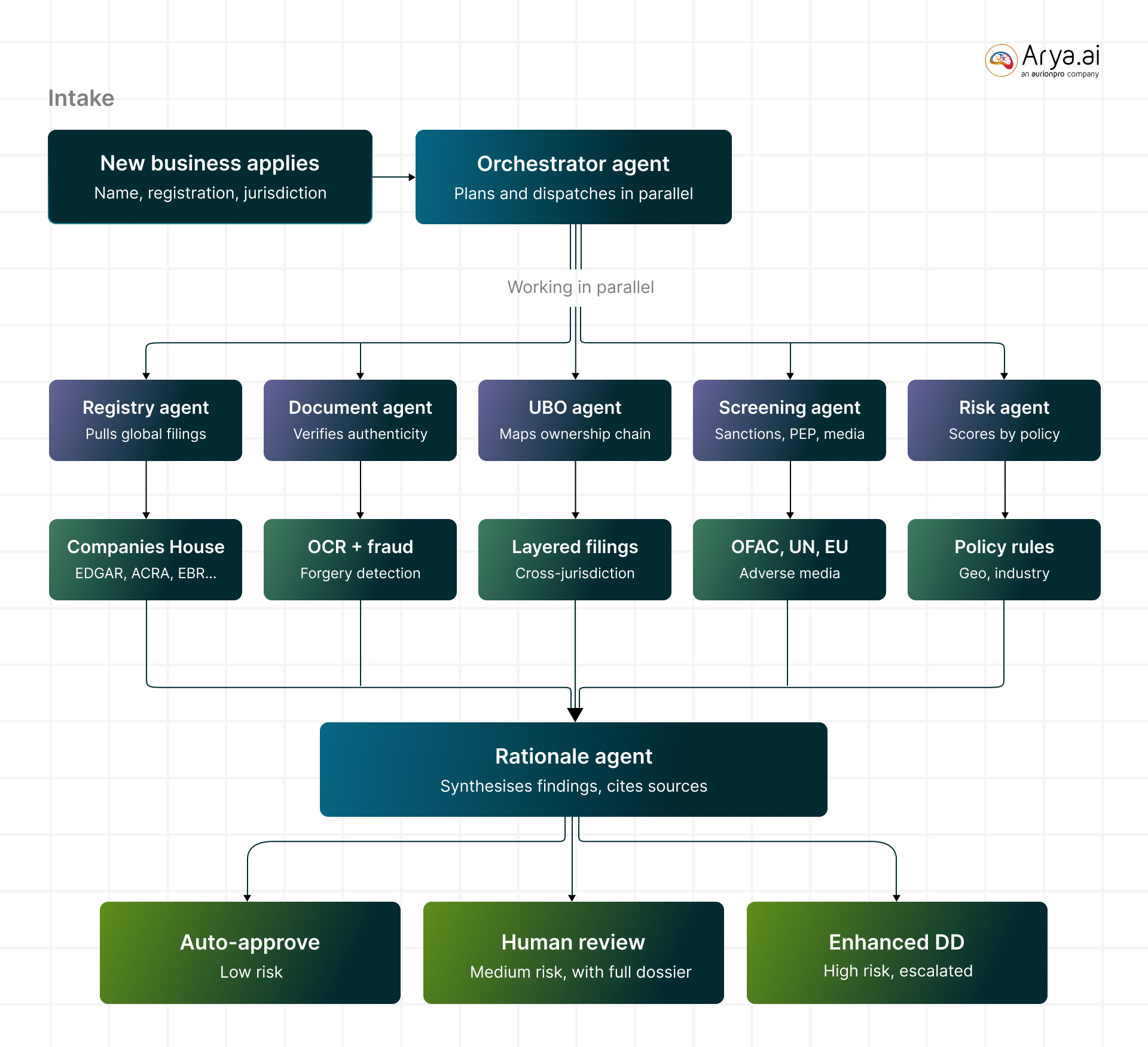
Strip away the marketing language and the architecture is reasonably consistent. A modern workflow typically moves through five connected stages:
- Intake and entity resolution: The system captures the company name, registration number and jurisdiction, checks the appropriate registry, retrieves available filings and pre-populates known fields. Parallel data retrieval removes much of the sequential clicking and re-keying that slows manual reviews.
- Document ingestion and verification: Document models extract information from incorporation records, shareholder registers and licences, then compare it with registry data. Mismatched addresses, dates, names or ownership details are surfaced as exceptions rather than silently normalised.
- Ownership discovery: The workflow follows parent entities through successive layers, calculates effective ownership and identifies natural persons who meet the institution's applicable ownership or control test. The threshold must be configured by jurisdiction and policy.
- Screening and risk assessment: The entity, directors, shareholders and relevant UBOs are screened against sanctions, PEP, adverse-media and other watchlists. Contextual matching can help distinguish genuine matches from namesakes, but false-positive reduction should be measured against the institution's own data before automation targets are set.
- Rationale, audit trail and routing: The system assembles the evidence, records the sources consulted, explains triggered risk factors and produces a review-ready case. Straightforward cases may pass through pre-defined approval paths; exceptions and higher-risk profiles move to enhanced due diligence or human approval.
Why the time compression is credible
The case for faster onboarding rests on three structural advantages rather than on one model producing a clever answer.
- Parallelism: A human reviewer generally consults sources in sequence. A controlled agentic workflow can query registries, screening services, and internal systems concurrently, reducing waiting time even when each individual check takes no less time than before.
- Context retention: Traditional processes lose information at hand-offs between systems and teams. A shared case record allows evidence, exceptions and policy decisions to travel together, making the final rationale more coherent and reducing repeated work.
- Better handling of unstructured evidence: Multimodal models can extract and compare information from scans, tables and documents in different languages. They do not make poor-quality evidence trustworthy, but they can reduce the manual effort required to find and reconcile relevant facts.
There are still limits. Forrester has warned that current AI agents are constrained by poor documentation, inconsistent permissions, and limited orchestration across disparate systems. Those constraints are particularly important in compliance, where an apparently efficient agent can amplify a bad policy or unreliable data source just as quickly as it can automate a good one.
What has not changed, and should not
Speed does not replace defensibility. The EU's new Anti-Money Laundering Regulation will apply from 10 July 2027, while supervisory expectations in the UK, United States, Singapore and other markets continue to emphasise risk-based controls, record-keeping and accountability. The practical model is therefore earned autonomy: automate bounded, well-tested work first, then widen the scope only when accuracy, escalation and auditability have been demonstrated.
The EU AI Act also needs careful interpretation. It imposes record-keeping, transparency and human-oversight duties on systems classified as high risk; it does not automatically make every use of AI in KYB a high-risk system. Institutions should determine the classification of each use case and still retain proportionate logs, source traceability, approval controls and the ability to intervene. Those controls are sound compliance practice even where the strictest AI Act obligations do not apply.
Nor does the agent's role end at onboarding. KYC programmes already combine periodic reviews with event-driven action. The same data connections used during onboarding can monitor changes in ownership, sanctions exposure and other risk signals, allowing the institution to refresh a profile when something material changes instead of waiting for the next calendar-based review.
The strategic shift
The bigger change in 2026 is not a race to remove compliance professionals from the process. It is a redesign of how they spend their time. When data collection, reconciliation and first-pass analysis are compressed, reviewers can focus on ambiguous ownership, unusual activity, policy exceptions and the quality of the final decision.
For compliance leaders, the practical question is no longer whether agentic techniques can help KYB. It is where they can be introduced without trading speed for regulatory defensibility. The strongest deployment pattern is straightforward: reliable data foundations, a narrow initial scope, measured accuracy and false-positive rates, human approval for higher-risk cases, least-privilege access, and a complete record of evidence and agent actions.
Multi-week onboarding can be compressed to hours for suitable cases, but it is not an automatic outcome and should not be presented as one. The real advantage comes from separating routine evidence work from genuine judgement - then automating the former while making the latter easier to perform and defend.
Share this post


Table of contents
Low-Code AI Automation Starts Here – Try Arya Apex


.png)



.png)
.png)
.svg)


