


.png)

Banking is one of the highest-stakes environments for agentic AI. A poor recommendation from a consumer chatbot may be inconvenient. An agent that contributes to an unfair credit decision, mishandles a suspicious-activity investigation or initiates an unauthorised payment can create direct harm, regulatory exposure and operational loss.
Adoption is already moving faster than governance. Wolters Kluwer's Q1 2026 survey of 148 financial institutions found that 31.8% had deployed AI or machine-learning technologies in production, while only 12.2% described their strategy as well defined and resourced. The gap does not prove that enforcement is imminent, but it does show why banks need governance controls that mature alongside deployment.
For agentic systems, three controls are especially important: a reconstructable audit trail, effective human authority and a regulatory map tied to the specific use case.
Why traditional model governance is not enough
Traditional model-risk management was built around systems with defined inputs, a specified methodology, measurable outputs and a controlled change cycle. Agentic systems introduce a different operating pattern: they can interpret context, select tools, retrieve information, plan several steps and hand work between specialised components. The resulting action may depend on a sequence of model calls, data retrievals and policy checks rather than on one bounded model output.
The US regulatory position also changed in 2026. The Federal Reserve, OCC and FDIC issued revised model-risk guidance under SR 26-2, superseding SR 11-7. Federal Reserve Vice Chair for Supervision Michelle Bowman subsequently stated that the revised guidance does not apply to generative or agentic AI and that other risk-management and governance practices are expected to support those systems. Banks should therefore avoid treating a conventional model-validation file as a complete governance framework for an agent.
The control question is broader than whether a model is accurate. It is whether the overall system is observable, appropriately constrained, tested for its intended use and capable of being stopped or escalated when conditions change.
Pillar 1: Audit trails as the forensic layer
For a consequential decision, the bank should be able to reconstruct what the system knew, which policies applied, what action it proposed or executed, and where a person intervened. Average accuracy is not a substitute for a decision-level record.
What an agent audit trail should contain
- Inputs and provenance: the records, documents and external responses consulted, including timestamps and relevant versions.
- System instructions and policy context: the approved prompt or instruction set, business rules, thresholds, sanctions lists and policy versions in force.
- Model and component identity: the model, agent, retrieval component and tool versions used in the workflow.
- Tool and system actions: functions called, material parameters, returned status and any state-changing action.
- Decision record: the output, confidence or risk indicator, structured rationale and evidence linked to the conclusion.
- Human action: review, approval, rejection, override or escalation, with the accountable person, time and reason.
- Outcome and follow-up: whether the action completed, failed, was reversed or generated an incident or customer challenge.
This is not the same as storing a model's hidden chain of thought. Internal reasoning traces may be unavailable, unstable, commercially sensitive or unsafe to retain. Governance should instead require a concise, structured rationale tied to observable evidence and system actions.
The EU AI Act requires automatic logging for high-risk systems and transparency that enables deployers to interpret outputs, while the NIST AI RMF promotes documentation, traceability and ongoing risk measurement.
Integrity, access and retention
An audit record is useful only if its integrity and custody can be defended. Banks should apply access controls, segregation of duties, retention schedules, time synchronisation and monitoring for alteration or deletion.
Append-only storage, digital signatures or hash chaining may strengthen evidence integrity for high-consequence workflows, but these are architectural choices rather than a blanket requirement of ISO/IEC 42001. The standard establishes requirements for an AI management system, including risk assessment, governance and continual improvement; it should not be cited as if it specifically mandates cryptographic logs.
Source attribution is a legal and operational control
In credit, a recommendation must be traceable to the factors that actually drove the outcome. The CFPB has repeatedly stated that ECOA and Regulation B require specific and accurate reasons for adverse action even when a creditor uses a complex or opaque algorithm. In AML operations, FinCEN requires institutions to retain SARs and supporting documentation, generally for five years. An agent that cannot link a conclusion to its evidence makes both obligations harder to satisfy.
Pillar 2: Human override as architecture
‘Human in the loop’ is often used as a general assurance, but it describes little unless the authority, timing and workload of the reviewer are specified. Three design patterns are useful:
- Human-in-the-loop: the system pauses for approval before a consequential action. This suits low-volume decisions where an error would be difficult to reverse.
- Human-on-the-loop: the system acts within approved limits while people supervise performance and intervene by exception. This can suit high-volume activity only when stop conditions and escalation routes are reliable.
- Human-in-command: people define the purpose, policy boundaries and conditions under which the system may operate, and retain authority to suspend or withdraw it.
These are design patterns, not formal regulatory categories. A bank may use all three, depending on the impact, reversibility, velocity and uncertainty of the use case.
Avoiding the oversight facade
Article 14 of the EU AI Act requires human oversight measures that are proportionate to the risks of a high-risk system. The people assigned to oversight must be able to understand relevant capabilities and limitations, remain alert to automation bias, interpret outputs, disregard or reverse them where appropriate, and intervene or stop the system. A nominal reviewer who lacks time, information, competence or technical authority does not meet that objective.
What effective override looks like
- Risk-tiered authority: approval requirements and autonomy limits are linked to impact and reversibility, not applied uniformly.
- Hard stop conditions: the system cannot proceed when it encounters missing evidence, policy conflicts, restricted actions or defined uncertainty thresholds.
- Named accountability: every approval and override is attributable to an authorised person, with a recorded reason.
- Operationally usable controls: reviewers can pause, block, quarantine or reverse an action where the underlying process allows it.
- Capacity and competence: review queues, service levels and training are designed so that review is substantive rather than ceremonial.
- Testing of the control itself: the bank tests whether alerts reach the right people, stop mechanisms work, and escalation remains effective under peak volumes.
Confidence thresholds can support this architecture, but a high model score should not automatically equal permission to act. Materiality, customer impact, legal restrictions and the availability of reliable evidence also belong in the decision policy.
Pillar 3: Regulatory readiness as a use-case map
There is no single ‘agentic AI regulation’ for banks. Applicable obligations depend on jurisdiction, customer, data, decision, and action. A useful compliance stack maps each use case across AI-specific rules, sector regulation, consumer protection, privacy, operational resilience, third-party risk and internal policy.
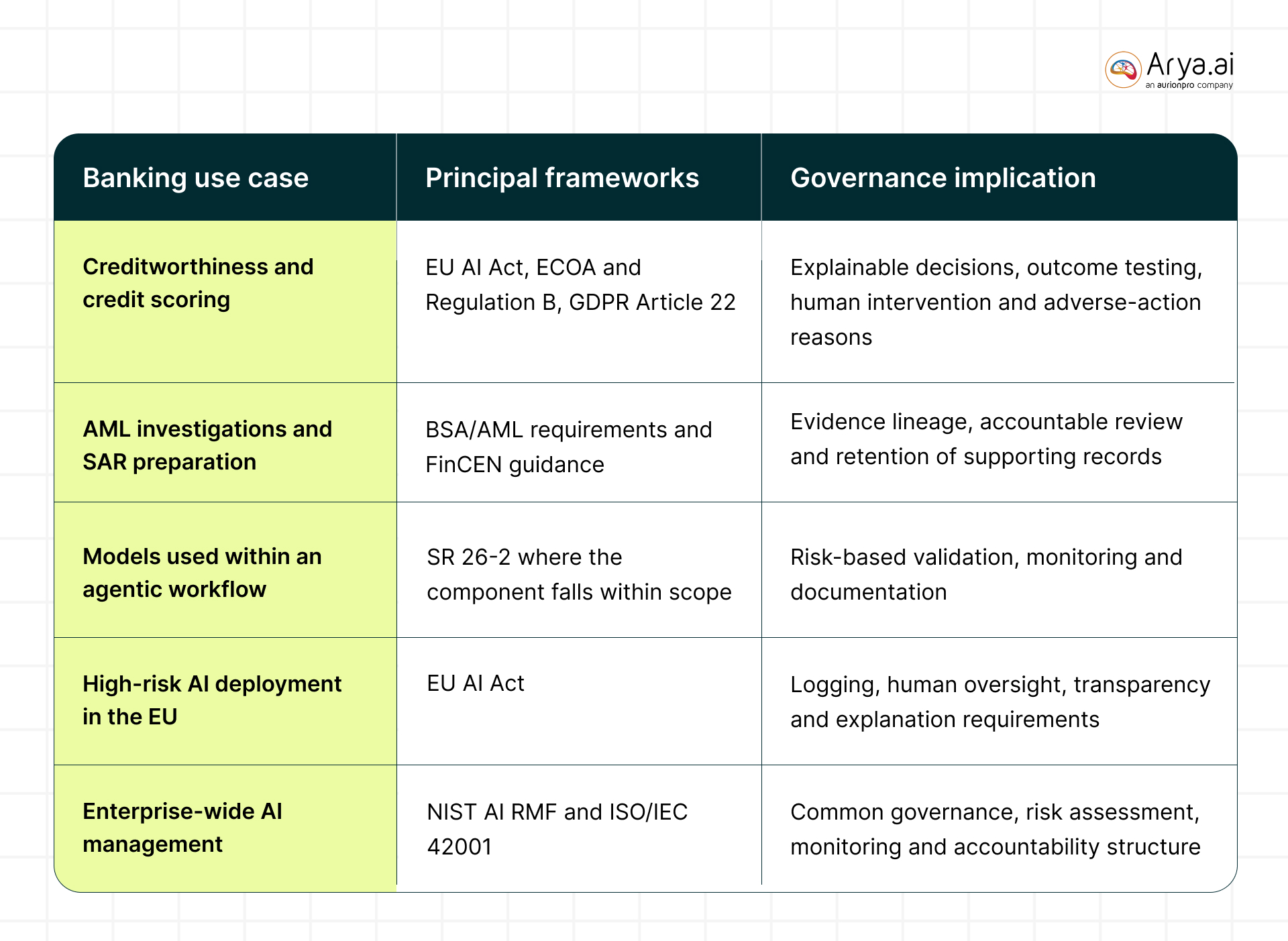
A practical maturity model
Banks can use the following four-stage model as an internal planning tool. It is a proposed maturity model, not a regulatory classification.
- Stage 1 - Isolated pilot: a narrow use case with basic application logs and largely manual governance. The bank can test capability but cannot yet evidence end-to-end control.
- Stage 2 - Retrofitted controls: logging and approval checkpoints are added after the workflow is built. This may support limited use but tends to create gaps in evidence lineage and operational capacity.
- Stage 3 - Governance by design: decision records, authority limits, escalation paths, testing and regulatory mapping are designed with the workflow. Controls are tied to the use case and action type.
- Stage 4 - Continuous assurance: the bank monitors performance, fairness, incidents, evidence completeness, policy exceptions and control effectiveness, and revalidates the system when models, tools, data or regulations change.
Closing thought
Agent governance is not a compliance layer added after deployment. It is the operating architecture around the agent: what the system may access, which actions it may take, what evidence it must retain, when it must stop and who remains accountable.
In regulated banking, autonomy is not a binary switch. It is a graduated authority model that should expand only when the institution can observe, test and control the resulting behaviour. The banks that establish that discipline will be better placed to scale agentic systems without losing the auditability and accountability on which financial services depend.
Share this post


Table of contents
Low-Code AI Automation Starts Here – Try Arya Apex


.png)




.png)
.png)
.svg)


