


.png)

The treasury team is equipped with one of the most daunting tasks in an organization: traversing risky landscapes while ensuring agility. If the mandate is simply "how quickly assets can be converted to cash," it's relatively straightforward to map the right path. But modern treasury is far more complex.
Balancing cash reserves with yield optimization is vital for steadying the ship during adversity. For decades, these processes were manual and reactive. Today, digital transformation is not just aiding the process—it is redefining it.
.jpg)
However, we are moving beyond simple automation. The 2025 standard is "Agentic AI"—systems that don't just predict outcomes but autonomously plan and execute tasks. The impact spans five critical treasury functions: cash flow forecasting, asset management, debt management, risk management, and cash positioning.
Below, we explore how AI is changing these functions, highlighting enterprise-level innovations and Generative AI use cases.
.jpg)
1. More Accurate Cash Flow Forecasting
.jpg)
AI-driven cash flow forecasting systems are dramatically improving the accuracy of projections. Traditional forecasting that relied on spreadsheets and human estimates maintained a significant error rate. In contrast, AI models expand the sources, including historical transactions, market data, and even news, to come up with a high-fidelity evaluation.
Machine learning also enables dynamic scenario planning. AI tools can simulate various economic or business scenarios to reveal how cash flows might change under different interest rates, market shifts, or seasonal patterns. When an actual crisis hits, enterprises will be better prepared.
According to Gartner, forecasting remains the #1 use case for AI in finance, yet over 40% of organizations still struggle with data latency. AI bridges this gap by processing real-time signals.
Essentially, treasures get an overview of the early warning signals and prepare a roadmap, which helps them become proactive rather than reactive. The trend is clear: AI is making cash flow forecasting faster, more accurate, and more insightful than ever before, allowing enterprises to anticipate liquidity needs and opportunities with unprecedented confidence.
2. Decision Making for Managing Assets and Investments
.jpg)
Corporate treasurers must make quick calls on where to invest surplus cash and manage short-term assets. This decision-making could be vastly enhanced with the help of AI. Ceaseless analysis is where AI can be of great help – where human resources falter, AI can continuously analyze market rates and credit ratings and keep a track of liquidity needs to optimize the deployment of cash.
AI can minimize reliance on static policies, as AI algorithms recommend the best places to park excess cash (e.g., money markets, short-term bonds) or when to pull funds for operations. For example, AI-driven liquidity models suggest short-term investments for idle funds or alert treasurers to opportunities to earn yield, all while ensuring enough liquidity for obligations.
3. AI in Debt Management and Capital Strategy
.jpg)
Managing corporate debt, from loans and credit facilities to bonds, is another function seeing an AI-fueled transformation. Treasurers must decide when to refinance, how to schedule repayments, and how to hedge interest rate exposures. AI aids these decisions by analyzing vast financial scenarios and market indicators that humans struggle to continuously monitor.
Predictive analytics for interest and FX rates allow AI systems to forecast borrowing costs. Armed with such forecasts, treasury teams can plan debt and hedging strategies more effectively. For instance, an AI model might predict that interest rates will rise in six months, prompting a company to refinance or lock in rates now.
AI-driven platforms can automatically collect all debt information, compute debt ratios, and even propose tailored repayment plans based on the company's cash flow projections and market trends. The AI essentially acts as a strategic advisor, constantly scanning for opportunities to rebalance debt to achieve cost savings or reduce risk.
4. Enhancing Risk Management with AI
.jpg)
AI is also pivotal in risk management. One major contribution is in fraud detection and security. AI algorithms excel at pattern recognition, sifting through vast transaction data to flag anomalies that could indicate fraud or errors. Organizations have used rule-based automation methods in this arena, like leveraging RPA tools for flagging transactions.
AI, however, adapts over time. Flagging payment fraud becomes much more nuanced while balancing customer experience as well as the risk appetite. Instead of balancing anything unusual, AI models intelligently detect patterns and flag activities that indicate fraud.
For instance, the US Treasury Department credited AI tools for preventing and recovering over $4 billion in fraudulent or improper payments in 2024, including using machine learning to catch check fraud that human screeners missed. This shows how AI's vigilance can safeguard corporate cash from both external fraud and internal errors.
5. Intelligent Cash Positioning and Liquidity Management
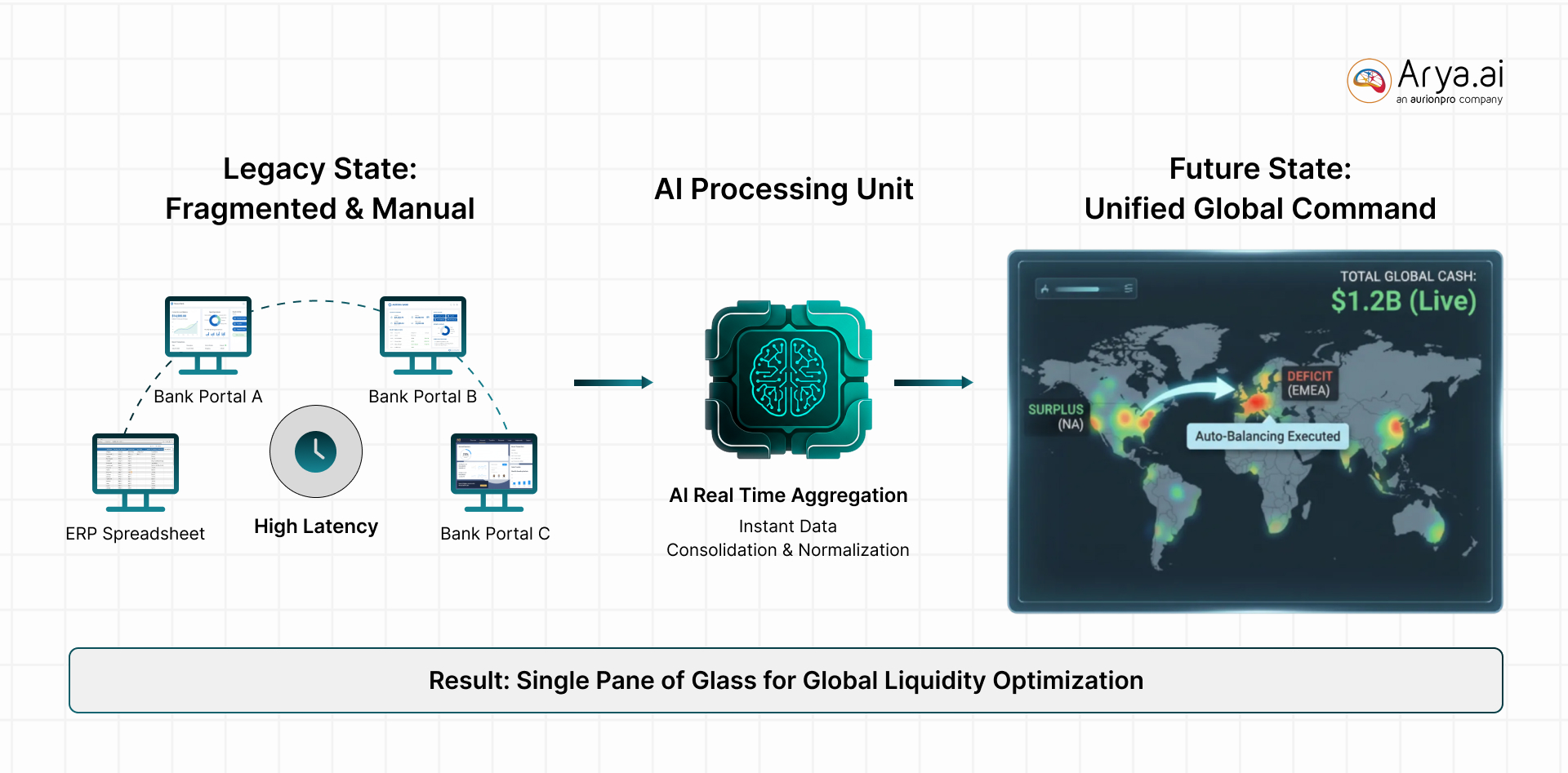
Traditionally, cash positioning involves logging into multiple bank portals and checking spreadsheets to consolidate balances and then manually transferring funds. AI streamlines this by providing real-time, consolidated visibility and even automating allocation of decisions across accounts.
AI tools can pull in balance data from all accounts and currencies instantly, giving treasurers a live picture of global cash. Consider an AI-based liquidity model that can continuously aggregate data from ERPs, bank feeds, and markets, and then suggest cash movements (like pooling excess funds or funding a deficit account) before a shortfall or surplus occurs.
This proactive positioning ensures no account is caught short, and no cash sits idle unnecessarily. Even small improvements add up at scale. AI might enable a company to reduce unnecessary inter-company loans or external credit line usage by ensuring internal cash is efficiently used first.
The Hurdles: Why AI Adoption Isn't 'Plug-and-Play'
While the potential of AI is immense, the road to implementation is rarely a straight line. A Citi 2025 report notes that while 82% of treasuries are exploring AI, only 5% have fully scaled it. The primary barriers include:
- Data Fragmentation: AI models are only as good as the data they are fed. If your ERP, bank portals, and spreadsheets are siloed, the AI will struggle to find a "single source of truth," leading to hallucinations or inaccuracies.
- The Skill Gap: Modern treasury teams need to evolve from being "Excel experts" to "Data architects." Understanding how to query an AI model and validate its outputs is becoming a required skill set.
- Integration Costs: Moving from legacy on-premise systems to cloud-native, AI-ready platforms requires significant initial capital and change management.
Conclusion
AI is bringing a new era of efficiency and strategic insight for enterprise treasury functions. With the help of AI, companies are achieving more accurate forecasts, more optimized use of cash, and more robust risk controls than were ever possible with manual methods.
Across these functions, a host of AI-enabled platforms are making an impact, from established players to fintech innovators. These solutions are not only streamlining operations (automating reconciliations, reports, and other mundane tasks) but also empowering treasury teams to make better strategic decisions.
With AI handling data-heavy analysis, treasurers can focus on higher-level strategies such as guiding business growth and financial planning. This deep transformation is still ongoing, but the trajectory is clear: AI-driven treasury management is becoming the new standard for financial excellence at the enterprise level.
Share this post


Table of contents
Low-Code AI Automation Starts Here – Try Arya Apex


.png)




.png)
.png)
.svg)


