


.png)

Enterprise AI maturity is best understood as a capability system. Maturity in a large organization with rich workflows spanning multitudes of operational areas will never be about a single model or a use case. Maturity will be defined by mastering AI-related capabilities to achieve high performance across the enterprise, its employees, and its customers.
AI’s integration is still in the nascent phase. Reports suggest that only about 1% of leaders describe their organizations as “mature,” meaning AI is fully integrated into workflows and driving substantial business outcomes.
Enterprise AI will ultimately deliver value, which is also why leaders are investing more money in the project. A study has highlighted bottlenecks, such as siloed systems and data quality issues, that prevent AI from delivering tangible outcomes.
This article proposes a pragmatic six-level maturity model (Levels 1–6) designed for industry-agnostic enterprises. The model’s key idea is that progression is cumulative: later levels do not replace earlier foundations; they build on and expand them.
A useful rule of thumb is that maturity accelerates when organizations treat AI as an operating model transformation. For example, McKinsey links AI value to management practices spanning strategy, talent, operating model, technology, data, and adoption/scaling; high performers also allocate meaningfully more budget to AI (often >20% of digital budgets) and are much more likely to have scaled AI.
Six Maturity Levels Level 1: Awareness and Foundations
AI exists mainly as an interest, with scattered experimentation, while leadership focuses on setting the intent. Efforts are allocated to early work on guardrails and data access, as well as to educating the workforce about AI’s potential and use.
Five things are important at this level:
- AI discussions are high, and measurable business outcomes are low
- Shadow AI use may appear
- Governance is mostly policy-driven rather than operationalized
- Data is not yet packaged or discoverable for AI at scale.
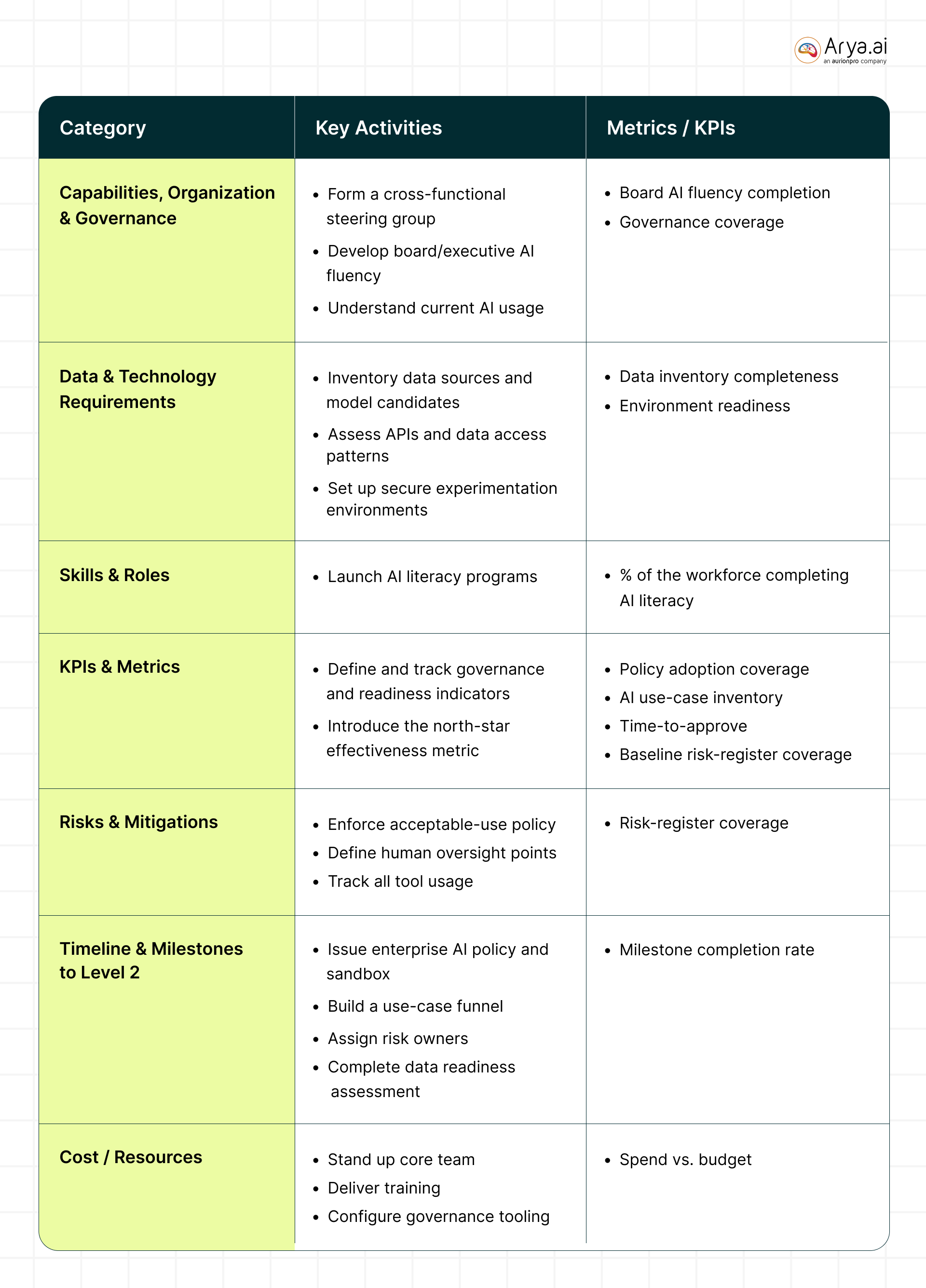
Level 2: Run Pilots and Value Proof
The organization runs multiple targeted pilots with explicit business hypotheses, while formalizing early-stage governance (e.g., responsible AI reviews, architectural reviews) and building internal capability through upskilling.
What is important at this level:
- Use-case selection becomes systematic
- Measurement begins
- Pilots run across several functions with limited productionization
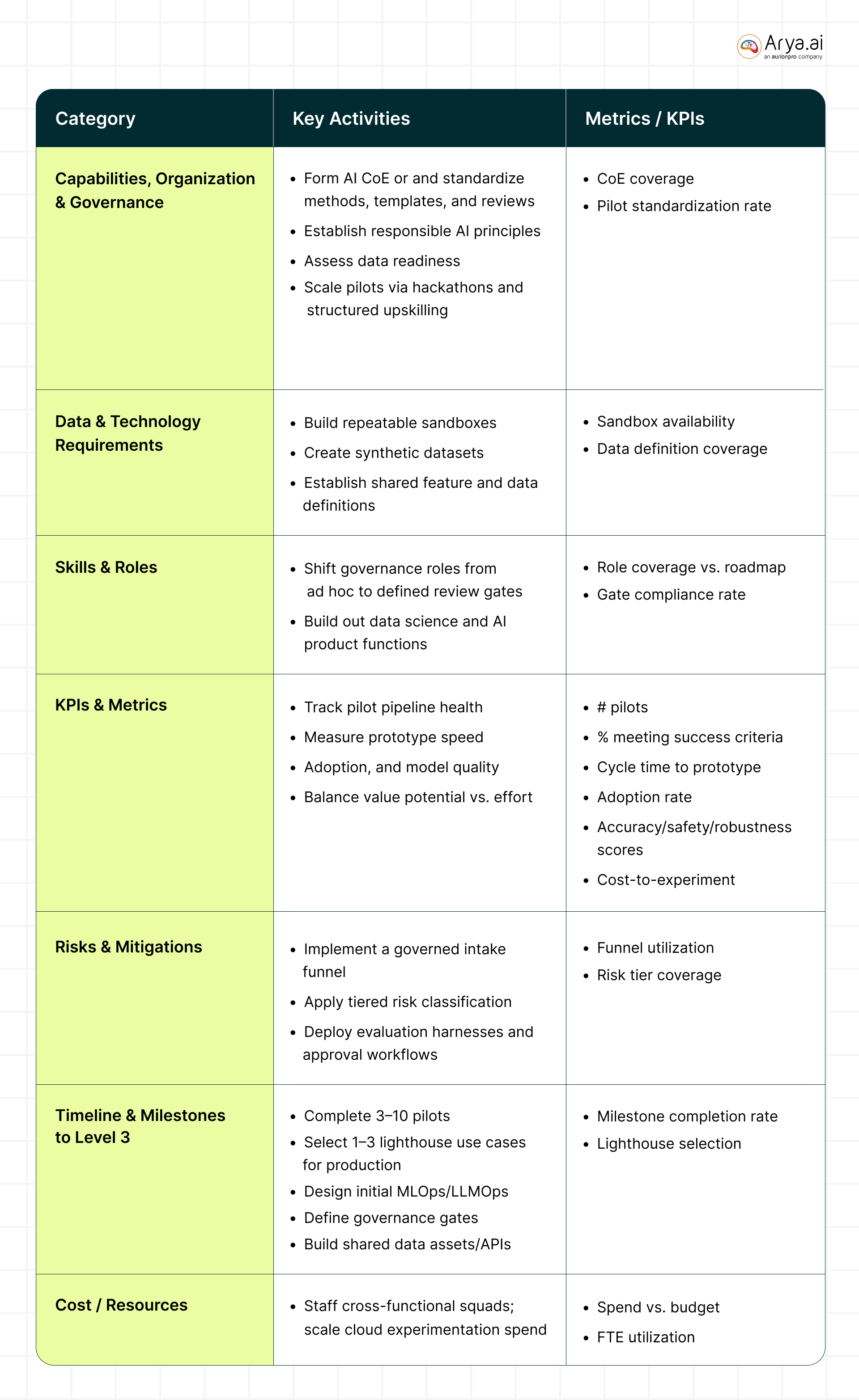
Level 3: Operationalize and Govern
AI is deployed into production in at least one core workflow with lifecycle governance (monitoring, incident response, human validation rules, and change management), supported by a more robust data platform and MLOps/LLMOps pipelines.
What is important at this level:
- AI outputs influence real decisions
- Reliability and compliance standards become explicit
- AI delivery resembles product engineering rather than experimentation
- Governance moves from policy measures and becomes operational (controls, telemetry, audits).
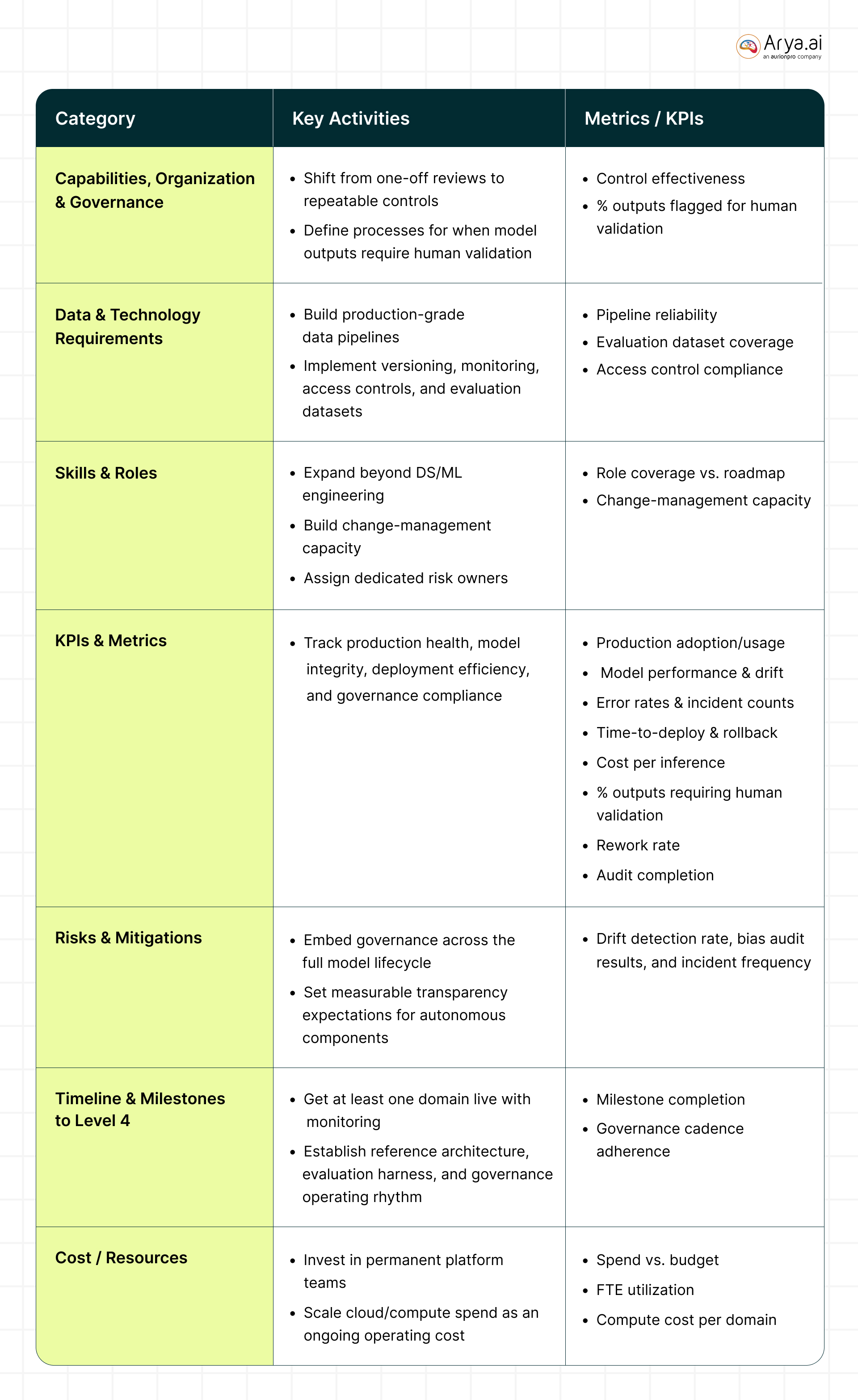
Level 4: Scale as an Enterprise Platform
At this leve, shift from isolated production deployments to a reusable, governed enterprise AI platform and federated delivery model. AI is embedded across many workflows, and the “cost of the next use case” falls due to tooling and component reuse.
What is important at this stage:
- Cross-domain reuse
- Coherent platform primitives (data products, retrieval pipelines, prompt libraries, model hubs, evaluation harnesses)
- Standardized governance tiers by risk/impact
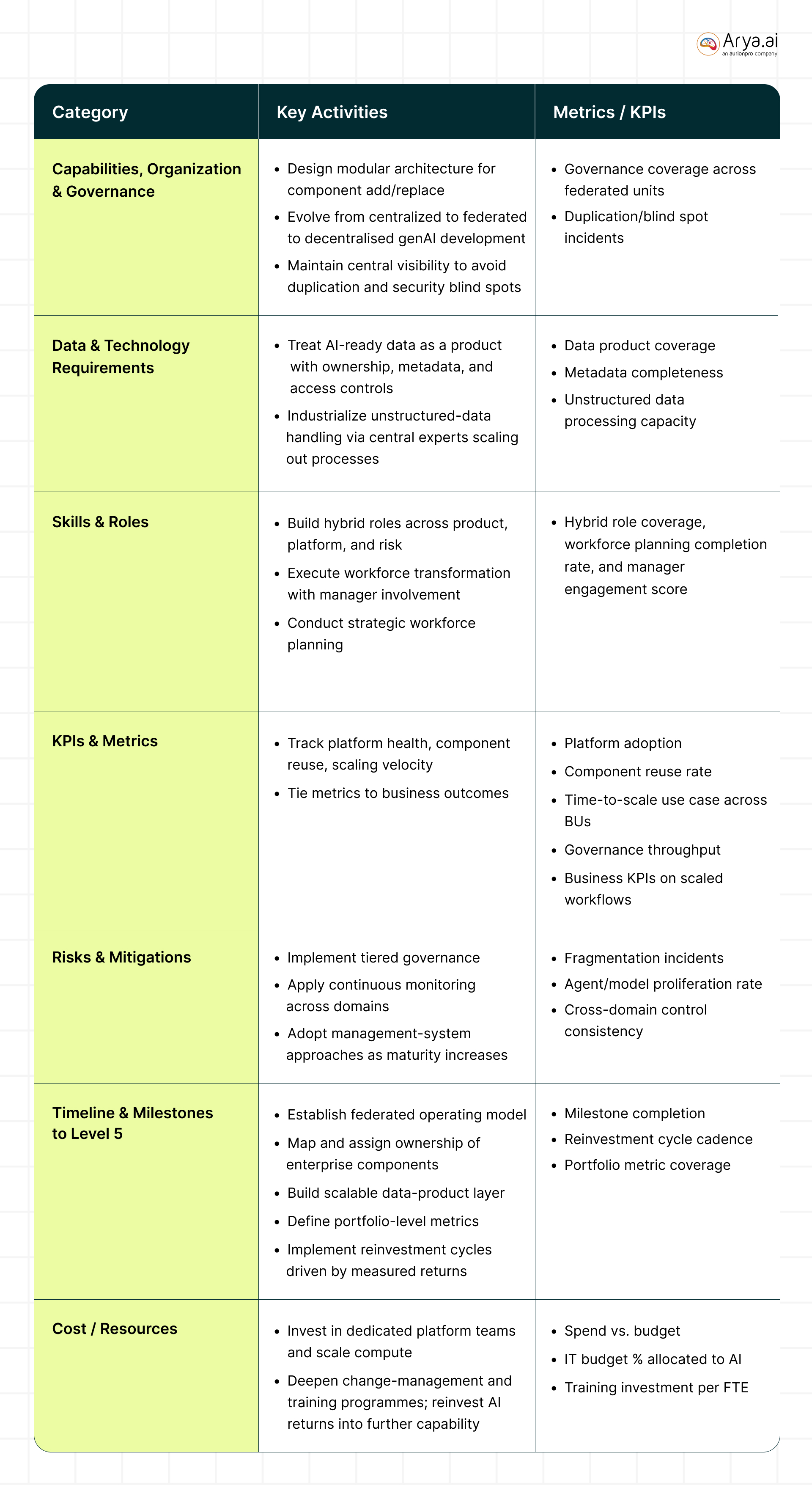
Level 5: AI-Fuelled Enterprise Transformation
AI is embedded into the organization’s operating model and core workflows end-to-end, so now the leadership drives transformation beyond productivity gains, including new products/services and structural changes to work.
What should be realized at this stage:
- AI is a strategic pillar
- Portfolio value is measured and governed
- Adoption is broad
- The organization grows “AI ways of working” (test-and-learn, reusable architectures, continuous innovation).

Level 6: Agentic Enterprise
The enterprise operates with mature human–AI teaming, in which AI agents execute multi-step workflows with meaningful autonomy under rigorous controls.
What is important at this stage:
- The organization behaves like an “agentic organization.”
- Humans and virtual/physical agents work side-by-side at scale
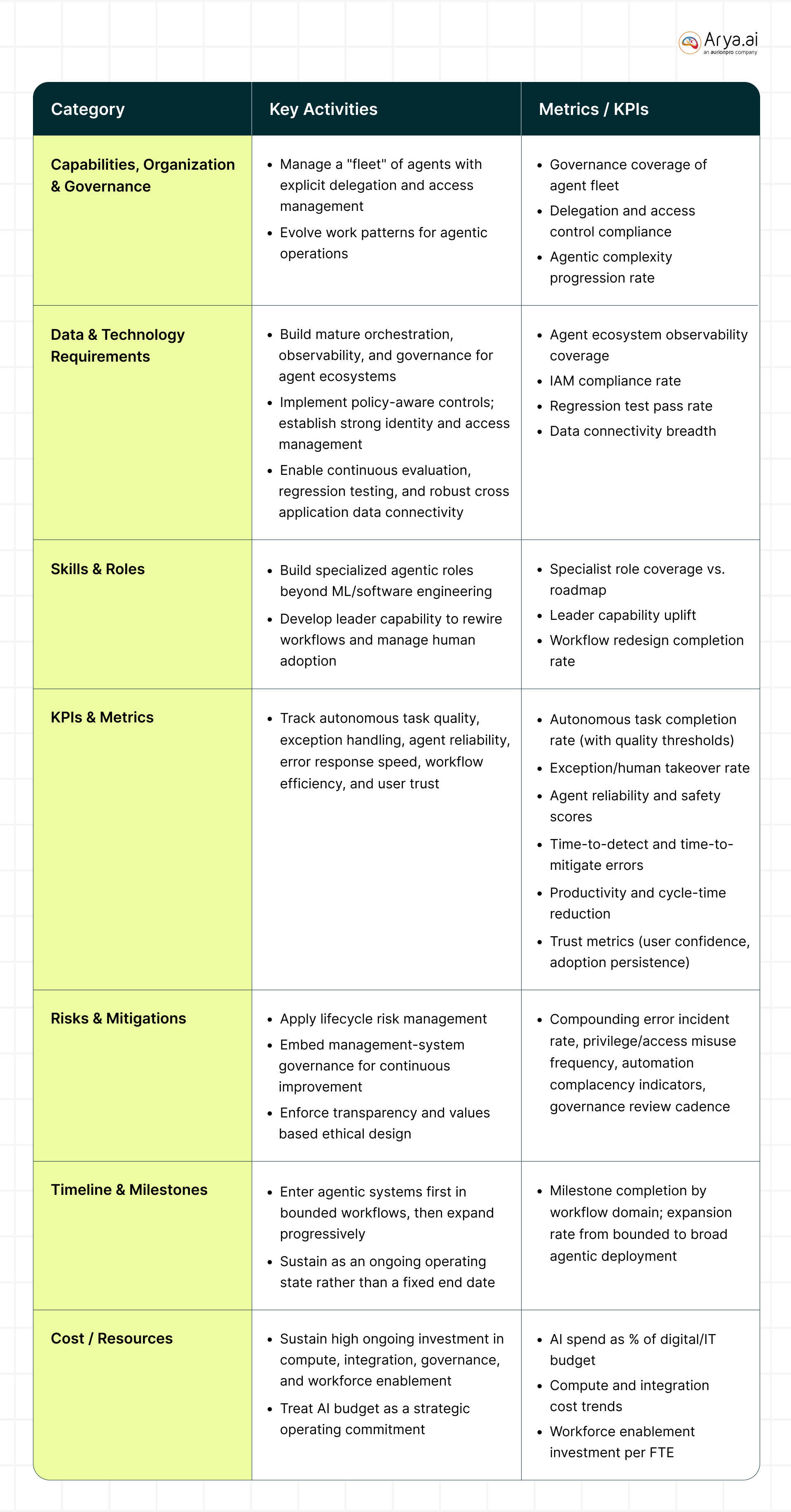
Roadmap for Leaders
The flowchart below is indicative of what each level represents, along with its key gate. As you can see, AI maturity is never about adopting more models. What it is, however, is the transformative ability of an enterprise to pivot and increase organizational capability.

Leaders should treat this journey as a structured progression, not a series of experiments. The biggest mistake leaders make is over-investing in novelty and under-investing in orchestration, context, and governance.
Share this post


Table of contents
Low-Code AI Automation Starts Here – Try Arya Apex


.png)


.png)
.png)
.svg)


